
Why the World’s Most Essential Industrial Equipment Is Becoming a Key Driver of Decarbonization
When discussions turn to renewable energy, attention often focuses on solar parks, wind farms, battery storage systems and green hydrogen projects. Yet behind the scenes of almost every manufacturing facility, refinery, food processing plant, pharmaceutical unit, paper mill, textile factory and power generation facility lies a technology that remains indispensable to industrial productivity.
The industrial boiler.
For more than a century, boilers have served as the backbone of industrial operations, generating steam and thermal energy required for manufacturing processes worldwide. Today, however, this mature technology is undergoing one of the most significant transformations in its history. Driven by rising energy costs, stricter environmental regulations, decarbonization targets and advances in digital technologies, industrial boilers are entering a new era defined by efficiency, sustainability and intelligent operation.
What was once viewed as conventional industrial equipment is increasingly becoming a strategic component of modern sustainability strategies.
The Hidden Giant of Industrial Energy Consumption
Industrial heating accounts for a substantial share of global energy demand.
According to the International Energy Agency (IEA), industrial processes consume nearly one-third of global energy, with thermal energy requirements representing a significant portion of industrial operations. Industries such as chemicals, food processing, pharmaceuticals, pulp and paper, textiles, steel and cement continue to rely heavily on steam and process heat for production.
For decades, these requirements were met primarily through fossil fuel-fired boilers. Today, however, governments and industries are under increasing pressure to reduce emissions while maintaining productivity and operational reliability. As a result, boiler manufacturers are rapidly developing advanced solutions capable of delivering higher efficiency, lower emissions and greater fuel flexibility.
The future of industrial heating is no longer about simply producing steam. It is about producing steam more efficiently, more sustainably and more intelligently than ever before.
Global Boiler Markets Are Being Reshaped by Sustainability Goals
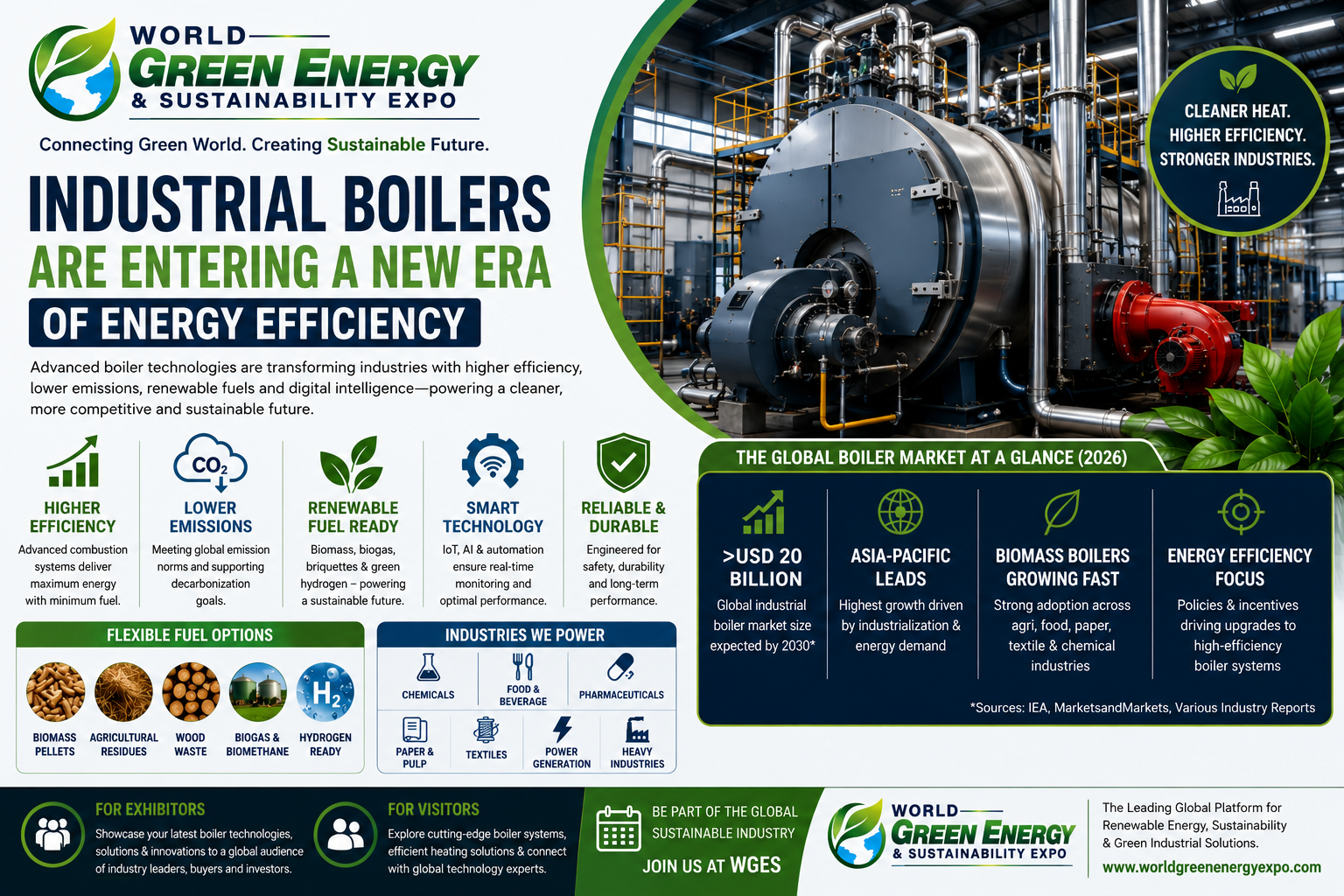
The global industrial boiler market continues to expand as industries modernize aging infrastructure and pursue energy efficiency improvements. Industry analysts estimate that the global industrial boiler market is expected to exceed USD 20 billion by the end of this decade, driven by industrial expansion, energy efficiency upgrades, biomass adoption and environmental compliance requirements.
The strongest growth is currently being observed in:
- Asia-Pacific
- India
- Southeast Asia
- Middle East
- North America
- Europe
Across these regions, industrial operators are increasingly replacing conventional systems with next-generation boiler technologies capable of supporting sustainability objectives while reducing operating costs.
Biomass Boilers Are Gaining Global Momentum
One of the most important developments in recent years has been the rise of biomass boilers. Unlike conventional fossil-fuel systems, biomass boilers utilize renewable feedstocks such as:
- Agricultural residues
- Wood pellets
- Forestry waste
- Crop residues
- Organic industrial by-products
- Biomass briquettes
For industries seeking practical decarbonization solutions, biomass boilers offer a pathway to reduce carbon emissions without requiring complete process redesign. This is particularly important for sectors where electrification remains technically challenging or economically unfeasible.
As governments strengthen renewable energy policies and carbon reduction commitments, biomass boiler adoption is accelerating across multiple regions.
India: A Fast-Growing Market for Sustainable Industrial Heating
India’s industrial sector is expanding rapidly, creating significant demand for efficient thermal energy systems. Government initiatives promoting renewable energy, biomass utilization, energy efficiency and industrial decarbonization are encouraging industries to modernize boiler infrastructure. The country generates hundreds of millions of tonnes of agricultural residues annually, creating enormous opportunities for biomass-based industrial heating solutions.
Sectors such as:
- Food processing
- Sugar manufacturing
- Textiles
- Chemicals
- Pharmaceuticals
- Paper & pulp
are increasingly exploring biomass boilers as a means of reducing fuel costs while meeting sustainability objectives. For international boiler manufacturers and technology providers, India represents one of the world’s most promising growth markets.
Europe: Efficiency and Emissions Driving Innovation
Across Europe, stringent environmental regulations continue to drive investment in advanced boiler technologies. The European Union’s climate policies, energy efficiency directives and industrial decarbonization programs are encouraging industries to adopt:
- Low-emission boilers
- Biomass heating systems
- Waste heat recovery solutions
- Smart combustion technologies
- Hydrogen-ready boiler systems
Germany, the Netherlands, France and Scandinavia remain among the most active markets for sustainable industrial heating technologies. For many European manufacturers, energy efficiency is no longer a compliance issue—it is a competitive advantage.
China: Scaling Industrial Efficiency at Unprecedented Levels
China’s industrial modernization strategy continues to create significant opportunities for advanced boiler technologies. As the world’s largest manufacturing economy, China is investing heavily in:
- Industrial efficiency improvements
- Cleaner combustion systems
- Biomass utilization
- Smart manufacturing technologies
- Low-carbon industrial infrastructure
The country’s focus on reducing industrial emissions while maintaining manufacturing competitiveness is accelerating demand for next-generation boiler solutions.
The Rise of Smart Boiler Technology
Perhaps the most significant transformation in the industry is the integration of digital technologies. Modern boiler systems increasingly incorporate:
- Artificial Intelligence (AI)
- Industrial IoT sensors
- Predictive maintenance systems
- Real-time performance monitoring
- Automated combustion optimization
- Digital energy management platforms
These technologies enable operators to improve fuel efficiency, reduce downtime, lower maintenance costs and optimize overall system performance. The industrial boiler of the future will not simply generate heat. It will become an intelligent energy management system.
Industrial Boilers and the Hydrogen Economy
Another emerging trend is the development of hydrogen-ready boiler technologies. As green hydrogen production expands globally, manufacturers are investing in systems capable of operating with:
- Hydrogen blends
- Renewable gases
- Biomethane
- Future low-carbon fuels
This evolution positions industrial boilers as critical components within the broader energy transition rather than legacy technologies facing obsolescence. For many industries, hydrogen-compatible thermal systems may become a vital bridge toward long-term decarbonization.
Why Global Collaboration Is Becoming Essential
As industrial heating technologies evolve, companies face increasing complexity.
- Manufacturers require advanced equipment.
- Plant operators seek proven technologies.
- Governments need scalable decarbonization solutions.
- Investors are looking for commercially viable projects.
- Technology providers seek new international markets.
- Engineering firms require strategic partners.
The future growth of the industrial boiler sector will depend not only on innovation but also on collaboration across industries and borders.
Why Industrial Boiler Companies Should Participate in WGES
The World Green Energy & Sustainability Expo (WGES) is being developed as a global business platform connecting the industries driving the future of sustainable industrial development.
As a leading renewable energy platform, green energy expo, sustainability expo, and clean energy conference, WGES provides a unique opportunity for boiler manufacturers, thermal technology providers, EPC contractors, industrial machinery companies, biomass suppliers, energy consultants and sustainability solution providers to engage directly with decision-makers from around the world.
For exhibitors, WGES offers access to:
- Industrial buyers
- Manufacturing companies
- EPC contractors
- Infrastructure developers
- Renewable energy companies
- Sustainability consultants
- Government agencies
- International investors
For visitors, the event provides an opportunity to discover emerging boiler technologies, evaluate energy-efficient heating systems, explore biomass and renewable fuel solutions, and connect with global technology leaders shaping the future of industrial energy.
The Future of Industrial Heating Is Sustainable
The global energy transition is often discussed in terms of electricity generation. Yet industrial heat remains one of the largest and most important energy challenges facing modern economies. Industrial boilers will continue to play a critical role in manufacturing, infrastructure and economic development. The difference is that future systems will be cleaner, smarter, more efficient and increasingly integrated with renewable fuels.
As industries pursue carbon neutrality and operational excellence simultaneously, advanced boiler technologies will become essential tools for achieving both objectives. The next generation of industrial growth will not be powered by conventional heating systems alone.
It will be powered by intelligent, energy-efficient and sustainable industrial boilers – and the companies leading this transformation will help define the future of global manufacturing.