
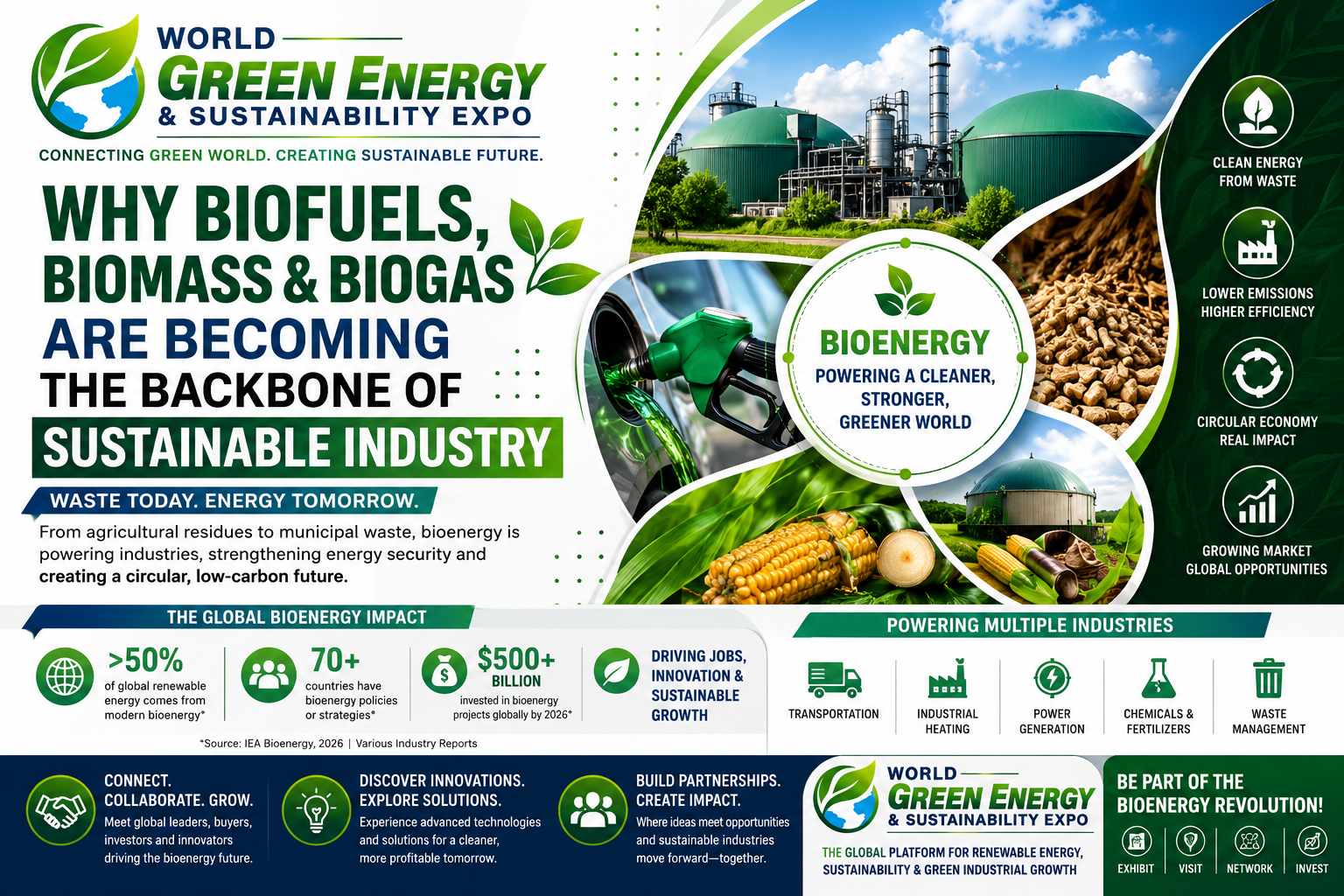
The Next Phase of the Global Energy Transition
For nearly two decades, the renewable energy conversation has largely revolved around solar parks, offshore wind farms, battery storage and, more recently, green hydrogen. These technologies continue to redefine electricity generation and are expected to dominate future power systems.
Yet beyond the headlines, another transformation is quietly reshaping global industry.
Across manufacturing plants, refineries, food processing facilities, agricultural economies and municipal waste systems, biofuels, biomass and biogas are emerging as indispensable pillars of industrial sustainability. Unlike intermittent renewable energy sources, modern bioenergy provides reliable heat, transport fuels and dispatchable power while simultaneously addressing one of the world’s greatest environmental challenges – the management of organic waste.
This unique ability to convert agricultural residues, municipal waste, industrial by-products and livestock waste into commercially valuable energy is positioning the bioenergy sector as one of the fastest-growing segments of the global renewable energy economy.
Bioenergy: The World’s Largest Renewable Energy Source
According to the International Energy Agency (IEA), modern bioenergy remains the world’s largest source of renewable energy, accounting for more than half of global renewable energy consumption across heat, transport and electricity. While solar and wind continue to expand rapidly, bioenergy plays an equally critical role because it can directly replace fossil fuels in sectors that are difficult to electrify, including industrial heating, aviation, shipping and heavy manufacturing.
The importance of bioenergy extends far beyond energy production.
It strengthens national energy security, reduces dependence on imported fossil fuels, creates new income opportunities for farmers, supports circular economy objectives and enables industries to reduce carbon emissions without compromising operational efficiency.
Few renewable technologies deliver economic, environmental and industrial benefits on such a broad scale.
Global Policies Accelerating Bioenergy Growth
Governments around the world are increasingly recognizing bioenergy as a strategic component of their long-term energy and climate policies.
Brazil continues to lead the global biofuel industry through its Fuel of the Future Program, expanding ethanol, biodiesel, biomethane and sustainable aviation fuel production while strengthening low-carbon transportation.
Across Europe, the Renewable Energy Directive (RED III) is encouraging greater adoption of advanced biofuels, renewable gases and sustainable feedstocks to accelerate industrial decarbonization and improve energy resilience.
In India, the National Policy on Biofuels, the SATAT initiative and the GOBARdhan program have significantly expanded ethanol blending and compressed biogas (CBG) production. According to the International Energy Agency’s India Bioenergy Market Report 2026, India’s production of liquid and gaseous biofuels is expected to more than double by 2030 under continued policy support, making the country one of the world’s fastest-growing bioenergy markets.
Meanwhile, Indonesia, Thailand and Malaysia are investing heavily in biodiesel, biomass power generation and waste-to-energy infrastructure, while North America continues to expand renewable natural gas, advanced biofuels and sustainable aviation fuel production through public and private sector investments.
Although each region follows a different policy pathway, the objective is remarkably similar: transforming local biomass resources into long-term economic and industrial value.
Bioenergy Is Reshaping Global Industries
The evolution of bioenergy extends well beyond fuel production. Today, modern bioenergy is creating business opportunities across numerous industrial sectors, including:
- Biofuel production technologies
- Biomass processing equipment
- Biogas plants and upgrading systems
- Industrial boilers and thermal technologies
- Waste-to-energy solutions
- Engineering, Procurement & Construction (EPC)
- Industrial automation and control systems
- Feedstock logistics and handling
- Environmental technologies
- Sustainable infrastructure development
Every new bioenergy project creates demand across an extensive industrial supply chain, opening opportunities for manufacturers, equipment suppliers, technology providers and engineering companies.
Why Investors Are Looking at Bioenergy
One of the greatest advantages of bioenergy lies in its commercial maturity. Unlike many emerging technologies, biofuels, biomass and biogas are already being deployed at industrial scale across transportation, manufacturing, agriculture and municipal infrastructure. The International Energy Agency projects strong long-term growth in global bioenergy demand, driven by increasing adoption of sustainable aviation fuels, renewable natural gas, industrial biomass heating and waste-to-energy solutions.
For investors, this represents an attractive combination of policy support, proven technologies, expanding markets and long-term infrastructure development.
Why International Collaboration Is Now Essential
As bioenergy projects become larger and more technologically advanced, collaboration has become just as important as innovation.
- Project developers require experienced EPC contractors.
- Technology providers seek global distributors.
- Governments need commercially proven solutions.
- Investors are looking for bankable projects.
- Industrial companies require integrated technologies capable of delivering measurable sustainability outcomes.
- No single organisation can build the global bioenergy economy alone.
Its future depends on strategic partnerships across industries and international markets.
WGES: Bringing the Global Bioenergy Industry Together
The World Green Energy & Sustainability Expo (WGES) has been envisioned as a global business platform connecting every segment of the renewable energy ecosystem.
As a leading renewable energy platform, green energy expo, sustainability expo and clean energy conference, WGES will bring together biofuel producers, biomass technology companies, biogas developers, industrial machinery manufacturers, boiler companies, waste management solution providers, EPC contractors, investors, policymakers and international buyers.
For exhibitors, WGES offers an opportunity to showcase technologies to a global audience, build international partnerships, expand into new markets and connect directly with decision-makers driving the renewable energy transition.
For visitors, the Expo provides access to the latest innovations, commercially proven technologies, investment opportunities, policy insights and business collaborations across the rapidly growing bioenergy sector.
Building the Backbone of a Sustainable Industrial Future
The renewable energy transition will not be achieved through a single technology. It will be built through complementary solutions that address the diverse energy needs of industries, economies and communities around the world.
Biofuels, biomass and biogas are uniquely positioned to deliver that balance. They convert waste into value, reduce industrial emissions, strengthen rural economies, improve energy security and support the development of a truly circular economy.
As governments strengthen climate commitments and industries accelerate decarbonization strategies, bioenergy is no longer a supporting technology within the renewable energy transition.
It is becoming one of the strongest foundations of sustainable industrial growth and as this global industry continues to expand, World Green Energy & Sustainability Expo (WGES) will serve as a meeting point where innovation, investment, policy and business come together to shape the future of bioenergy worldwide.