
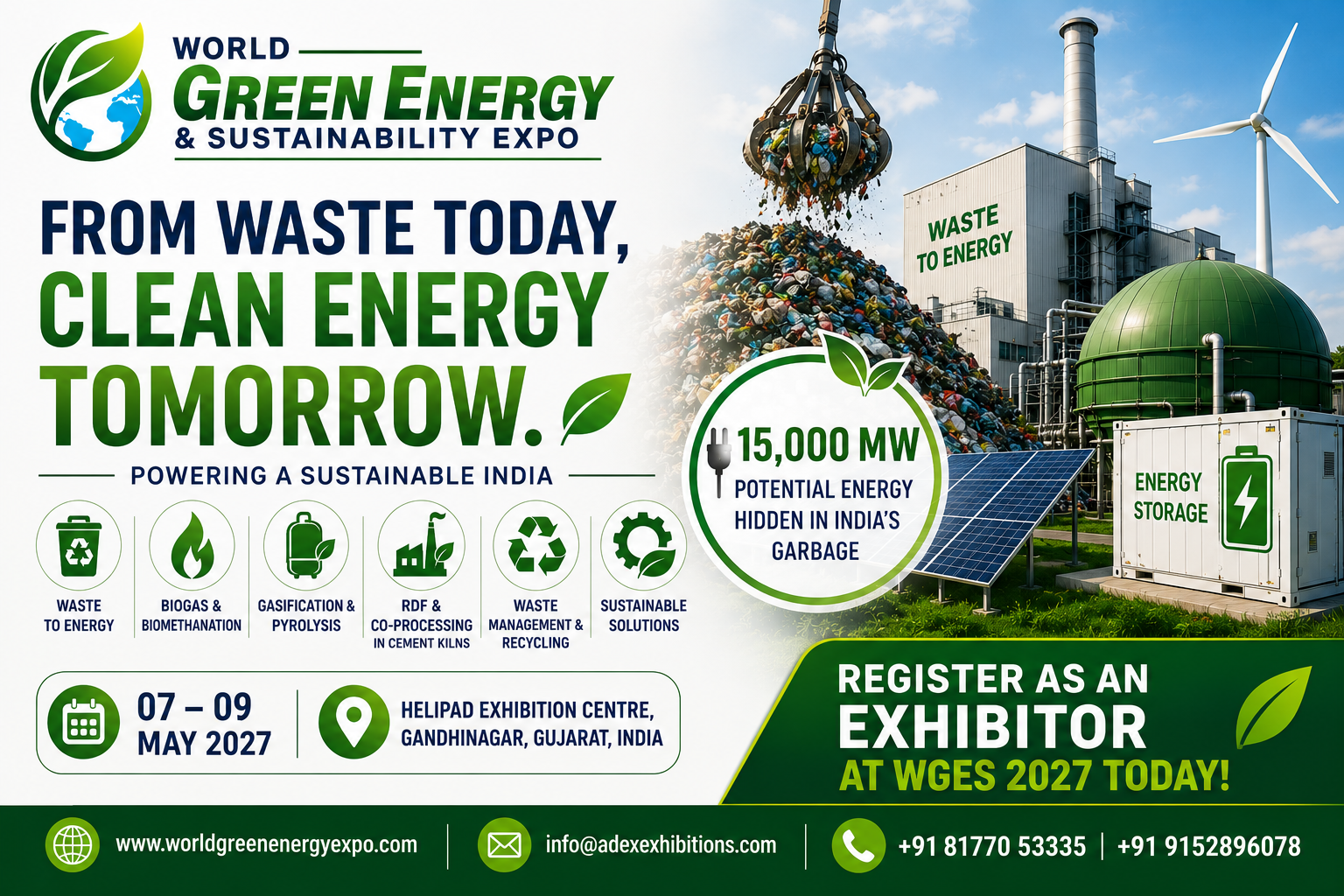
India Is Sitting on 15,000 MW of Energy – Hidden Inside Its Garbage
Every day, India’s cities generate approximately 170,000 tonnes of municipal solid waste. Every single day. That number is growing at 3 to 5% per year as urbanization accelerates, consumption patterns shift toward packaged goods, and India’s middle class expands faster than at almost any other point in economic history.
Most of that waste goes to overflowing landfills – Ghazipur in Delhi, Deonar in Mumbai, Pallikkaranai in Chennai – some of which are taller than the Qutub Minar and have been burning uncontrollably for years, releasing toxic gases that affect millions of nearby residents. India’s landfills are not just an environmental problem. They are a public health crisis, a land use emergency, and one of the most visible symbols of the gap between the country’s clean energy ambitions and its current waste management reality.
Inside that 170,000 tonnes of daily waste sits an energy resource of extraordinary scale. With a conservative energy recovery rate of 500 kWh per tonne, India’s untreated MSW has the theoretical capacity of providing more than 15,000 MW of power generation capacity.
To put that in context, 15,000 MW is approximately equivalent to the output of 15 large coal power stations. It is enough electricity to power every household in Rajasthan, Gujarat, and Maharashtra simultaneously. It is renewable, it is domestic, it eliminates a waste disposal problem, and it is available every single day regardless of whether the sun is shining or the wind is blowing.
India has 21 operational WTE plants and 133 biogas facilities. India’s operational 21 WTE plants produce over 170 MW of electricity, contributing to decentralized urban energy supply. As of now, there are 412.5 MW of WTE installed in India and 48 construction-stage WTE plants as per Swachh Bharat Mission data. This is less than 3% of the waste stream’s theoretical support capacity.
The gap between 170 MW currently generated and 15,000 MW theoretically available – exploiting less than 3% of the potential – is not a failure of technology or policy. It is the largest single infrastructure deployment opportunity in India’s entire waste management and renewable energy ecosystem. And 2027 is the year when the combination of regulatory tightening, government investment, technology maturation, and private sector capital is beginning to close it – at a pace that every company in this sector should be tracking closely.
The Complete Policy Framework – Every Scheme Every Waste to Energy Company Must Know
India’s Waste to Energy policy ecosystem has become significantly more robust over the past two years, with a combination of mandatory waste management rules, direct financial incentives, and renewable energy recognition frameworks creating the most commercially supportive policy environment for Waste to Energy investment in the country’s history.
Swachh Bharat Mission Urban 2.0 (SBM-U 2.0)
The Swachh Bharat Mission Urban 2.0, running from 2021 to 2026, is the primary driver of Waste to Energy plant commissioning in Indian cities. It links central government funding to verifiable waste processing outcomes – meaning cities that commission WTE plants and demonstrate processing metrics receive central financial assistance, while cities that continue landfilling face reduced CFA eligibility. The Swachh Bharat Mission, in both its urban and rural forms, promotes waste to energy as a key method for managing India’s growing waste volumes. By encouraging cities and towns to adopt WTE solutions, SBM helps reduce waste sent to landfills while enabling energy recovery and resource efficiency.
SBM-U 2.0 specifically targets the scientific disposal of legacy waste from existing landfills – the bioremediation of India’s mountain landfills – creating an additional feedstock stream for WTE projects alongside fresh municipal waste collection.
Solid Waste Management Rules 2026
Revised Solid Waste Management Rules, effective October 1, 2025, mandate waste segregation and impose penalties for non-compliance, accelerating the shift from open dumping toward formal processing systems. Regulatory measures are increasingly encouraging waste diversion toward energy recovery, industrial co-processing, and refuse-derived fuels, with public-private partnerships and dedicated waste-to-energy projects being established to reduce landfill reliance.
The October 2025 SWM Rules revision is commercially significant on multiple levels. Mandatory source segregation – wet waste and dry waste separated at the household level – dramatically improves the feedstock quality entering WTE plants, improving both energy recovery efficiency and the economics of downstream sorting and material recovery. Penalties for non-compliance create enforcement mechanisms that previous incarnations of the rules lacked. And the explicit recognition of refuse-derived fuel as a compliant waste disposal pathway opens the RDF co-processing route in cement kilns and industrial facilities at legally confirmed scale.
India is expanding waste-to-energy plants to convert non-recyclable waste into power under the Solid Waste Management Rules 2026. WTE plants reduce municipal solid waste volume by nearly 90%, helping cities manage over 62 million tonnes of annual waste generation in India.
CPCB Bulk Waste Generator Mandate
The Central Pollution Control Board now requires bulk waste generators – commercial complexes more than 20,000 square meters, industrial parks, and hotels – to get their waste processed by them or pay to certified processors.
This mandate creates an entirely new commercial WTE market in the commercial and industrial sector – independent of municipal solid waste processing. Large malls, IT parks, hotel chains, and food processing facilities are now legally required to process their organic and non-recyclable waste through certified systems rather than simply depositing it in municipal bins. For decentralized WTE technology providers – bio methanation systems, small gasifiers, organic waste converters – this mandate opens a business-to-business market of enormous scale that does not require engagement with urban local bodies or complex public-sector contracting processes.
MNRE WTE Program – The National Bioenergy Program Component
MNRE is implementing the WTE program under the umbrella of the National Bioenergy Program on generating energy from urban, industrial, agricultural wastes and residues, as well as MSW. For the fiscal years 2021-2022 through 2025-2026, the WTE Program has a budget outlay of INR 600 crore.
The MNRE WTE program provides central financial assistance for WTE projects of all scales – from small bio methanation units serving individual markets or housing colonies through large MSW-to-power plants serving entire cities. The program’s technology-neutral approach – supporting incineration, gasification, pyrolysis, bio methanation, and refuse-derived fuel equally – means that the optimal technology for a given site and feedstock can be selected without being constrained by subsidy availability for specific pathways.
GOBARdhan Scheme
Indore’s GOBARdhan plant, Asia’s largest, processes 17,000 kg of Bio-CNG daily from organic waste, preventing 130,000 tonnes of CO2 emissions annually. Launched under the Swachh Bharat Mission, it supports sustainable agriculture with over 100 tonnes of compost daily and has registered 1,300 biogas plants nationwide.
The GOBARdhan scheme – already described in detail in our Biogas and CBG article – is directly relevant to the WTE sector because it creates the financial and institutional framework for organic municipal solid waste conversion to biogas and compressed biogas. Urban organic waste – from vegetable markets, restaurant chains, institutional kitchens, and organic household waste – is exactly the feedstock that GOBARdhan-supported plants are designed to process.
SATAT Integration
SATAT is an initiative launched by the Ministry of Petroleum and Natural Gas to promote the production and use of compressed biogas as a green fuel. Under SATAT, entrepreneurs are encouraged to set up CBG plants using agricultural residue, municipal waste, and organic feedstock. The compressed gas is then sold to oil marketing companies such as Indian Oil, BPCL, and HPCL under long-term offtake agreements.
The integration of SATAT – which provides long-term OMC offtake agreements for CBG – with the WTE framework creates one of the most commercially compelling project structures in the entire Indian clean energy sector. An urban organic waste CBG plant receives tipping fees from the municipality for processing waste, MNRE CFA for the conversion infrastructure, and a 15-year OMC offtake agreement for the CBG produced. Three revenue streams from a single project structure – using a feedstock that is both free and legally mandated to be processed.
IREDA Financing
Project loans at preferential rates are available for Waste to Energy projects from IREDA. Collateral-free loans up to INR 2 crore are available for MSME-scale biogas and gasifier units.
IREDA’s WTE-specific financing – classified as Priority Sector Lending in many configurations – reduces the cost and complexity of project finance for credible WTE developers. IREDA’s technical assessment team has developed deep familiarity with WTE project structures, reducing due diligence timelines and improving the bankability of well-structured projects.
Waste to Energy Technologies – The Complete Guide for India’s Specific Conditions
India’s waste characteristics – high organic fraction, high moisture content, variable calorific value, and limited source segregation at scale in most cities – create a specific technology selection framework that differs meaningfully from the European and North American contexts in which most Waste to Energy technology has been developed and scaled.
Technology 1: Bio methanation and Anaerobic Digestion
Bio methanation is the most immediately scalable Waste to Energy technology for Indian conditions, precisely because it is optimized for the high-moisture, high-organic-fraction waste that Indian cities generate. Wet organic waste – vegetable market waste, food processing residues, institutional kitchen waste, and segregated household organic waste – is processed through anaerobic digestion to produce biogas, which is then either used for electricity generation, cooking fuel supply, or upgraded to compressed biogas for the SATAT offtake market.
Pune has adopted decentralized biogas plants, converting market waste into energy for public lighting and cooking. These plants generate revenue and reduce the burden on landfills. The bio methanation pathway has the lowest capital cost per unit of waste processed, the shortest construction timeline, the most developed domestic equipment supply chain in India, and the most comprehensive government subsidy support through MNRE, GOBARdhan, and SATAT simultaneously. For first-time WTE project developers in India, bio methanation is the lowest-risk entry point into the sector.
Technology 2: Incineration with Energy Recovery
Incineration – burning waste at high temperatures (850 to 1,200 degrees Celsius) to generate steam that drives a turbine for electricity generation – is the dominant Waste to Energy technology globally and accounts for the majority of India’s 412.5 MW of installed WTE electrical capacity. The Ghazipur Waste to Energy plant in Delhi processes over 1,500 tonnes of municipal waste daily and generates electricity that feeds into the state grid under a power purchase agreement.
The specific challenge of incineration in Indian conditions is the mixed, high-moisture waste that reduces combustion efficiency and requires auxiliary fuel (typically natural gas or diesel) to maintain furnace temperature when wet waste fractions are high. This increases operating costs and reduces the net energy output below what European incineration plants achieve on drier, higher-calorific-value waste streams.
Source segregation – separating wet organic waste at the household level before it reaches the incineration plant – is the operational prerequisite for economically viable large-scale incineration in Indian cities. Cities that have achieved meaningful source segregation – Indore being the most cited example – are consequently the cities where incineration-based Waste to Energy operates most economically.
Technology 3: Gasification and Pyrolysis
Gasification converts waste through high-temperature chemical reactions in a low-oxygen environment, producing syngas (synthesis gas) – a mixture of carbon monoxide, hydrogen, and methane – that can be burned directly for electricity generation, used as a chemical feedstock, or reformed into hydrogen. Pyrolysis operates at lower temperatures and in the complete absence of oxygen, producing oil, char, and gas as co-products.
The India MSW gasification and waste-to-energy plant market is projected to grow at a compound annual growth rate of approximately 13.2% over the forecast period from 2025 to 2032.
Gasification’s key advantage over incineration is its ability to handle heterogeneous waste streams with variable calorific value more efficiently, and to produce syngas that is usable across multiple applications rather than being locked into electricity generation. Small-scale gasifiers – in the 10 to 200 tonne per day range – are particularly suited to tier-2 Indian cities where waste volumes do not justify large incineration plant investment but exceed what bio methanation alone can process.
December 2024: Nagpur inaugurated India’s first mobile dry fermentation waste-to-energy plant at Bhandewadi landfill. Developed in partnership with SusBDe and WTT Technology, the plant processes 200 metric tonnes of waste daily, aiming for full-scale operations by March 2025, converting waste into biogas and electricity.
Technology 4: Refuse Derived Fuel (RDF)
Refuse Derived Fuel is produced by processing mixed municipal solid waste to remove recyclables and organic fractions, shredding the remaining combustible material, and compressing it into pellets or fluff with a consistent calorific value suitable for co-processing in cement kilns, industrial boilers, or thermal power stations.
RDF is the most commercially pragmatic Waste to Energy pathway for cities where waste volume is high but existing WTE plant capacity is insufficient – because RDF production adds value to waste without requiring electricity generation infrastructure, using the combustion capacity of existing cement kilns and industrial facilities instead. India’s cement sector – one of the world’s largest, operating dozens of large kilns across Rajasthan, Madhya Pradesh, Andhra Pradesh, and Chhattisgarh – has significant installed co-processing capacity for RDF that is actively seeking supply partners.
Technology 5: Organic Waste Converters and Decentralized Systems
Organic Waste Converters – mechanical bio-treatment systems that accelerate the aerobic decomposition of organic waste into compost or biomass – represent the smallest-scale entry point into Waste to Energy technology, suitable for individual housing colonies, hotels, food processing facilities, and institutional campuses. They address the CPCB bulk waste generator mandate by providing a compliant on-site processing solution that eliminates dependence on municipal collection infrastructure.
February 2025: AIIMS Delhi launched Srjanam, an automated biomedical waste conversion system developed by CSIR-NIIST. The environmentally friendly technology neutralizes hazardous waste without incinerators, improving efficiency. It can process 400 kg per day and offers a safer, more economical waste disposal solution.
The Market in Numbers – What Every Investor and Project Developer Must Know
The India Waste to Energy Market was valued at USD 1,050 million in 2023 and is expected to grow at a CAGR of 3.12% from 2024 to 2032. The market is projected to reach approximately USD 3.85 billion by 2032, supported by a growing pipeline of urban local body concession projects and industrial co-processing contracts. In terms of processing capacity, operational and under-construction WTE facilities accounted for approximately 14.8 million tonnes per annum of sanctioned treatment capacity as of the base year.
The wide variance between different research house projections – ranging from 3.12% CAGR to 13.2% CAGR through 2032 – reflects genuine uncertainty about how quickly India’s regulatory enforcement, source segregation, and project development ecosystem will mature. The more conservative estimates assume slow regulatory enforcement and continuing land and permitting challenges. The more optimistic estimates reflect the October 2025 SWM Rules enforcement trigger, the Swachh Bharat Mission 2.0 incentive framework, and the rapidly expanding private sector interest in PPP-based WTE concessions.
The technology-specific growth picture is clearer. The India MSW gasification and waste-to-energy plant market is projected to grow at a CAGR of approximately 13.2% over the forecast period from 2025 to 2032 – significantly faster than the overall WTE market, reflecting the specific suitability of gasification to Indian MSW characteristics and the tier-2 city deployment opportunity.
City-by-City – India’s WTE Landscape in 2027
Indore – The National Model
Indore’s GOBARdhan plant, Asia’s largest, processes 17,000 kg of Bio-CNG daily from organic waste, preventing 130,000 tonnes of CO2 emissions annually and supporting sustainable agriculture with over 100 tonnes of compost daily.
March 2025: Indore launched India’s first PPP-based green waste processing plant under the Swachh Bharat Mission-Urban, which will recycle green waste into eco-friendly products like sawdust and wooden pellets, generating revenue and promoting sustainability.
Indore operates large-scale composting and biogas plants supported by multiple central schemes and has also implemented WTE projects that power parts of its municipal operations. Indore is the reference case for what Indian WTE can achieve when source segregation, municipal governance quality, and technology deployment align. Its city-wide 100% source segregation system – achieving complete wet-dry separation at the household level – is the foundation on which every subsequent WTE investment is built. For any company, municipality, or investor evaluating what a mature Indian WTE ecosystem looks like at city scale, Indore is the most instructive case study in the country.
Delhi NCR – The Large-Scale Incineration Market
Delhi’s WTE story centers on its large MSW incineration plants – Okhla, Ghazipur, and Narela – which collectively process thousands of tonnes of waste daily and generate electricity under power purchase agreements with Delhi’s state electricity distribution companies.
The Ghazipur WTE plant in Delhi processes over 1,500 tonnes of municipal waste daily and generates electricity that feeds into the state grid under a power purchase agreement. The oldest waste-to-energy plant in India is the Narela Waste-to-Energy Plant. It processes 2,000 metric tonnes of waste every day to generate 24 MW of energy.
Delhi’s WTE experience also contains the most honest lessons about what goes wrong when waste quality is poor and source segregation is absent. Early operational difficulties at the Okhla and Ghazipur plants – driven by mixed, high-moisture waste with insufficient calorific value – created efficiency shortfalls that have been extensively documented and that informed the mandatory source segregation provisions of the 2025 SWM Rules revision.
Pune – The Decentralized Success Story
Pune has adopted decentralized biogas plants, converting market waste into energy for public lighting and cooking. These plants generate revenue and reduce the burden on landfills.
Pune’s decentralized approach – small bio methanation units at individual markets, residential complexes, and institutional campuses rather than one large centralized plant – is particularly relevant for the CPCB bulk waste generator mandate, which creates exactly the type of institutional demand that decentralized systems serve.
Nagpur – The Innovation Hub
December 2024: Nagpur inaugurated India’s first mobile dry fermentation waste-to-energy plant at Bhandewadi landfill. Developed in partnership with SusBDe and WTT Technology, the plant processes 200 metric tonnes of waste daily, converting waste into biogas and electricity.
Nagpur’s mobile dry fermentation innovation is particularly significant because it addresses the legacy landfill remediation challenge that most Indian cities face – converting existing landfill waste into energy while simultaneously reclaiming valuable urban land currently occupied by overflowing dump sites.
Surat – Gujarat’s Opportunity
Surat is among the tier-2 cities already generating 500 to 1,500 tonnes per day of MSW with no WTE plant – representing the most commercially accessible WTE project development opportunity in India.
Surat’s MSW generation of over 1,000 tonnes per day – from its enormous textile, diamond, and food processing industries alongside a rapidly growing urban population – creates a WTE opportunity of significant scale in the WGES 2027 host city’s metropolitan area. The absence of existing WTE infrastructure means that first-mover project developers in Surat face no incumbent competition and can design projects optimized for current technology and current regulatory requirements rather than working around legacy infrastructure.
Hyderabad and the Telangana Cluster
Hyderabad has already implemented or proposed WTE facilities as part of its municipal waste management strategy. Telangana’s rapid economic growth and urbanization, combined with the Hyderabad Metropolitan Development Authority’s proactive infrastructure planning, create one of the most commercially attractive WTE project development environments in South India.
The Companies Shaping India’s Waste to Energy Industry
Essel Infraprojects Limited
Essel Infraprojects Limited is among the ten most consequential WTE players in India, alongside SEIL (SMS Envocare India Limited), Antony Lara Enviro Solutions, IL&FS Environment Infrastructure and Services Limited, Ramky Enviro Engineers Limited, and A2Z Waste Management.
Essel Infraprojects is one of India’s largest infrastructure development companies, with WTE plants in its portfolio alongside road, metro, and social infrastructure projects. Its balance sheet strength and project execution track record make it one of the preferred concession partners for urban local bodies seeking experienced private developers for large-scale WTE plant PPP projects.
Jindal Urban Waste Management
The Jindal Group’s urban waste management division – which operates the Visakhapatnam WTE plant and several other MSW-to-power facilities – is one of India’s most experienced large-scale incineration-based WTE operators. According to the agreement between Jindal Group and the GVMC, the recycling plant at Visakhapatnam will generate about 15 MW of electricity daily, generating about 9.90 MW of power per day using one boiler from a facility commenced in March 2022.
Ramky Enviro Engineers
Ramky Enviro Engineers is India’s most experienced integrated waste management company, covering collection, transportation, segregation, composting, recycling, and WTE across multiple Indian cities. Its end-to-end waste management capability – from bin to plant – gives it a unique position in the WTE ecosystem as a company that can manage the entire waste supply chain required to make a WTE plant operate economically.
Antony Lara Enviro Solutions
Antony Lara specializes in urban waste management and WTE technology, with operational experience across multiple Indian cities and a technology portfolio spanning bio methanation, composting, and mechanical biological treatment. Its track record with urban local body concession contracts makes it a benchmark reference developer for municipalities evaluating their first WTE projects.
IL&FS Environment Infrastructure and Services
IL&FS Environment – despite its parent company’s well-documented financial difficulties – continues to operate waste management and WTE infrastructure across multiple Indian cities, with technical competencies in large-scale MSW processing that are among the most developed in the Indian market.
A2Z Waste Management
A2Z Waste Management is among the ten most consequential players in India’s MSW gasification and WTE plant market. A2Z’s specific expertise in gasification-based WTE technology makes it particularly relevant for tier-2 city applications where mixed waste quality creates challenges for incineration-based systems.
International Technology Companies
Several international WTE technology companies have established or are establishing Indian market presence as the policy environment matures and project pipeline grows. Hitachi Zosen INOVA, Covanta Energy, Babcock and Wilcox, and Suez Environnement are all evaluating Indian WTE partnerships. German, Dutch, and Japanese WTE technology companies – whose home markets have operated mature WTE industries for decades – bring process engineering, combustion optimization, and emissions control expertise that India’s emerging WTE industry actively needs.
The Economics of Waste to Energy in India – The Numbers Every Investor Must Understand
The financial case for WTE investment in India is built on a revenue model with multiple streams – which is both its strength (diversified income) and its complexity (multiple counterparty relationships required simultaneously).
Revenue Stream 1: Tipping Fee
Urban local bodies pay WTE plant operators a tipping fee per tonne of waste delivered for processing – the primary revenue anchor for most WTE projects. Tipping fees in India range from INR 300 to INR 800 per tonne depending on city size, contract structure, and the capital cost of the plant. For a 500-tonne-per-day plant at INR 500 per tonne tipping fee, this generates approximately INR 9.1 crore per year – forming the revenue foundation from which all other income streams add incremental value.
Revenue Stream 2: Power Sale
For electricity-generating WTE plants – incineration and gasification with power generation – electricity is sold to the state grid or to captive industrial buyers under power purchase agreements. WTE electricity typically commands tariffs of INR 3 to INR 7 per kWh depending on the state, the vintage of the contract, and whether the project qualifies as a renewable energy source under state renewable purchase obligations.
Revenue Stream 3: CBG Offtake
For bio methanation-based WTE plants, CBG sales to oil marketing companies under SATAT 15-year purchase agreements at INR 62 to INR 72 per kilogram provide long-term revenue certainty that significantly improves project bankability.
Revenue Stream 4: RDF Sales
For plants producing refuse-derived fuel, sales to cement kilns and industrial boilers at INR 2,000 to INR 4,000 per tonne provide an additional revenue stream from the non-organic, non-recyclable fraction of processed waste.
Revenue Stream 5: Compost and FOM Sales
For bio methanation and composting-integrated WTE plants, compost and fermented organic manure sales at INR 2 to INR 5 per kilogram provide revenue from the organic processing residue – particularly valuable in agricultural states where demand for organic soil amendment is high.
A 10 to 20 tonne per day bio methanation or gasifier unit can be commissioned for under INR 2 crore net of MNRE subsidy. The feedstock is free. The tipping fee pays your operating costs. The gas or power is your upside.
This economic summary – from a June 2026 analysis – captures the commercial logic of small-scale decentralized WTE more clearly than any market research report: when feedstock is free and tipping fees cover operating costs, the energy output becomes essentially pure upside. For tier-2 cities and bulk waste generators operating under the CPCB mandate, this economic structure makes WTE investment compelling at relatively modest scale.
The Investment Opportunity – Segment by Segment
The WTE market creates distinct commercial opportunities across multiple value chain segments – from project development and EPC contracting through technology licensing and equipment supply to financing and carbon credit monetization.
For project developers and ULB concession bidders: The pipeline of 48 plants under construction and the backlog of tier-2 cities with 500 to 1,500 TPD MSW generation and no WTE infrastructure represents one of the most clearly defined project development pipelines in India’s clean energy sector. Cities including Surat, Varanasi, Patna, Indore, and Coimbatore are named priority opportunities – where waste generation volume and the absence of existing WTE infrastructure combine to create first-mover advantage for credible project developers.
For WTE technology licensors and equipment manufacturers: Every new Waste to Energy plant commissioned in India is a technology procurement event. Combustion grate systems, gasifier vessels, anaerobic digestion reactors, biogas upgrading systems, power generation equipment, flue gas treatment systems, and SCADA monitoring platforms all require procurement from specialist suppliers. International technology companies with proven Waste to Energy plant references – particularly in South and Southeast Asian contexts where waste characteristics are similar to India – are well-positioned to access this procurement pipeline through Indian EPC partnerships or direct project developer relationships.
For EPC contractors: The construction of Waste to Energy plants – particularly the civil works, mechanical installation, electrical systems, and commissioning services – is a growing EPC market that sits at the intersection of civil construction, process plant engineering, and environmental technology. Indian EPC companies with experience in both industrial process plants and waste management infrastructure are the natural domestic execution partners for both domestic and international WTE developers.
For RDF offtake and cement co-processing companies: India’s cement sector – consuming over 350 million tonnes of clinker annually across facilities from Rajasthan to Tamil Nadu – has significant co-processing capacity for refuse-derived fuel. Cement companies including Ultratech, ACC, Ambuja, and Shree Cement are actively expanding their co-processing operations. For Waste to Energy plant operators producing RDF, establishing long-term supply agreements with cement companies provides offtake certainty for the non-organic, non-recyclable fraction of processed waste.
For carbon project developers: Waste to Energy plants – particularly bio methanation and landfill gas capture projects – generate verifiable greenhouse gas emission reductions through methane avoidance and fossil fuel displacement. These reductions are eligible for Indian Carbon Market credits and voluntary carbon market credits, providing an additional revenue stream for well-structured projects. Carbon project development companies that can register, verify, and trade WTE emission reductions add direct commercial value to project economics without requiring any additional capital investment in plant infrastructure.
The Challenges – What Every Waste to Energy Company Must Navigate Honestly
India’s WTE sector has a history of projects that underperformed expectations – and understanding why is commercially critical for anyone entering this market.
Waste quality and source segregation remain the primary operational challenge. Without source segregation – separating wet organic waste from dry recyclable waste at the household level – WTE plants receive heterogeneous, high-moisture, low-calorific-value waste that reduces efficiency for incineration plants and reduces biogas yield for bio methanation systems. The October 2025 SWM Rules revision with mandatory segregation requirements is the most important policy development for improving this situation, but enforcement timelines vary significantly across cities and states.
Tipping fee payment reliability from urban local bodies has historically been inconsistent. ULBs – the primary WTE offtake counterparties for tipping fees – have variable financial health across India’s 4,000-plus urban local bodies. Well-governed ULBs with strong municipal finances make reliable tipping fee payers. Cash-strapped smaller municipalities with weak revenue bases create payment risk that must be structured carefully in PPP concession agreements.
Land acquisition and environmental clearances add significant time and cost to WTE projects. WTE plants require specific site characteristics – proximity to waste sources, distance from residential areas, grid connectivity for power export, road access for waste transport – that frequently conflict with available land use in dense urban environments. Environmental clearance timelines from MoEFCC and State PCBs can extend project development timelines by one to three years beyond what financial models typically assume.
Technology mismatch with Indian waste characteristics has caused underperformance in several early incineration plants. Technologies designed for European or North American waste streams – with lower moisture and higher calorific value – have operated below design efficiency when fed with Indian MSW without appropriate pre-treatment. This is not a technology failure but a specification mismatch that is correctable through proper waste characterization before technology selection.
Why World Green Energy & Sustainability Expo (WGES 2027) Is the Right Platform for India’s WTE Industry
India’s waste-to-energy sector is entering its most commercially active phase – with mandatory SWM Rules creating demand, Swachh Bharat Mission 2.0 funding creating project development momentum, CPCB bulk generator mandates creating a new B2B market, and the combined GOBARdhan-SATAT-MNRE policy framework creating the most commercially supportive WTE investment environment in the country’s history.
Every part of this transition – the WTE technology, the project engineering, the anaerobic digestion equipment, the RDF production systems, the compost distribution logistics, the carbon credit monetization, and the project finance structuring – represents procurement activity happening in the same commercial ecosystem that WGES 2027 serves.
World Green Energy & Sustainability Expo (WGES 2027)’s waste management and recycling exhibitor category directly targets this ecosystem – connecting WTE technology providers, project developers, equipment manufacturers, environmental engineering companies, and carbon project developers with the urban local body officials, industrial companies subject to CPCB bulk generator mandates, and institutional investors evaluating WTE project finance opportunities who attend World Green Energy & Sustainability Expo (WGES 2027) as visitors and buyers.
Gujarat – World Green Energy & Sustainability Expo (WGES 2027)’s host state – contains exactly the tier-2 city WTE opportunity that is India’s most commercially accessible near-term deployment opportunity. Surat’s 1,000-plus TPD MSW generation with no operational WTE plant, the Vadodara municipal corporation’s active WTE project evaluation, and the state government’s progressive waste management policy framework all create direct commercial relevance between the WTE market opportunities described in this article and the exhibitor and visitor community that World Green Energy & Sustainability Expo (WGES 2027) assembles in Gandhinagar.
For Waste to Energy technology licensors seeking Indian EPC and project developer partnerships, for gasification and bio methanation equipment manufacturers targeting India’s growing tier-2 city Waste to Energy pipeline, for RDF production technology companies addressing the cement sector co-processing market, for environmental engineering firms evaluating Waste to Energy project development opportunities, for carbon project developers targeting WTE emission reductions under the Indian Carbon Market, and for financial institutions evaluating WTE project finance across India’s expanding concession pipeline – World Green Energy & Sustainability Expo (WGES 2027) is where India’s waste-to-energy community meets the technology, capital, and commercial ecosystem that will build the next generation of WTE capacity.