
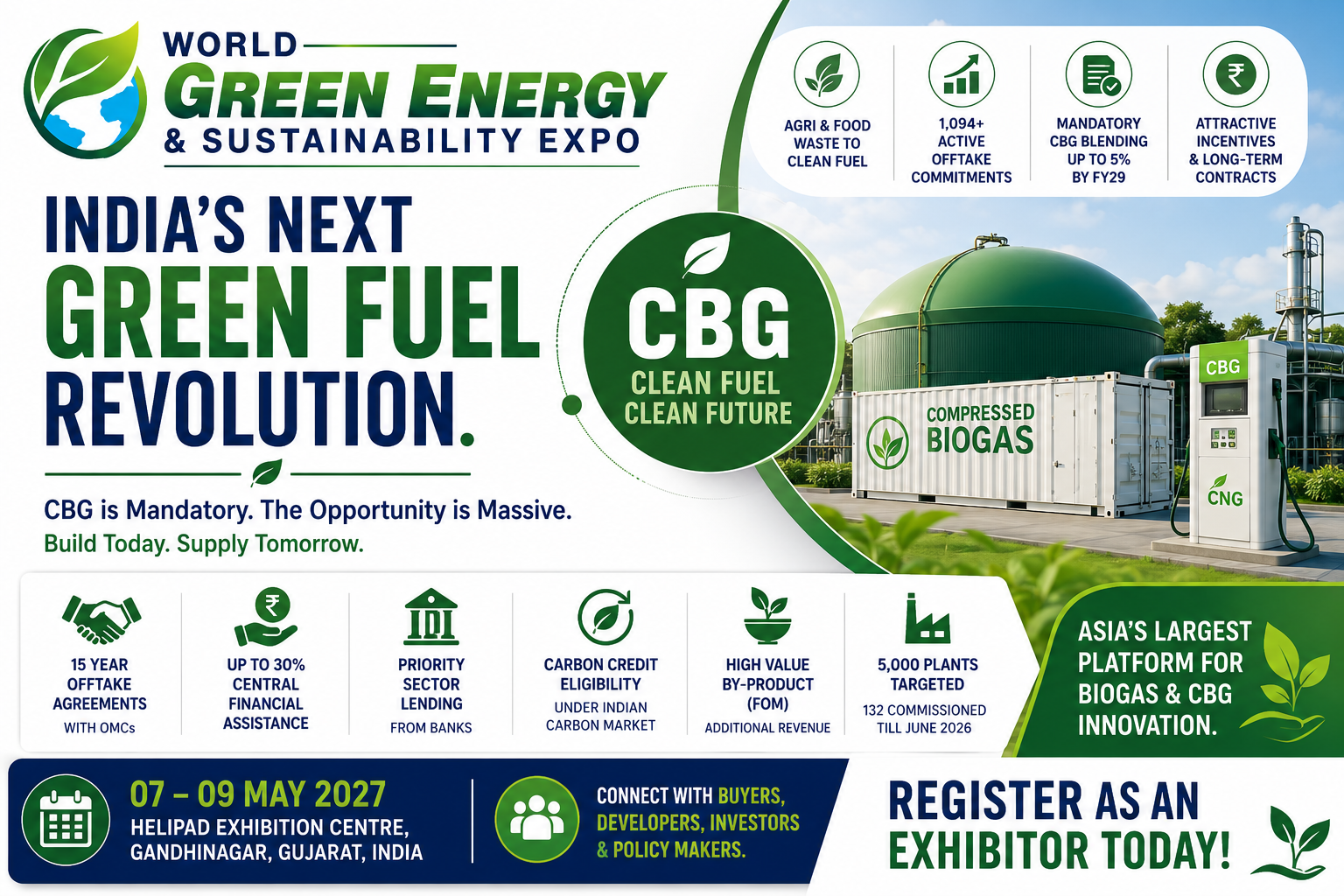
India’s Most Underappreciated Green Energy Opportunity Has Just Become Mandatory
There is a green energy market in India that combines mandatory government procurement at fixed prices, 15-year supply agreements with oil marketing companies, central financial assistance of up to 30% of capital cost, priority sector lending from public banks, carbon credit eligibility under the Indian Carbon Market, and a feedstock base drawn from the agricultural and food waste that India generates in such quantities that it is currently causing air pollution rather than producing energy.
This market has 1,094 active Letters of Intent from oil marketing companies waiting for projects to be commissioned against them. It has 5,000 plants targeted for development. It has 132 commissioned as of June 2026. The gap between those two numbers – 1,094 active offtake commitments seeking projects, and 132 projects actually built – is not a sign of a failing market. It is the most commercially significant deployment gap in India’s entire green energy ecosystem.
This market is compressed biogas – universally called CBG in India – and 2027 is the year it becomes mandatory.
The government has introduced a mandatory requirement for blending CBG with CNG used in transportation and PNG supplied to households. The compulsory blending requirement began at 1% in FY26 and is scheduled to increase to 3% in FY27, 4% in FY28, and 5% from FY29 onwards.
For biogas plant developers, anaerobic digestion technology companies, biogas upgrading equipment suppliers, engineering and construction contractors, feedstock aggregators, and agricultural technology companies – the Indian CBG market in 2027 is not an emerging opportunity. It is an active, policy-backed, mandatory-demand market with more unmet offtake capacity than commissioned production, and a five-year mandatory blending escalation schedule that makes the demand outlook one of the most structurally secure in the entire green energy sector.
What Is Biogas and Compressed Biogas – The Technical Guide
Understanding what biogas and CBG actually are – and how they differ from conventional natural gas and LPG – is the starting point for any commercial evaluation of this market.
Biogas is produced through anaerobic digestion – the biological breakdown of organic material in the absence of oxygen by naturally occurring microorganisms called methanogens. The process occurs continuously in nature wherever organic matter decomposes in oxygen-deficient conditions – in wetlands, paddy fields, livestock guts, and the bottoms of lakes and reservoirs. Industrial biogas plants replicate this process in enclosed digesters, controlling temperature, feedstock composition, and retention time to maximize gas yield from a given quantity of organic input material.
Raw biogas emerging from an anaerobic digester is a mixture of approximately 55 to 65% methane, 30 to 45% carbon dioxide, and small quantities of hydrogen sulphide, water vapor, and trace gases. It has significant energy value – it can be used directly for cooking, heating, or electricity generation – but it is not interchangeable with compressed natural gas because of its lower methane content and the presence of CO2 and other impurities.
Compressed biogas – CBG or bio-CNG – is biogas that has been upgraded to remove CO2, hydrogen sulphide, and other impurities, raising the methane content to a minimum of 90% (per India’s IS 16087:2016 standard), then compressed to 250 bar pressure for storage and dispensing. At this specification, CBG is chemically and energetically equivalent to compressed natural gas – it can be used in any CNG vehicle, appliance, or industrial application without modification. This drop-in compatibility with the existing CNG infrastructure is CBG’s most commercially decisive characteristic.
The co-products of biogas production are as commercially important as the gas itself. Fermented Organic Manure – FOM – is the nutrient-rich solid residue left after digestion, containing nitrogen, phosphorus, potassium, and micronutrients in plant-available form. It is a genuine replacement for chemical fertilizer, and in well-structured CBG projects, FOM revenue contributes 20 to 35% of total project revenue – significantly improving economics and reducing dependence on CBG offtake pricing alone. A 400 kilogram per day CBG plant produces approximately 8 to 10 tonnes of FOM daily – a volume that requires active marketing and distribution infrastructure but that represents a valuable and commercially accessible revenue stream in India’s agriculture-intensive rural economy.
The Market Scale – India’s Biogas Potential and Current Reality
Understanding both the scale of India’s theoretical biogas potential and the current state of commercial deployment is essential for any company evaluating this market honestly.
India’s biogas resource base is genuinely enormous. India generates approximately 750 million tonnes of agricultural residues annually, 32 million tonnes of livestock manure daily, 62 million tonnes of municipal solid waste per year, significant quantities of food processing waste, distillery effluent, and press mud from sugar mills, and sewage sludge from urban wastewater treatment plants. The theoretical biogas potential from these combined feedstock streams exceeds 60 billion cubic metres per year – enough to supply approximately 40% of India’s current domestic gas consumption from renewable, domestically produced biological methane.
The SATAT scheme, launched in October 2018, set a target of 5,000 CBG plants producing about 15 million tonnes per year, which was meant to replace roughly 40% of domestic compressed natural gas use.
Against this theoretical potential, the current reality is more modest but commercially specific. As per the SATAT portal, 108 CBG plants had been commissioned with 1,094 active Letters of Intent issued as of July 2025. The MoPNG Annual Report 2024-25 indicates approximately 100 CBG and biogas plants commissioned with an installed capacity of approximately 700 metric tonnes per day have been commissioned up to March 2025.
Progress under SATAT has remained slow, as only 132 plants had been completed by June 3, 2026, compared with the original target of 5,000 plants.
CBG is now available in some 315 retail outlets and delivered to industrial customers. CBG-CGD synchronization scheme has started sales in 54 geographical areas of the City Gas Distribution network.
India’s oil marketing companies had issued more than 3,800 Letters of Intent for CBG plants by mid-2025, government records show. Fewer than 200 were operational or being commissioned. The gap between announced capacity and working capacity is the defining feature of the sector, and it is wide.
This gap – between 3,800-plus Letters of Intent and fewer than 200 operational plants – is the most commercially significant fact in India’s CBG market in 2027. It means that every credible project developer who can demonstrate technical competence, secure feedstock supply, navigate regulatory approvals, and commission a bankable CBG project is entering a market where the buyer – the oil marketing company – is already waiting with a signed offtake commitment. The normal B2B challenge of finding a customer does not apply to Indian CBG projects in the way it applies to almost every other clean energy technology market. The customers are pre-committed. The challenge is building the plants.
The Complete Policy Framework – Every Scheme Every Company Must Know
India’s CBG policy ecosystem is unusually comprehensive, spanning production incentives, demand mandates, feedstock support, grid injection facilitation, and carbon market integration. Understanding it fully is a commercial prerequisite for any company in this sector.
SATAT – Sustainable Alternative Towards Affordable Transportation
SATAT is an initiative launched in 2018 to promote compressed biogas as an affordable and sustainable transport fuel. Under SATAT, oil marketing companies – IOCL, BPCL, and HPCL – issue Letters of Intent to CBG project developers committing to purchase all CBG produced at notified prices for a defined contract term. The LoI is the commercial gateway to project bankability – it provides the revenue certainty that banks and financial institutions need to advance project finance for CBG plant construction.
IOCL, BPCL, and HPCL are the nodal agencies for issuing LoIs and signing offtake agreements. As of 2025, the procurement price from OMCs generally ranges between INR 62 to INR 72 per kilogram, determined by the calorific value of the CBG. OMCs generally offer a 15-year purchase agreement with an option to extend.
The LoI confirms OMC commitment to procure CBG at notified prices for the agreed term, typically 15 years. The 1,094 active LoIs as of July 2025 against only 108 commissioned plants indicates ample LoI availability for credible developers. Application is via the SATAT portal at iocletenders.nic.in and respective OMC portals.
Compressed Biogas Blending Obligation (CBO) – The Mandatory Demand Framework
The CBO is a positive policy initiative aimed at creating assured offtake and improved demand. The CBO was optional until 2024-25 but is mandatory from 2025-26. For fiscal years 2026, 2027, and 2028, the CBO has been set at 1%, 3%, and 4% of the overall consumption of CNG or PNG respectively. The CBO will increase to 5% from 2028-29.
The mandatory nature of the CBO from FY2025-26 is the single most commercially transformative policy development in India’s CBG market in recent years. It transforms CBG from a voluntarily purchased alternative fuel into a legally mandated component of every cubic meter of CNG and PNG sold in India. City gas distribution companies – including Mahanagar Gas, Gujarat Gas, GAIL, Adani Total Gas, and IGL – are now legally required to blend CBG into their networks at the specified proportion, whether or not it is commercially convenient for them to do so.
This mandatory blending creates a demand floor that grows year by year through 2029 and beyond, providing project developers and investors with demand certainty that is completely independent of market price dynamics, energy price competition, or individual buyer commercial decisions.
GOBARdhan – The Rural Biogas Development Program
GOBARdhan – Galvanizing Organic Bio-Agro Resources Dhan – specifically targets cattle dung and agricultural residue conversion to biogas and CBG in rural areas. The scheme provides central financial assistance for biogas plants in rural communities, livestock farms, and dairy cooperatives. Budget 2024-25 allocated expanded resources to GOBARdhan with new pilot programs in 500 districts – bringing the scheme’s geographic footprint to near-national scale and creating biogas development opportunity in every major agricultural state.
GOBARdhan’s significance extends beyond the CFA it provides. It creates the institutional framework – district-level implementation committees, feedstock aggregation support, and regulatory facilitation – that makes rural CBG plant development administratively possible for first-time project developers who lack the institutional relationships to navigate the regulatory landscape independently.
National Bioenergy Program – The MNRE Framework
Under the Ministry of New and Renewable Energy’s National Bioenergy Program, Central Financial Assistance is offered for various components relating to power generation, biogas and bio-CNG generation, and briquette and pellet manufacturing. Overall, targeted policy measures are being introduced for the entire value chain, from feedstock aggregation and briquette manufacturing to CBG production, blending, and transport.
Biomass Aggregation Machinery Scheme (BAM)
The Biomass Aggregation Machinery scheme has been launched with an outlay of INR 5.64 billion for the period 2023-24 to 2026-27, targeting one of the biggest challenges in the CBG value chain – feedstock availability. In July 2025, the government revised the CFA disbursement process for CBG projects to support the purchase of BAM.
The BAM scheme addresses one of the most operationally specific challenges in CBG project development – the collection, transport, and preparation of dispersed agricultural residue feedstocks. Agricultural residues – paddy straw, wheat straw, corn stover, sugarcane tops – are geographically distributed across large rural areas, seasonally available, and require cutting, baling, and transportation infrastructure that most CBG project developers do not independently possess. BAM subsidizes the equipment needed to aggregate this feedstock cost-effectively, directly improving the economics of agricultural residue-fed CBG projects.
CBG-CGD Synchronization Scheme
The CBG-CGD Synchronization Scheme enables CBG injection directly into the city gas distribution pipeline network at a Uniform Base Price blended with domestic natural gas. This scheme removes one of the most significant infrastructure bottlenecks for CBG commercialization – the need for a dedicated CBG dispensing infrastructure at each CBG plant or retail point. The CBG-CGD Synchronization Scheme operated by GAIL enables CBG injection into the CGD network at Uniform Base Price blended with domestic natural gas. CBG-CGD synchronization has started sales in 54 geographical areas of the city gas distribution network.
Carbon Credits – The Emerging Additional Revenue Stream
Bio-CNG plants are earning voluntary carbon credits for methane avoidance, with pilots for the Indian Carbon Market from 2025. CBG production prevents the methane that would otherwise be released from decomposing organic waste from entering the atmosphere. Since methane is approximately 84 times more potent than CO2 as a greenhouse gas over a 20-year timeframe, this methane avoidance creates a quantifiable and verifiable carbon credit that can be sold through voluntary carbon markets or the emerging Indian Carbon Market. For well-structured CBG projects using livestock manure or municipal solid waste feedstocks, carbon credit revenue can add INR 1 to 4 per kilogram of CBG equivalent to project economics – a meaningful improvement in project returns that makes otherwise marginal projects bankable.
CBG Plant Economics – What Every Project Developer Must Know
The financial case for CBG plant investment is the most commercially specific information any company evaluating this market needs, and it deserves detailed treatment.
Capital intensity: A 400 kilogram per day plant needs about INR 1.65 crore. A 5,000 kilogram per day plant needs about INR 16 crore.
As of 2025, the procurement price from OMCs generally ranges between INR 62 to INR 72 per kilogram, determined by the calorific value of the CBG.
At INR 62 to INR 72 per kilogram for CBG – compared to CNG retail prices typically in the INR 70 to 95 per kilogram range across Indian cities – CBG production at these prices offers positive unit economics for projects with feedstock available at low or negative cost. Municipal solid waste, press mud from sugar mills, dairy effluent, and paddy straw in regions where burning is the alternative all represent feedstocks with zero or very low procurement cost, significantly improving project margin profiles versus projects competing commercially for feedstock.
The 15-year OMC offtake agreement provides the revenue certainty that makes CBG plant finance possible through Priority Sector Lending from public sector banks – typically at interest rates of 8 to 11%, with loan-to-value ratios of 65 to 75% of total project cost. Combined with MNRE Central Financial Assistance of up to 30% of project cost for qualifying plants, the equity requirement for a well-structured CBG project can be reduced to 15 to 25% of total cost – an accessible entry point for agricultural entrepreneurs, sugar mill operators, dairy cooperatives, and municipal bodies developing CBG projects on or adjacent to their existing feedstock generation operations.
Every additional commissioned plant that enters the market in the next 2 to 3 years is entering an undersupplied market with guaranteed, price-linked buyers. With approximately 47% of India’s natural gas currently imported, CBG offers a domestic, renewable alternative to CNG, reducing fossil fuel dependency.
The FOM revenue dimension deserves specific attention because it is frequently underestimated in project feasibility analyses. A 5,000 kilogram per day CBG plant processes approximately 150 to 200 tonnes of organic feedstock daily, generating 80 to 100 tonnes of FOM. At INR 2 to 5 per kilogram retail price for FOM against chemical fertilizer alternatives, this represents INR 16,000 to INR 50,000 per day of additional revenue – INR 58 lakh to INR 1.8 crore per year – from a co-product that requires no additional capital investment beyond the FOM drying, packaging, and distribution infrastructure.
Feedstocks – India’s Resource Base for CBG Production
India’s CBG feedstock diversity is one of the market’s most commercially attractive features – reducing dependence on any single agricultural commodity and enabling CBG plant siting across a wide range of geographic and agricultural contexts.
Agricultural Residues – The Highest-Volume Feedstock
India produces 120 to 160 million metric tonnes of crop residues annually. Paddy straw – the most abundant and most problematic agricultural residue, particularly in Punjab, Haryana, and western Uttar Pradesh where field burning creates severe air pollution – is the priority feedstock for agricultural residue CBG plants in North India. The combination of available BAM scheme support for aggregation equipment and the air quality crisis created by straw burning makes paddy straw a feedstock with strong political support for diversion to CBG production. Wheat straw, corn stover, sugarcane tops, and cotton stalks provide additional residue streams across different states and seasons.
Feedstock such as paddy straw, bagasse, and press mud is available locally in most agri-processing belts. This is an entry format most accessible for first-generation entrepreneurs in Tier 2 cities of Punjab, Haryana, UP, and Maharashtra.
Cattle Dung and Dairy Waste – The Rural Opportunity
India’s dairy sector – the world’s largest – generates enormous quantities of cattle dung, dairy wash water, and animal slurry daily. These feedstocks are among the most biogas-productive per unit mass, with cattle dung containing active methanogenic microbial communities that accelerate digester start-up and stabilize biogas production. Dairy cooperatives, goshala operators, and large-scale dairy farms are natural CBG project developers – they already manage the feedstock, they benefit from on-site gas supply for dairy processing, and FOM provides direct value as fertilizer for their own or neighboring agricultural land.
The GOBAR-Dhan scheme specifically targets this cattle dung feedstock stream at village scale, creating a policy support framework for the smallest-scale biogas plants serving rural households and small dairy operations alongside the larger plants targeting the SATAT offtake market.
Municipal Solid Waste – The Urban Opportunity
India generates approximately 62 million tonnes of municipal solid waste annually, with organic fraction typically representing 40 to 60% of waste in Indian cities – significantly higher than in developed countries due to India’s predominantly vegetarian diet and fresh food consumption patterns. MSW-fed CBG plants address two problems simultaneously – waste management and clean fuel production – making them highly attractive to urban local bodies seeking integrated waste management solutions.
Indore’s bio-CNG plant – India’s largest – processes 550 tonnes of waste per day. The Indore model has become the reference case for municipal solid waste-to-CBG development in India, demonstrating that large-scale MSW-CBG plants are technically and commercially viable in Indian urban contexts. Cities including Pune, Nagpur, Surat, Coimbatore, and several others are evaluating or developing MSW biogas facilities based on the Indore template.
Press Mud and Sugar Mill Effluent – The Industrial Feedstock
Sugar mills generate press mud – the solid residue from juice clarification – and effluent from washing and processing operations that are extremely productive biogas feedstocks. A 5,000 tonne per day crushing capacity sugar mill generates 15 to 25 tonnes of press mud daily, sufficient to operate a 200 to 400 kilogram per day CBG plant year-round (during the crushing season) and potentially year-round with supplementary feedstock. The co-location of CBG plants with sugar mills creates combined heat and power synergies – biogas can supplement bagasse for steam generation during and between crushing seasons – improving overall mill energy economics.
Distillery Effluent – The High-Yield Waste Stream
India’s rapidly expanding ethanol distillery industry generates vinasse – the liquid residue from fermentation and distillation – in large volumes at every distillery facility. Vinasse is a highly concentrated organic waste with a chemical oxygen demand of 50,000 to 100,000 milligrams per litre – making it an extremely productive biogas feedstock that must in any case be treated before discharge. CBG plants co-located with distilleries convert a mandatory effluent treatment obligation into a revenue-generating biogas production asset, dramatically improving the economics of both the distillery and the CBG plant.
Food Processing Waste – The Commercial and Industrial Stream
Food processing facilities – fruit and vegetable processors, grain mills, poultry processing plants, fish processing units, bakeries, and institutional kitchens – generate organic waste streams that are consistently among the most productive biogas feedstocks due to their high fat, protein, and carbohydrate content. Commercial and institutional food waste typically yields 2 to 3 times more biogas per tonne than agricultural residues, significantly improving CBG plant economics when food waste is available as a co-feedstock alongside primary agricultural or cattle dung inputs.
The Technology Stack – What a CBG Plant Actually Requires
For equipment manufacturers, technology licensors, and engineering companies evaluating the CBG market, understanding the complete technology scope of a CBG plant identifies where commercial opportunities sit and what specifications buyers are actually procuring.
Feedstock Reception and Pre-treatment
Every CBG plant begins with feedstock reception – receiving, weighing, sampling, and storing incoming organic materials. Pre-treatment equipment includes size reduction – shredders, choppers, and slurry mixers for solid feedstocks – and dilution or pH adjustment for feedstocks outside the optimal range for anaerobic digestion. For agricultural residue plants, pre-treatment also includes steam explosion or mechanical treatment to improve cellulose accessibility for microbial digestion.
Anaerobic Digester
The digester is the core processing vessel where organic material is broken down by microbial communities to produce biogas. Indian CBG plants use a range of digester configurations depending on feedstock type and plant scale. Continuously Stirred Tank Reactors (CSTR) are the most common configuration for wet feedstocks including cattle dung, press mud, and food waste. Plug Flow Reactors are preferred for solid agricultural residues. High-Rate Anaerobic Reactors – including UASB, CSTR with biofilm carriers, and membrane bioreactors – achieve higher volumetric gas production rates and are increasingly used for industrial-scale applications.
Digester sizing, materials specification (reinforced concrete, HDPE, or coated steel), heating and insulation design for different climatic conditions, and agitation system selection are all engineering decisions that significantly affect both capital cost and long-term operational performance of CBG plants.
Biogas Upgrading and Purification
Upgrading raw biogas from 55 to 65% methane to the 90% minimum required by IS 16087:2016 requires removing carbon dioxide and trace impurities. The primary upgrading technologies used in Indian CBG plants are Pressure Swing Adsorption (PSA) – using molecular sieves that selectively adsorb CO2 under pressure – and Water Scrubbing, which dissolves CO2 in pressurized water. Both are commercially mature, widely available from Indian and international equipment manufacturers, and capable of achieving the specification required for OMC offtake. Membrane separation and chemical scrubbing (amine scrubbing) are also deployed in specific applications.
The choice of upgrading technology affects capital cost, energy consumption, methane slip (the fraction of methane lost through venting during upgrading), and the quality of recovered CO2 as a potentially marketable co-product. Methane slip is particularly important – methane vented during upgrading negates carbon credit eligibility for methane avoidance, so low-slip technologies are preferred for projects targeting carbon market revenues.
Compression and Dispensing
Upgraded biomethane must be compressed to 250 bar for dispensing as CBG. Compression equipment – typically multi-stage reciprocating compressors with interstage cooling – represents one of the most capital-intensive components of a CBG plant and one of the most maintenance-intensive over the plant’s operational life. Cascade storage systems, priority fill panels, and sequential fill dispensers complete the compression and dispensing infrastructure for plants operating their own CNG station.
For plants connected to the CGD network through the CBG-CGD Synchronization Scheme, compression requirements may differ – CBG can be injected at network pressure rather than 250 bar, reducing compression energy and equipment cost for plants with direct pipeline access.
Zero Liquid Discharge and Effluent Management
India’s Central Pollution Control Board requires CBG plants handling wet feedstocks to implement Zero Liquid Discharge systems preventing any process effluent from reaching surface water or groundwater. ZLD systems – comprising membrane bioreactors, reverse osmosis, and evaporation units – add capital and operating cost to CBG projects but are a regulatory prerequisite for plant operation and commissioning.
SCADA and Remote Monitoring
Modern CBG plants are instrumented with sensors measuring feedstock input, digester temperature and pH, gas production rate and composition, upgrading system performance, and compression output – all integrated into SCADA systems providing real-time remote monitoring and alarm management. For large CBG development companies operating multiple plants, centralized monitoring capability is essential for operational efficiency and OMC compliance documentation.
The Companies Shaping India’s CBG Industry
India’s CBG industry is structured across three distinct company types – technology and engineering companies providing plant design and equipment, project developers building and operating plants, and feedstock aggregators managing the agricultural supply chain.
Advance Biofuel (Biotexus Energy Pvt. Ltd.) – The Ahmedabad Engineering Pioneer
Advance Biofuel, headquartered in Ahmedabad, has more than 12 years of experience designing and commissioning compressed biogas plants across India. Turnkey delivery covers biogas digester engineering, biogas upgrading and CO2 removal, compression systems, quality testing infrastructure, Fermented Organic Manure handling, Zero Liquid Discharge compliance, and full CPCB-compliant plant configuration. The company also supports clients through DPR preparation, MNRE subsidy documentation, and OMC LoI application – the three documents that determine whether a project gets financed and sanctioned.
Advance Biofuel’s Ahmedabad base is directly relevant to World Green Energy & Sustainability (WGES 2027) advisory board – a Gujarat-headquartered CBG engineering company with over a decade of operational experience, capable of supporting project developers from feasibility through commissioning across every feedstock type. For international equipment suppliers and technology licensors seeking Indian implementation partners with established MNRE relationships and regulatory navigation expertise, Advance Biofuel represents precisely the type of domestic engineering company that accelerates market entry.
Praj Industries – The Integrated Bioenergy Technology Leader
Praj Industries is India’s most comprehensive bioenergy technology company, with CBG plant technology alongside its core ethanol distillery, 2G biofuel, and SAF capabilities. Praj’s biogas upgrading technology – combined with its integration expertise across fermentation, distillation, and gas processing – positions it as the natural technology partner for integrated biogas projects combining agricultural residue processing with CBG production and FOM marketing.
GAIL India – The Grid Integration Anchor
GAIL’s role in the CBG-CGD Synchronization Scheme – as the primary CGD network operator enabling CBG injection at 54 geographical areas – makes it the most commercially important downstream partner for CBG producers targeting network injection rather than standalone retail dispensing. GAIL’s CBG injection infrastructure development across its CGD network is the physical foundation of the offtake pathway that makes CBG projects commercially viable without building dedicated retail filling stations.
Adani Total Gas and Mahanagar Gas – The CGD Distribution Channels
India’s city gas distribution companies – including Adani Total Gas, Mahanagar Gas, IGL, Gujarat Gas, and Torrent Gas – are the entities subject to the Compressed Biogas Obligation mandate. They are legally required to blend CBG into their networks at the mandated percentage, making them direct procurement counterparties for CBG producers with CGD connection capability. Their active development of CBG procurement infrastructure – including CBG quality testing, pressure regulation, and network injection points – is accelerating the commercial viability of CBG-CGD integration projects.
Sugar Cooperatives and Mill Groups – The Industrial Project Developers
Maharashtra’s cooperative sugar mills – through bodies like the National Federation of Cooperative Sugar Factories – are among the most actively interested CBG project developers in India, given their combination of available press mud feedstock, existing power co-generation infrastructure, and the government’s March 2025 multi-feed distillery notification that explicitly supports sugar mill diversification into bioenergy. A 2,500 tonne crushing capacity sugar mill typically generates sufficient press mud and effluent to support a 200 to 400 kilogram per day CBG plant as an integrated addition to existing mill operations.
Large CBG Development Companies
A new tier of dedicated CBG development companies – including GreenO2 Energy, Biogas and More, and several private equity-backed platforms – is emerging to aggregate multiple CBG project sites under professional project development and operational management. These companies deploy standardized plant designs, centralized procurement, shared operations teams, and portfolio-level financing to reduce the per-plant costs and operational risks that make individual small-scale CBG development commercially challenging for first-time developers.
India’s One Star Performance – What the Satna Plant Teaches Us
A sharp rise in operational plants and offtake volumes signals the execution gap is closing. One Indian biogas plant runs at triple the industry average. The Satna plant – India’s highest-performing CBG facility by utilization rate – demonstrates what is commercially possible when feedstock security, operator expertise, and OMC integration are all managed at the highest standard simultaneously.
The lessons from Satna are directly applicable to every company evaluating CBG project development or technology supply in India. Feedstock reliability is the single most important operational variable. A CBG plant operating at 120% of nameplate capacity – as Satna has achieved – is not operating different technology. It is managing feedstock supply more consistently than its peers. The engineering and technology required to achieve Satna-level performance is available from multiple suppliers. The feedstock management capability required to sustain it is the genuine differentiator.
For technology suppliers, this insight points toward the commercial value of offering feedstock management advisory alongside plant engineering. For project developers, it points toward the primacy of feedstock security in project feasibility assessment. For investors, it points toward feedstock supply commitment – multi-year agreements with municipalities, dairy cooperatives, or agricultural processing companies – as the most important due diligence variable in CBG project investment decisions.
The Global Biogas Market – Where India Sits in the World Picture
India’s CBG market exists within a global biogas industry that provides important context for technology suppliers, investors, and international companies evaluating the Indian opportunity.
Germany is the leader in Europe, accounting for 212 out of the total 1,322 CBG plants in Europe, producing 12,753 GWh in 2021. The United Kingdom has 130 plants installed, while China plans to establish 197 CBG plants by 2025.
Europe’s biomethane industry – far more mature than India’s – provides the technology templates and operational best practices that India’s CBG sector is drawing on. European companies including Greenlane Renewables, DMT Environmental Technology, Malmberg Water, Pentair, and Bright Biomethane have commercialized biogas upgrading technology at the scale and specification that India’s CBG standard requires, and many are actively evaluating or establishing Indian market presence as the CBO mandate creates structural domestic demand.
The global biomethane market is growing at approximately 25 to 30% annually, driven by mandatory blending targets across the EU, UK, Canada, Japan, and now India. This global growth is creating supply chain and technology investment that benefits Indian CBG development through reduced equipment costs, greater technology availability, and more experienced engineering contractors capable of delivering projects to the quality and timeline standards that Indian project finance requires.
India’s specific advantage within the global biogas market is feedstock volume and diversity. No other country has India’s combination of agricultural residue scale, livestock population density, urban waste generation growth rate, and rapidly expanding food and beverage processing industry – all of which translate into CBG feedstock availability at a scale that makes India’s theoretical production potential among the highest in the world.
The Challenges – What Every CBG Company Must Navigate Honestly
Progress under SATAT has remained slow, as only 132 plants had been completed by June 3, 2026, compared with the original target of 5,000 plants. This underperformance against target is not random – it reflects specific structural challenges that any company evaluating the Indian CBG market must understand and plan for.
Feedstock logistics is the primary bottleneck. Agricultural residues are geographically dispersed, seasonally available, and require collection, transportation, and pre-processing infrastructure that adds cost and operational complexity to CBG projects that use them. Without the BAM scheme support and without multi-year feedstock supply agreements with multiple agricultural suppliers, project developers face feedstock supply risk that undermines OMC offtake agreement compliance and project finance bankability.
Regulatory approval timelines are longer than feasibility models typically assume. Plant commissioning is often delayed in India due to statutory approvals. Conservatism should be the basis for scenarios that entrepreneurs set. Use this in your feasibility model – it is not pessimism, it is math’s. Environmental clearance from MoEFCC, State Pollution Control Board NOC, and PESO licenses for compressed gas storage are the primary approval streams, with combined timelines typically running 12 to 24 months from application to commissioning readiness.
Financing for first-time project developers remains challenging. Despite Priority Sector Lending designation and MNRE CFA availability, commercial banks’ assessment of CBG project risk is not yet standardized across all lending institutions. Despite SATAT, bankability remains a challenge for new entrepreneurs. Experienced project developers with track record, established feedstock agreements, and professional DPR documentation face significantly better financing conditions than first-time developers with identical technical proposals.
Skill gaps in plant operations are real and growing. Anaerobic digestion plant operation requires microbiology awareness, chemical process understanding, gas quality monitoring, and mechanical maintenance capability that India’s current technical workforce does not universally possess. Operator training, continuous technical support, and centralized remote monitoring are commercially valuable services for any technology or engineering company that can provide them alongside plant commissioning.
Payment delays in OMC procurement have been a recurring industry concern. Payment terms are structured but developers should plan working capital for occasional payment delays – a recurring industry concern flagged in policy reviews. Well-capitalized developers with working capital buffers absorb these delays without operational disruption. Under-capitalized developers face production curtailment that compounds the financial impact.
The Business Opportunity – Segment by Segment
The CBG market creates immediately actionable commercial opportunities across multiple value chain segments, each with different capital requirements, timescales, and competitive dynamics.
For anaerobic digestion technology companies: Every CBG plant needs digester design, construction, and commissioning services. The 1,094 active LoIs represent a pipeline of potential plant construction projects that will convert to active engineering procurement over the next two to four years as project developers complete feasibility studies, secure financing, and begin construction. International AD technology companies with Indian operations or Indian partner relationships are best positioned to capture this pipeline.
For biogas upgrading equipment suppliers: PSA, membrane, and water scrubbing upgrading systems are required at every CBG plant. The European companies that dominate global biogas upgrading technology supply – Greenlane Renewables, DMT Environmental Technology, Malmberg Water, Pentair, and others – are all evaluating or establishing Indian presence as the mandatory CBO creates structural demand. Indian manufacturing partners for these companies face immediate commercial opportunity.
For compression equipment manufacturers: Multi-stage reciprocating compressors for CBG service at 250 bar represent a specialized equipment category with significant recurring demand across India’s expanding CBG plant fleet. Both imported equipment and domestically manufactured compression systems have commercial opportunities in this market.
For EPC contractors and plant engineering companies: Turnkey CBG plant construction – including civil works, process equipment installation, electrical and instrumentation, commissioning, and regulatory documentation – is the highest-value service in the CBG supply chain. Companies with demonstrated commissioning track records, established MNRE subsidy documentation expertise, and CPCB-compliant plant configurations command meaningful price premiums over general construction contractors.
For agricultural equipment and feedstock logistics companies: BAM scheme-eligible biomass aggregation machinery – balers, shredders, collection vehicles, and weighing systems – represents government-subsidized procurement from every agricultural residue CBG project developer. Companies with biomass handling equipment ranges suitable for BAM scheme procurement are entering a structurally subsidized market with clear multi-year demand visibility.
For carbon project developers: The methane avoidance carbon credits that CBG plants generate under the Indian Carbon Market represent an emerging revenue stream that is not yet captured in most project feasibility models. Carbon project development companies that can register, verify, and trade CBG methane avoidance credits add direct financial value to CBG projects without requiring any additional capital investment in plant infrastructure.
For project finance advisors and green finance institutions: The combination of OMC offtake agreements, mandatory blending demand, MNRE CFA, PSL designation, and carbon credit potential makes CBG one of the most financeable clean energy project structures in India’s portfolio. Financial advisory firms that can structure bankable CBG project finance – integrating MNRE subsidy, PSL debt, carbon credit revenue, and OMC offtake – provide commercially critical services to the many project developers who have secured LoIs but have not yet achieved financial close.
State-by-State – Where CBG Development Is Most Active
Punjab and Haryana – The Agricultural Residue Belt
These two states combine the highest paddy straw generation density in India with the most severe agricultural burning crisis, creating both the most abundant agricultural residue CBG feedstock and the strongest policy imperative to divert it from burning to productive use. The National Thermal Power Corporation’s paddy straw plant in Sangrur, Punjab, and IOCL’s 2G ethanol plant in Panipat, Haryana, both use paddy straw as their primary feedstock – validating the large-scale agricultural residue processing model that CBG plant developers in these states can replicate.
Uttar Pradesh – The Sugar Belt Opportunity
India’s largest sugarcane state generates press mud, bagasse, and distillery effluent at sufficient scale to support hundreds of CBG plants co-located with sugar mills and distilleries. The state government’s active support for agricultural biogas development through UP New and Renewable Energy Development Agency provides institutional facilitation for project development alongside MNRE central support.
Maharashtra – The Urban and Cooperative Opportunity
Maharashtra combines large urban municipalities with high organic waste generation – Pune, Mumbai, Nagpur, and Nashik are all evaluating or developing MSW biogas facilities – with a dense cooperative sugar mill network in the Vidarbha and Marathwada regions offering press mud feedstock. Maharashtra’s city gas distribution network operated by Mahanagar Gas is one of the most developed in India, creating abundant CBG-CGD synchronization infrastructure for network injection.
Gujarat – The Industrial and Agricultural Convergence
Gujarat’s combination of industrial food processing, dairy cooperatives, textile dyeing effluent, pharmaceutical waste, and agricultural activity across its varied geography creates a diverse CBG feedstock base. The state’s City Gas Distribution network – served by Gujarat Gas, Adani Total Gas, and Torrent Gas – provides pipeline injection infrastructure across much of the state’s urban and peri-urban area. Gujarat’s position as World Green Energy & Sustainability Expo (WGES 2027)’s host state directly connects the biogas exhibition community to the state’s active CBG procurement and development ecosystem.
Why World Green Energy & Sustainability Expo (WGES 2027) Is the Right Platform for India’s Biogas Industry
India’s CBG market is at the most commercially productive moment in its history – with mandatory blending creating structural demand, 1,094 active LoIs creating project opportunity, government financing frameworks reducing capital barriers, and carbon market integration creating additional revenue streams. Every segment of the value chain – plant engineering, equipment supply, feedstock logistics, project finance, and carbon project development – has immediate, specific, commercially actionable opportunity right now.
World Green Energy & Sustainability Expo (WGES 2027)’s Advance Biofuel association partner connection places it directly at the institutional centre of India’s CBG engineering community – a 12-year Ahmedabad-headquartered CBG plant engineering company whose expertise spans every feedstock type, every plant scale, and every regulatory pathway that Indian project developers navigate.
Gujarat, the World Green Energy & Sustainability Expo (WGES 2027) host state, is home to Advance Biofuel’s headquarters, Gujarat Gas’s CBG-CGD synchronization infrastructure, Adani Total Gas’s growing CBG procurement operations, and the agricultural and industrial feedstock base that makes Gujarat one of India’s most active CBG development states.
For anaerobic digestion technology companies seeking Indian project partnerships, for biogas upgrading equipment suppliers evaluating Indian market entry, for compression and gas handling equipment manufacturers targeting CBG project procurement, for EPC contractors seeking CBG project construction opportunities, for carbon project developers registering Indian methane avoidance credits, for agricultural equipment companies targeting BAM scheme procurement, and for financial institutions and advisors supporting CBG project finance – World Green Energy & Sustainability Expo (WGES 2027) is where India’s biogas community meets the technology and commercial ecosystem that will build the next generation of CBG plants.