The Device at the Heart of the Entire Green Hydrogen Economy
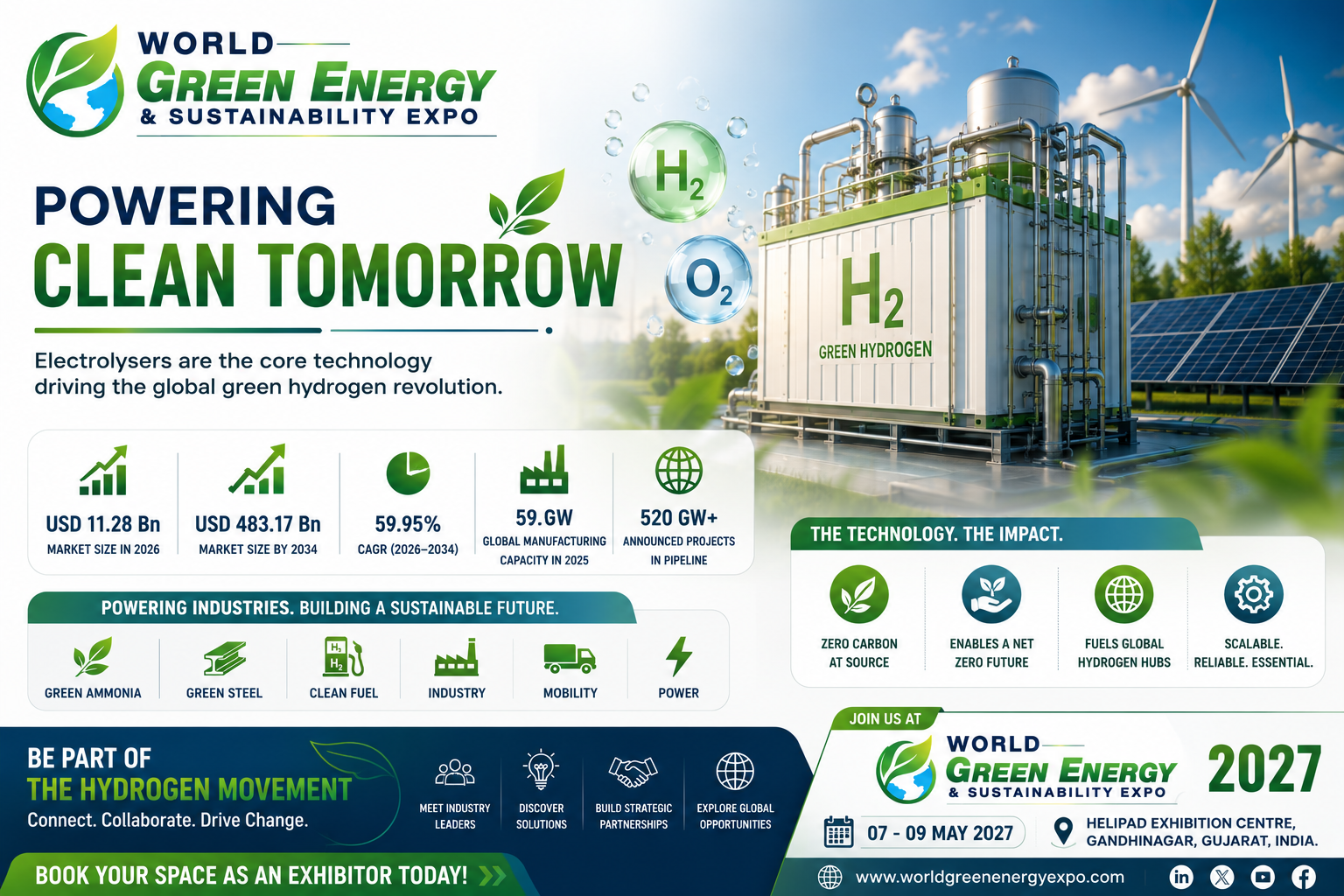
Every tonne of green hydrogen ever produced came from one device. Every tonne of green ammonia, green methanol, or green steel that will ever be made will trace its origin to the same device. Every green hydrogen hub – in Gujarat, in Kakinada, in Oman, in Saudi Arabia, in Rotterdam, in Texas – is built around a core of this same technology. That device is the electrolyser.
Understood simply, an electrolyser does one thing: it passes electricity through water and splits it into hydrogen and oxygen. When that electricity comes from solar panels or wind turbines, the hydrogen produced carries zero carbon emissions from source to output. It is the fundamental enabling technology of the entire green hydrogen economy – the point at which renewable electricity becomes a storable, transportable, industrial-scale clean fuel.
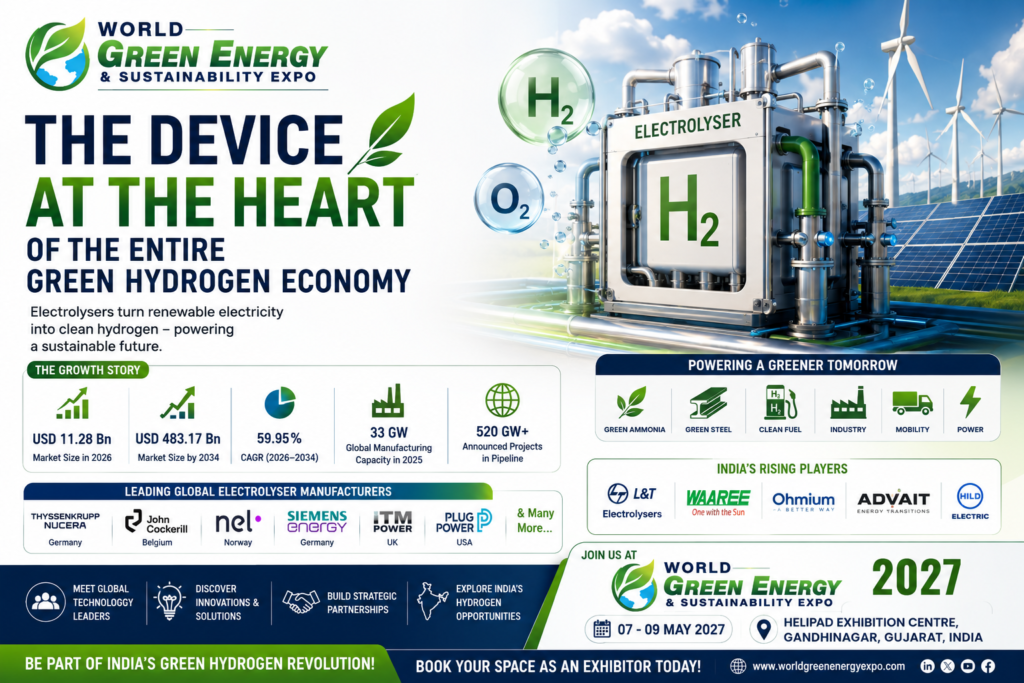
And the market for electrolysers is growing at a pace that makes almost every other clean energy technology look gradual by comparison. The global electrolysers market is projected to grow from USD 11.28 billion in 2026 to USD 483.17 billion by 2034, exhibiting a CAGR of 59.95% over the forecast period. The market size was USD 7.61 billion in 2025. The global electrolysers market is projected to reach USD 14.48 billion by 2031 from USD 2.08 billion in 2025, registering a CAGR of 38.2%. The expansion of renewable energy deployment, national hydrogen mission programs, and the rising integration of green power into industrial and mobility applications are driving growth.
The variance across these figures reflects genuine methodological differences – some research houses include only electrolyser hardware, others include balance of plant, engineering services, and downstream infrastructure. What is consistent across every credible source is the direction and the growth rate – this is among the fastest-expanding technology markets in the entire clean energy sector.
Global manufacturing capacity reached approximately 33 GW per year by 2025 and is projected to hit 50-plus GW by 2030, with China leading at approximately 25 GW of annual manufacturing capacity. According to the International Energy Agency, announced global electrolyser projects reached nearly 520 GW in pipeline capacity by late 2024.
For electrolyser manufacturers, component suppliers, membrane and catalyst producers, power electronics companies, engineering contractors, and the industrial companies evaluating hydrogen procurement, this article gives you the complete picture of where this market stands in 2027, which technologies are winning, which companies are leading, and what the procurement opportunity looks like across every major geography.
The Four Electrolyser Technologies – A Plain-Language Guide to What Actually Matters
The electrolyser market is frequently described in ways that assume prior technical knowledge that most commercial audiences – buyers, investors, and policy decision-makers – do not have. Before examining the market, it is worth establishing clearly what each technology does, how it differs from the others, and why those differences translate into commercial advantages and disadvantages in specific applications.
Alkaline Water Electrolysis (AWE) – The Proven Industrial Standard
Alkaline Electrolyser: The most well-established type of electrolyser is alkaline – the most robust and least expensive of the types. It uses a liquid alkaline solution, usually potassium hydroxide, as an electrolyte for the production of hydrogen and oxygen. They became popular in the industrial world because these devices have high durability and suit continuous operation. AWE achieves approximately 65 to 75% efficiency on a higher heating value system level basis, mature and cost-effective for large-scale deployment.
Alkaline electrolysers are the technology that industrial hydrogen production has relied on for over a century. Their advantages are straightforward: they are robust, durable, manufactured at scale, and significantly cheaper per kilowatt of installed capacity than alternatives. They do not require expensive platinum group metals – the iridium and platinum that PEM systems depend on – which removes both a cost constraint and a supply chain vulnerability.
Their primary limitation is response time. Alkaline electrolysers generally require several minutes to reach steady-state operation and usually operate within a narrower load range, commonly 20 to 40% minimum load, making them less well suited for direct coupling with highly variable wind and solar power without energy storage intermediation. The traditional alkaline electrolyser is the dominating segment in the market share of 91.93% in 2026. The traditional alkaline electrolyser sector remains a leading part of the market because of its affordability, extended operational life, adaptability, and well-established technological foundation.
For large-scale green ammonia projects – where continuous, high-utilisation electrolyser operation is the economic foundation of project bankability – alkaline electrolysis is the technology of choice. The AM Green Kakinada project, the ACME Oman project, and Saudi Arabia’s NEOM HELIOS facility all use alkaline technology for exactly this reason.
Proton Exchange Membrane (PEM) Electrolysis – Speed, Flexibility and Purity
Unlike alkaline systems, PEM electrolysers offer rapid dynamic response – startup in seconds – higher energy density, and superior performance under volatile power inputs from wind and solar. PEM electrolysers can ramp from standby to near full load within seconds and typically support a wide turndown ratio, often approximately 5 to 100%, making them well suited for direct coupling with highly variable wind and solar power. PEM electrolysers are capable of delivering very high hydrogen purity directly from the stack; under appropriate system configuration, output purity can reach up to 5.0 grade – 99.999%.
PEM achieves approximately 60 to 70% efficiency at system level, with high purity output and flexible operation. The commercial case for PEM is strongest in applications requiring fast response to variable renewable power inputs, high hydrogen purity without downstream purification, and compact, modular, containerized system configurations. Hydrogen refueling stations, grid-balancing applications, and smaller distributed hydrogen production facilities all favor PEM for these reasons.
The constraint that limits PEM’s cost competitiveness at the largest scales is its dependence on platinum group metals. Proton exchange membrane electrolysis depends heavily on critical and scarce materials, such as platinum, titanium, and iridium, which are essential for maintaining performance under highly oxidative conditions on the anode side. The reliance on these platinum group metals not only elevates production expenses but also constrains scalability due to their scarcity and geographically concentrated supply.
In terms of technology, the Proton Exchange Membrane segment is expected to contribute 38.4% share of the market in 2026, owing to its flexibility in design and operation. PEM Water Electrolyser Market size was valued at USD 8.37 billion in 2025 and is set to exceed USD 17.25 billion by 2035, expanding at over 7.5% CAGR during the forecast period.
Research is advancing rapidly on reducing or eliminating platinum group metal requirements in PEM systems. Research and development activities are exploring the applications of improved membrane technologies and materials, such as platinum group metal alternatives. Success in this area would fundamentally improve PEM’s cost competitiveness at gigawatt scale and remove the supply chain risk that currently limits its deployment in the largest projects.
Solid Oxide Electrolysis Cells (SOEC) – High Efficiency at High Temperature
Solid oxide electrolysers operate at very high temperatures and achieve efficiency with the use of solid ceramic as an electrolyte. Industry is where these electrolysers find the most suitable application, as waste heat is then available and can be used for the supply of electrolysis energy. Emerging technology still holds promise for large-scale hydrogen production with minimal energy losses. However, their high operating temperatures and the cost of materials still limit their wider application today, although research is being pursued to address these challenges.
SOEC achieves approximately 80 to 90% efficiency with heat input, making it the most electrically efficient of all electrolyser technologies. Sunfire has reported SOEC efficiency levels of around 84%. SOEC’s extraordinary efficiency advantage is meaningful only when waste heat is available – because the technology requires heat input at 650 to 850 degrees Celsius to operate. In industrial settings where that waste heat exists – steel plants, refineries, chemical facilities, cement works – SOEC is potentially the most economic green hydrogen production route available, because it converts a larger fraction of each unit of electricity into hydrogen compared to any other technology.
The solid oxide electrolyser is projected to dominate the growth during the electrolyser market forecast period. The high operating temperatures of Solid Oxide Electrolysers lead to higher hydrogen production efficiency. The growing demand for hydrogen as a clean and adaptable energy carrier in the industrial sector was driving the use of Solid Oxide Electrolysers.
The solid oxide electrolysis segment is expected to register the highest growth with a CAGR of 31.7%, driven by its substantially higher electrical efficiency compared to conventional electrolysers, its ability to operate in co-electrolysis mode, and its compatibility with waste heat integration from the exothermic Haber-Bosch ammonia synthesis loop that improves overall system efficiency by 20 to 30%.
Anion Exchange Membrane (AEM) – The Emerging Low-Cost Hybrid
AEM technology is emerging as a cost-efficient alternative for small-to-medium-scale hydrogen production, offering a balance between the low cost of alkaline systems and the flexibility of PEM systems, making them suitable for decentralized and small-scale hydrogen production. AEM achieves approximately 60 to 70% efficiency at system level, positioning as a low-cost hybrid between alkaline and PEM technologies.
AEM uses an anion exchange membrane rather than liquid electrolyte, enabling operation without the corrosive potassium hydroxide solution that alkaline systems require, while also avoiding the expensive platinum group metals that PEM depends on. The technology is genuinely promising but at an earlier commercial maturity stage than the three technologies above. Companies including Enapter are building commercial AEM products for the distributed, small-scale hydrogen market – a segment where neither large alkaline systems nor expensive PEM are optimal.
The Global Electrolyser Market – Key Statistics for 2027
The headline numbers across different research houses vary significantly – reflecting both genuine methodological differences and the extraordinary pace at which this market is evolving. The most useful approach is to look at consistent patterns across sources rather than anchoring on any single figure. Electrolyser manufacturing capacity doubled in 2023 to 25 GW per year, with China commanding 60% of global capacity and Europe reaching 10.6 GW by May 2025.
Leading industry giants ThyssenKrupp Nucera, Siemens Energy, Nel ASA, John Cockerill Hydrogen, Plug Power, and ITM Power dominate the competitive landscape, collectively representing over 60% of market concentration globally. Europe holds 35% of the global hydrogen electrolyser market share, supported by strong policy mandates and deep integration of renewable energy sources. Germany, France, and the Netherlands lead with high-profile green steel and renewable integration projects.
The Asia-Pacific electrolyser market size is exhibited at USD 21.29 billion in 2025 and is projected to be worth around USD 258.10 billion by 2035, growing at a CAGR of 28.34% from 2026 to 2035. The cost trajectory is where the most commercially significant data sits.
The electrolyser stack represents 58.3% of total CAPEX, while the Balance of Plant – including thermal management and power electronics – accounts for 30% of system cost.
The commissioning of over 150 GW of electrolyser capacity globally by 2030, as announced in national hydrogen strategies across Europe, Asia-Pacific, and North America, is underpinning a sustained growth trajectory for the entire electrolyser value chain – from stack manufacturers through component suppliers to engineering contractors.
India’s Electrolyser Market – The SIGHT Program Opportunity
India’s electrolyser market is being shaped primarily by the SIGHT program under the National Green Hydrogen Mission, which has created the most structured and largest single domestic electrolyser manufacturing development program outside China and the European Union.
In January 2025, India dedicated a budget of around USD 513.7 million to support the manufacturing capacity of up to 3 GW per year of electrolysers through two tender rounds of 1.5 GW each. As of May 2025, 15 firms carry awards for 3,000 MW of annual electrolyser manufacturing capacity under SIGHT. Scheduled commercial dates under Tranche 1 run from August 2026 and under Tranche 2 from March 2027.
The strategic logic of the SIGHT electrolyser manufacturing incentive is clear and commercially significant. India currently imports the vast majority of its electrolyser equipment – primarily from China and Europe – meaning that every green hydrogen project adds to the country’s import bill and exposes project costs to currency risk and supply chain disruptions. Building a domestic manufacturing base reduces project capital costs, reduces import dependency, and creates a domestic supply chain that serves both India’s own project pipeline and potential export markets across South Asia and Southeast Asia.
Three port facilities have been designated as Green Hydrogen Hubs – Deendayal Port in Gujarat, V.O. Chidambaranar Port in Tamil Nadu, and Paradip Port in Odisha – providing the export infrastructure that gives India’s electrolyser manufacturers a clear sight line to international markets alongside domestic demand.
The Global Electrolyser Manufacturers – Who Is Building This Industry
ThyssenKrupp Nucera (Germany) – Industrial Scale Alkaline Leader
ThyssenKrupp Nucera is a major player in the electrolyser market specializing in high-efficiency alkaline electrolysers with a strong focus on large-scale hydrogen production. With over 600 electrolysis projects globally and more than 10 GW installed, the company is a global leader in chlor-alkali electrolysis technology.
ThyssenKrupp Nucera specializes in large alkaline electrolysis plants for industrial hydrogen, with experience in integrated plant engineering and delivering multi-MW to GW projects. In June 2025, ThyssenKrupp Nucera completed the acquisition of key technology assets including IP and a test facility from Green Hydrogen Systems, strengthening its capabilities in pressurized alkaline water electrolysis up to approximately 35 bar.
ThyssenKrupp Nucera’s lineage stretches back through its predecessor Uhde Chlorine Engineers – formerly a joint venture between Industrie De Nora and ThyssenKrupp – to over 60 years of electrochemical plant engineering experience. That depth of experience in industrial electrolysis at scale is precisely what the largest green ammonia and green hydrogen production facilities require, and it is why ThyssenKrupp Nucera consistently appears in the supply chain of the world’s most ambitious green hydrogen projects.
John Cockerill Hydrogen (Belgium) – The Pressurized Alkaline Specialist
John Cockerill Hydrogen brings decades of hydrogen experience and focuses on pressurized alkaline electrolysers and turnkey solutions including balance of plant and hydrogen gas treatment. The company targets industrial customers such as ammonia, refining, and heavy industry with packaged, high-pressure systems.
John Cockerill is known as the best in pressurized alkaline electrolyser manufacturers. John Cockerill’s 5 MW single-stack pressurized commercial electrolyser is described as the largest on the market and a must for low CAPEX and OPEX. The company also builds hydrogen refueling stations with capacities from 100 to 1,000 kg suitable for light and heavy-duty applications. In June 2025, John Cockerill expanded its hydrogen business with a USD 134.5 million capital increase, aimed at scaling up production capacity and accelerating the global deployment of its next-generation pressurized alkaline electrolysers.
John Cockerill’s most commercially significant recent move is its direct presence in India through its landmark supply agreement for the AM Green Kakinada project. On 30th October 2024, AM Green placed an order with John Cockerill for the supply of India’s largest electrolyser order of 1.3 GW for one of the world’s largest green hydrogen ammonia projects.
This is not simply a supply contract – John Cockerill is establishing an electrolyser manufacturing factory in Kakinada alongside the project it is supplying, creating an industrial co-location model that positions it directly in the Indian electrolyser manufacturing market for the long term. For WGES 2027 attendees in the green hydrogen space, John Cockerill is one of the highest-value international technology companies actively investing in India’s electrolyser ecosystem right now.
John Cockerill achieved approximately 1 GW of annual manufacturing capacity post-acquisitions in 2025, having acquired McPhy assets that expanded its technology range and European manufacturing footprint. In April 2025, John Cockerill signed a Memorandum of Understanding with The Green Solutions Group in Vietnam to supply pressurized alkaline electrolysers and jointly develop green hydrogen and ammonia projects, strengthening its regional presence in Asia.
Nel ASA (Norway) – Nearly a Century of Electrolysis Experience
Nel ASA has been pioneering renewable hydrogen for almost a century. Nel ASA is a globally recognized leader in alkaline and PEM water electrolysis technologies and makes electrolysers for industry, Power-to-X, transport, and other applications. In March 2025, Nel Hydrogen US received a purchase order for one 2.5 MW containerized PEM unit for the Aberdeen Hydrogen Hub project in the north-east of Scotland – a scalable green hydrogen production, storage and distribution facility powered by renewable energy, delivered through a joint venture between bp and Aberdeen City Council.
On 27th March 2025, Nel Hydrogen US received a purchase order for PEM electrolyser stacks worth USD 6 million from Collins Aerospace. These hydrogen stacks will be used by the US Navy to produce oxygen for critical life support for onboard submarines. On 21st March 2025, Nel Hydrogen US announced it received a purchase order for two MC500 containerized PEM electrolysers each with 2.5 MW capacity totaling 5 MW capacity, valued at USD 7 million, to produce hydrogen for a new steel mill in the United States.
Nel’s diversification across defence, industrial, and renewable energy applications – and across both alkaline and PEM technologies – gives it a resilience that pure-play green hydrogen equipment companies lack.
Siemens Energy (Germany) – The PEM Powerhouse
Siemens Energy focuses on PEM electrolysis with approximately 500 MW of annual manufacturing capacity and strong integration with renewable energy systems through its Silyzer product line. Its collaboration with BASF on industrial-scale electrolysis is among the most commercially significant partnerships in the European green hydrogen industry. In March 2025, BASF revealed the commissioning of a 54 MW water electrolyser built in collaboration with Siemens Energy. The electrolyser has an annual production capacity of 8,000 metric tonnes of hydrogen — making it one of the largest single PEM electrolyser installations in the world at the time of commissioning.
The Hamburg Green Hydrogen Hub is developing a green hydrogen electrolysis facility with a capacity of 100 MW at the previous Moorburg coal site. Siemens Energy will provide and set up six electrolyser units for this hub. Construction commenced in 2025, with complete operation anticipated by 2027, generating 10,000 tonnes of green hydrogen each year.
ITM Power (United Kingdom) – The Modular PEM Pioneer
A UK pioneer in PEM electrolysis, ITM Power develops modular PEM systems suited for grid-interactive and industrial use, from small containerized units to multi-MW modules. ITM’s product portfolio targets rapid ramping and integration with variable renewables. In May 2025, ITM Power announced that the company had signed an agreement with a customer, confirming the selection as the supplier of over 300 MW of electrolysers to produce green hydrogen for use in a power plant in the Asia Pacific region, thereby avoiding carbon emissions.
A 300 MW single-customer order for ITM Power is transformative – it moves the company from primarily demonstrating technology at the tens-of-megawatt scale to delivering at the scale that large power and industrial projects genuinely require. It is a signal that PEM technology has crossed the threshold of commercial confidence for projects that previously defaulted to alkaline as the only proven option at scale.
Plug Power (USA) – From Fuel Cells to Full Green Hydrogen Stack
Originally known for fuel cells, Plug Power has aggressively diversified into green hydrogen production, developing PEM electrolysers and securing multi-GW supply deals and partnerships. In October 2025, Plug Power delivered its first 10 MW GenEco PEM electrolyser to Galp’s Sines Refinery in Portugal, marking the start of Europe’s largest 100 MW PEM project and enabling significant refinery decarbonization with an estimated 110,000 tonnes of CO2 reduction per year.
In May 2025, Plug Power’s hydrogen plant in Woodbine, Georgia produced 300 metric tonnes of liquid hydrogen in April 2025 – the facility’s highest monthly output to date and a new benchmark for the US hydrogen industry.
Sungrow Hydrogen (China) – The Solar-to-Hydrogen Integrator
Sungrow Hydrogen is identified as a Tier 1 manufacturer based on existing and planned capacity up to 2030, alongside LONGi, ThyssenKrupp Nucera, PERIC, John Cockerill, and Plug Power. Sungrow Hydrogen is the electrolyser arm of Sungrow Power Supply – the world’s third-largest BESS integrator and one of the leading solar inverter manufacturers. This corporate positioning gives Sungrow Hydrogen a unique advantage: it can offer integrated solar-to-hydrogen systems combining its own inverter technology, power conversion systems, and electrolyser equipment – eliminating the interface engineering that buyers must manage when sourcing components from separate suppliers.
In January 2025, Sungrow Hydrogen signed an agreement to supply water electrolysis equipment for ACME’s 320 MW green ammonia project in Oman, with deliveries set for completion in 2025. The project is expected to begin operations in 2026 and will initially produce 300 tonnes of green ammonia per day. This Oman contract – with an Indian developer for a Middle Eastern production facility targeting export markets – exemplifies the genuinely international nature of the green hydrogen supply chain that is forming right now.
LONGi Hydrogen (China) – The Solar Giant Enters Electrolysis
LONGi – the world’s second-largest solar module manufacturer – entered the electrolyser business with the same vertical integration logic it applied to solar manufacturing: control the core technology, achieve manufacturing scale, reduce costs through volume, and establish leadership in a market before conventional equipment companies recognise the threat. LONGi is identified as a Tier 1 electrolyser manufacturer based on existing and planned capacity up to 2030. Its alkaline electrolyser products benefit from LONGi’s deep manufacturing capability, supply chain management experience, and access to solar generation assets that provide both renewable power supply and commercial credibility with clean energy project developers.
Sunfire (Germany) – The SOEC Specialist
Sunfire focuses on high-temperature solid oxide electrolysis and also supplies PEM and alkaline solutions via partnerships. Its SOEC approach targets high electrical-to-hydrogen efficiency, especially when integrated with waste heat or industrial heat sources, making it attractive for certain industrial decarbonization pathways. In April 2023, Sunfire declared the successful installation of the world’s first SOEC electrolyser in the Netherlands – a multi-megawatt high-temperature electrolyser aimed at boosting the green hydrogen production in the country through Neste’s renewable products refinery in Rotterdam.
Sunfire’s SOEC technology has a compelling value proposition for heavy industry – where waste heat is available and where the 20 to 30% improvement in electricity-to-hydrogen efficiency that SOEC delivers versus alkaline or PEM represents a direct reduction in operating cost that compounds over decades of project life. As industrial decarbonization moves from pilot to commercial scale, Sunfire is positioned to capture the most technically demanding segment of the electrolyser market.
Enapter (Germany/Italy) – The AEM Pioneer
Enapter AG is pioneering anion exchange membrane electrolysers, which offer a balance between the low cost of alkaline systems and the flexibility of PEM systems, making them suitable for decentralized and small-scale hydrogen production. Enapter’s standardized, modular, stackable AEM electrolyser design – where customers scale hydrogen production capacity by adding standard modules rather than commissioning bespoke large systems – is uniquely suited to the distributed, on-site hydrogen production market. Its approach to electrolyser design is analogous to what containerized data centres did for computing infrastructure: replacing expensive, bespoke, site-specific installations with scalable, standardized, plug-and-play units.
Bloom Energy (USA) – The SOEC Wild Card
Bloom Energy focuses on SOEC high-temperature electrolysis, achieving 80 to 90% efficiency with heat input, with approximately 500 MW of annual manufacturing capacity. Its approach uses reversible fuel cell technology – the same hardware that generates electricity from hydrogen can also consume electricity to produce hydrogen – making it attractive for grid-balancing and industrial energy management applications.
HydrogenPro ASA (Norway) – High-Pressure Alkaline for Large Projects
HydrogenPro designs and supplies advanced hydrogen production plants which are adaptable for seamless integration, scalable to site requirements, and tailored to clients’ needs. HydrogenPro’s high-pressure electrolysis system is known as one of the top green hydrogen producers with outstanding energy efficiency. On 3rd March 2025, HydrogenPro received a 100 MW electrolyser unit order from ANDRITZ for its project in Germany.
India’s Domestic Electrolyser Manufacturers – Building the National Supply Chain
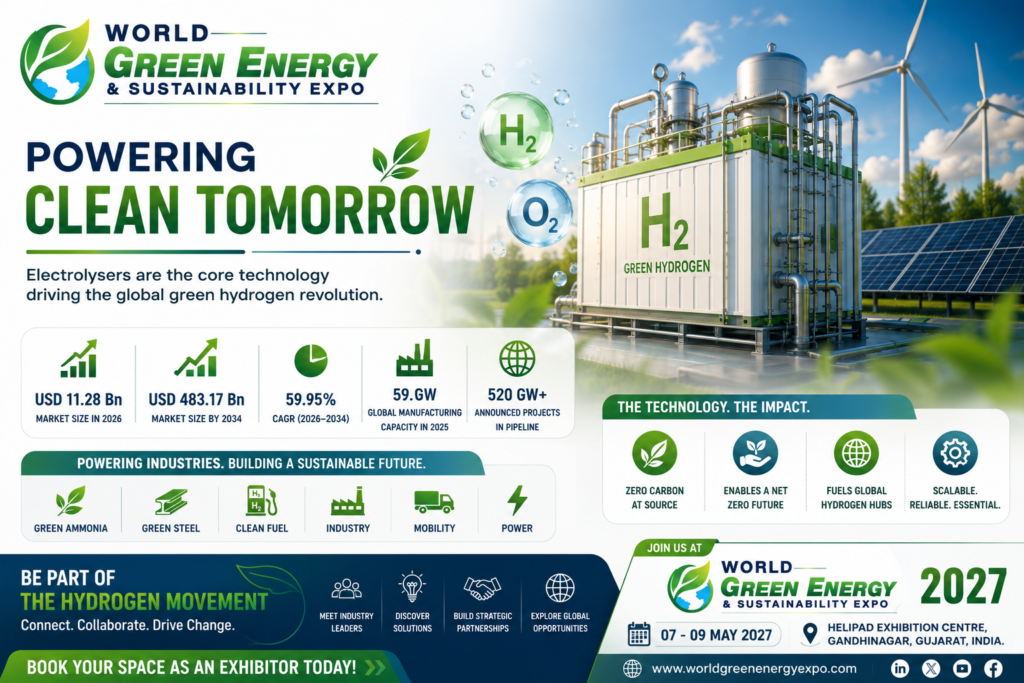
India’s electrolyser manufacturing ecosystem is developing rapidly under the SIGHT program’s incentive framework, with a mix of established industrial companies, solar manufacturers diversifying into hydrogen, and international companies establishing Indian manufacturing through joint ventures and technology licensing.
L&T Electrolysers Limited – India’s First Domestic Electrolyser Manufacturer
L&T Electrolysers Ltd is India’s first Indian electrolyser manufacturer with alkaline electrolyser technology, meeting domestic and international market needs. McLyzer electrolysers manufactured by L&T Electrolysers Ltd at the state-of-the-art electrolyser manufacturing facility in Hazira, Gujarat are based on a license from McPhy Energy. McLyzer Electrolyser is an alkaline-based technology that provides flexibility and thermal stability. It delivers product excellence by operating in hot standby mode for extended durations and rapidly reaching full load within 30 seconds.
In July 2025, L&T incorporated Panipat Green Hydrogen Private Limited, a wholly-owned subsidiary dedicated to large-scale green hydrogen and clean ammonia projects in India. In June 2025, L&T secured land in Kandla, Gujarat – the industrial port city that sits within the Deendayal Port Authority’s broader logistics cluster and adjacent to the designated Green Hydrogen Hub area.
L&T’s entry into electrolyser manufacturing brings the most formidable engineering and project delivery organization in India into the green hydrogen supply chain – with the balance sheet, engineering depth, and supply chain management capability that no pure-play hydrogen startup can match.
Waaree Energies – From Solar to Hydrogen
In the recent SECI auction, Waaree Energies won an electrolyser manufacturing capacity of 300 MW of the 1.1 GW tender based on any stack technology. On 10th February 2025, Waaree Group announced the groundbreaking ceremony for its Electrolyser Manufacturing Facility in Valsad, Gujarat. Waaree’s move into electrolyser manufacturing is strategically coherent – it is India’s largest solar module manufacturer, with direct access to the renewable electricity generation that powers electrolysers, and now adding the electrolyser manufacturing capability to potentially offer integrated solar-plus-electrolyser packages to green hydrogen project developers. Its Valsad facility in Gujarat places it geographically at the centre of India’s green hydrogen hub infrastructure.
Ohmium International – The PEM Pioneer in India
In July 2024, Ohmium International announced the launch of its new gigafactory in Doddaballapura, India. This next-generation manufacturing facility aims to ship around 2 gigawatts of fully assembled and tested electrolyser systems across the world. In June 2025, Ohmium signed an MoU with Toyota Kirloskar Motor to explore green hydrogen project opportunities in India that will integrate Toyota’s fuel cell modules with Ohmium’s PEM electrolysers. In March 2025, Ohmium partnered with Res Integra to deploy a 4 MW green hydrogen project in Sicily using Ohmium’s PEM electrolyser system. In April 2024, Ohmium announced a joint venture with Tata Projects to develop green hydrogen projects in India.
Ohmium’s Doddaballapura gigafactory – with a 2 GW annual shipping target – would make it the largest PEM electrolyser manufacturing facility in India and one of the largest in the world, bringing India into the global PEM manufacturing landscape alongside European and American producers.
Advait Energy Transitions – Technology Transfer from China
On 14th August 2024, Advait signed a technology licensing agreement with China’s Guofu Hydrogen Energy Equipment. Under this agreement, GuoFu Hydrogen will provide Advait with critical technical documentation, know-how, and training for alkaline-based electrolyser technology. Advait will use Guofu Hydrogen’s advanced technology to manufacture and assemble equipment for green hydrogen production in India. The agreement was signed to manufacture 300 MW electrolysers annually, planned to further expand to 1,000 MW per year.
Hild Electric – The NTPC Supplier
In 2023, Hild Electric gained popularity after being awarded a contract by NTPC to manufacture and deploy 600 MW of alkaline electrolysers – making it one of the largest single electrolyser supply contracts awarded to an Indian domestic company and establishing Hild as a significant player in the national electrolyser manufacturing landscape.
The Cost Reduction – How Electrolyser Economics Are Changing
Cost reduction in electrolysers is the central commercial narrative of this industry – and for good reason. The cost of green hydrogen is primarily determined by two inputs: the cost of renewable electricity and the capital cost of the electrolyser. Both are falling, and the rate of decline is accelerating as manufacturing scale increases.
The worldwide electrolyser manufacturing capacity crossed 25 GW annually by 2023, nearly double what it was in 2022. To meet the net-zero emission by 2050 target, the installed electrolysis capacity is expected to reach 560 GW by 2030. The doubling of manufacturing capacity within a single year – from approximately 12 GW in 2022 to 25 GW in 2023 – is precisely the kind of scale inflection that triggers meaningful cost reduction through manufacturing learning curves. Solar module manufacturing followed a similar trajectory between 2008 and 2012, with costs falling by 75% as Chinese gigafactories came online. The electrolyser industry is earlier in that curve, which means the most dramatic cost reductions are still ahead.
The balance of plant cost – the power electronics, thermal management, gas purification, control systems, and civil infrastructure that surround the electrolyser stack – is as important as stack cost for overall system economics. The electrolyser stack represents 58.3% of total CAPEX, while the Balance of Plant including thermal management and power electronics accounts for 30% of system cost. The remaining approximately 12% covers engineering, installation, and commissioning costs.
This cost structure has direct implications for the competitive landscape: companies that can reduce balance-of-plant costs through smart system integration, standardized packaging, and digital control systems – rather than only competing on stack technology – have a meaningful route to differentiation even as stack costs converge across manufacturers.
The Technology Comparison – Choosing the Right Electrolyser for Your Application
For industrial buyers, project developers, and procurement engineers evaluating electrolyser technology for specific applications, the technology choice matters more than the brand choice in most cases. Here is the honest framework.
Choose alkaline electrolysis when: you are developing a large-scale, continuous-operation facility such as a green ammonia plant, a large hydrogen-for-refinery project, or a green steel direct reduction installation. You need the lowest capital cost per kilowatt, proven durability over decades, and do not require rapid response to variable power inputs – or you have storage that manages the power variability for you.
Choose PEM electrolysis when: your renewable power input is highly variable and you cannot afford the energy waste of an alkaline system sitting at minimum load while solar or wind output varies. You need high hydrogen purity without downstream purification. Your project requires a compact, containerised system configuration. Or your project is in a market where platinum group metal supply risk is manageable.
Choose SOEC when: you are co-locating hydrogen production with a high-temperature industrial process that generates waste heat – a steel plant, refinery, cement facility, or chemical plant. The 20 to 30% improvement in electrical efficiency that SOEC delivers in this context directly reduces operating cost and improves project economics in ways that neither alkaline nor PEM can match.
Choose AEM when: you are developing distributed, small-to-medium scale hydrogen production. You want to avoid both the liquid electrolyte management of alkaline systems and the platinum group metal cost of PEM. Your project is early-stage and you want a modular technology that can scale incrementally as demand develops.
The Challenges – What Every Electrolyser Company Must Navigate in 2027
The electrolyser industry’s extraordinary growth trajectory coexists with genuine structural challenges that affect every company in this value chain.
Critical materials and supply chain concentration. PEM electrolysis depends heavily on critical and scarce materials such as platinum, titanium, and iridium. Both platinum and iridium are among the most resource-intensive and emission-heavy metals to produce, and their supply is geographically concentrated in South Africa and Zimbabwe, creating supply chain risk for any manufacturer scaling PEM production rapidly.
Project pipeline versus actual deployment gap. The 520 GW of announced global electrolyser project pipeline stands in significant contrast to the approximately 1.4 GW of installed dedicated hydrogen production capacity confirmed by the IEA as of 2023. Converting the announced pipeline into commissioned projects depends on cost reductions, off-take agreements, and grid connectivity that are still maturing in most markets.
Skilled workforce shortage. Every large electrolyser project requires engineers, technicians, and operators with specific electrochemical and hydrogen safety expertise that the global workforce does not yet have at the scale the industry needs.
Permitting and grid connection delays. Green hydrogen projects that require dedicated renewable energy supply face the same grid connection delays that affect standalone solar and wind projects – adding months or years to project timelines that directly affect the economics of projects financed with time-sensitive capital.
Why World Green Energy & Sustainability (WGES) Expo 2027 Is the Platform Where the Electrolyser Industry Meets India
The electrolyser market is, more than almost any other clean energy technology market, a relationship-driven business. Projects are large, contracts are long-term, and the technical due diligence required to select an electrolyser supplier – across technology type, stack efficiency, system integration, warranty terms, and service network capability – requires sustained, face-to-face engagement between buyers and suppliers.
India’s electrolyser procurement pipeline – 3,000 MW of SIGHT-awarded manufacturing capacity coming online from August 2026, 862,000 tonnes of SIGHT-awarded green hydrogen production capacity in development, and India’s largest electrolyser order of 1.3 GW already placed for the AM Green Kakinada project – represents the most concentrated single-country electrolyser procurement opportunity in Asia outside China right now.
Gujarat sits at the absolute centre of this opportunity. L&T’s electrolyser manufacturing facility is in Hazira, Gujarat. Waaree’s electrolyser facility is in Valsad, Gujarat. The Deendayal Port Green Hydrogen Hub is in Gujarat and World Green Energy & Sustainability (WGES) Expo 2027 is in Gandhinagar, Gujarat – directly connecting every international electrolyser manufacturer seeking Indian market entry with every Indian project developer, engineering contractor, and green hydrogen production company building the facilities that will need their technology.
For ThyssenKrupp Nucera, John Cockerill, Nel ASA, Siemens Energy, ITM Power, Sungrow Hydrogen, and LONGi Hydrogen like companies seeking to build commercial relationships with India’s growing green hydrogen developer community – World Green Energy & Sustainability (WGES) Expo 2027 is the most efficient single platform for doing so.
For L&T Electrolysers, Waaree, Ohmium, Hild Electric, and Advait Energy Transitions like companies seeking to demonstrate their products, attract project developer customers, and establish international technology partnerships – World Green Energy & Sustainability (WGES) Expo 2027 is the platform where India’s green hydrogen industry meets globally.
World Green Energy & Sustainability (WGES) Expo 2027 in Gandhinagar, Gujarat, is your fastest and most direct route to those relationships.
Register as an exhibitor at the World Green Energy & Sustainability (WGES) Expo 2027 today. Secure your position in front of India’s most active solar buyers, developers, investors, and policymakers – all in one place, at the moment the market is moving fastest.
For more details: contact us at info@adexexhibitions.com | +91 81770 53335 | +91 91528 96078
For Exhibitor Registration: If you have not registered, you may also fill out this Exhibitor Registration Form.