
The Day India Changed Industrial Chemistry Forever
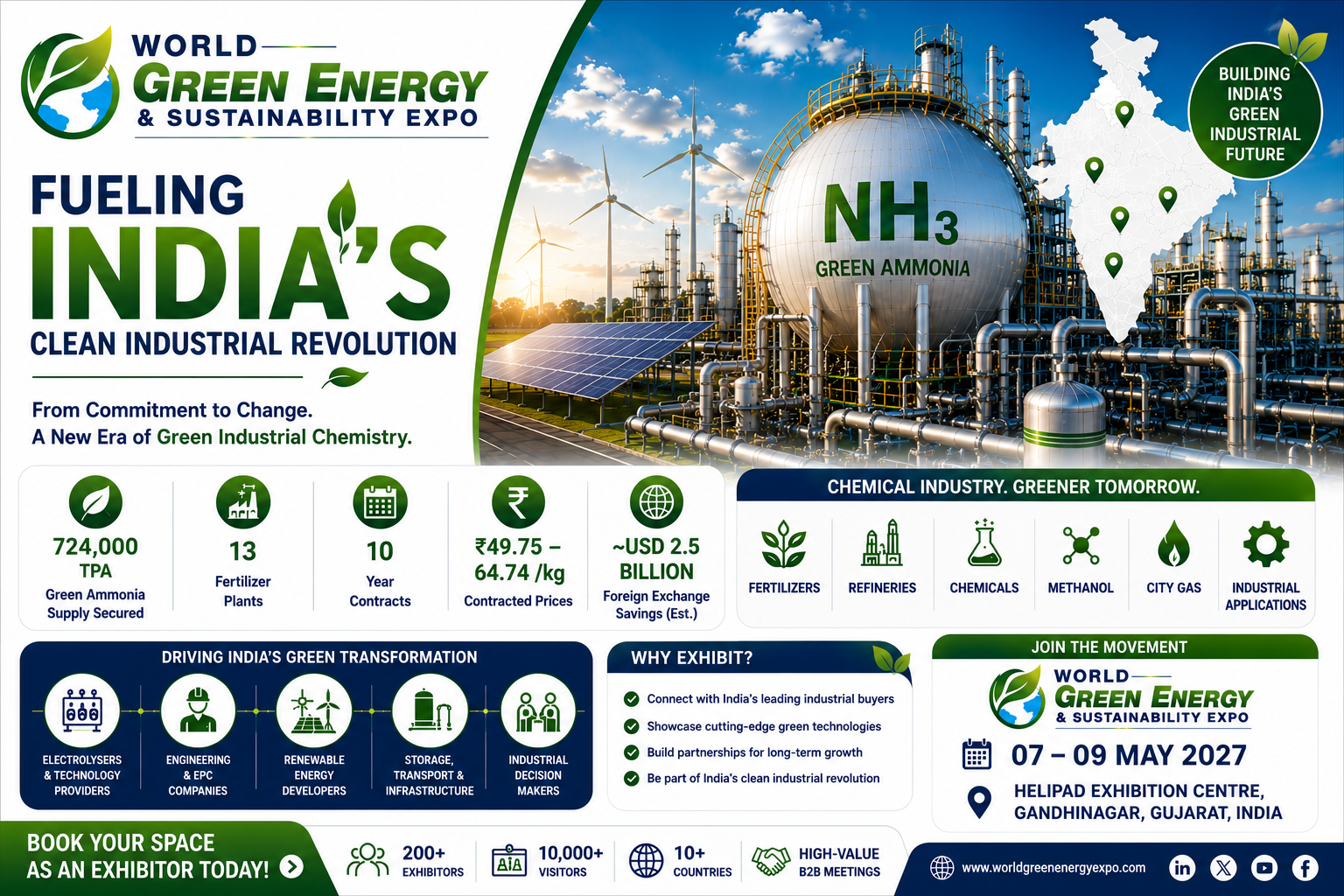
March 30, 2026 will be remembered as a date when India did something the rest of the world had been talking about for years and not really delivering on. At Atal Akshay Urja Bhawan in New Delhi, with Union Minister of New and Renewable Energy Pralhad Joshi and Union Minister of Health, Chemicals and Fertilizers J P Nadda presiding, the Solar Energy Corporation of India sat six private developers down and got them to sign binding, ten-year contracts to supply 724,000 tonnes per year of green ammonia to thirteen fertilizer plants across India.
The prices were, frankly, startling. They came in between INR 49.75 per kilogram and INR 64.74 per kilogram – equivalent to roughly USD 572 and USD 744 per tonne. At the lower end, that is approximately half of what Europe paid in its H2Global auction for equivalent product the previous year. And it came with a government estimate attached: the whole program will save approximately USD 2.5 billion in foreign exchange over the decade by replacing imported grey ammonia with domestically produced green ammonia.
This was not a memorandum of understanding, not a letter of intent, not a feasibility study. These were binding purchase and supply agreements – Green Ammonia Purchase Agreements – between SECI, six private developers, and thirteen fertilizer units, with committed volumes, committed prices, and committed delivery timelines. For India’s fertilizer and chemical industries, this single event marked the transition from green hydrogen as a future aspiration to green hydrogen as a present contractual obligation. For the developers, technology companies, electrolyser manufacturers, engineering contractors, and equipment suppliers serving this market – it marked the opening of one of the largest structured demand corridors for clean industrial molecules anywhere in the world.
Why India’s Fertilizer Industry Is the Most Important Entry Point for Green Hydrogen
To understand why green hydrogen’s transformation of Indian industry begins in fertilizers rather than steel, shipping, or power, you need to understand one fundamental fact about how ammonia and hydrogen relate to each other. Every kilogram of ammonia contains approximately 178 grams of hydrogen.
Every tonne of nitrogen fertilizer – urea, ammonium nitrate, ammonium sulphate, DAP – traces its origin to an ammonia molecule, and every ammonia molecule was synthesized from hydrogen. India’s fertilizer industry consumes approximately six million tonnes of hydrogen annually – effectively all of it grey hydrogen produced from natural gas through steam methane reforming.
Replacing that grey hydrogen with green hydrogen is not a theoretical exercise in industrial chemistry. It is a direct, practical, commercially structured transaction: instead of buying grey ammonia produced from imported natural gas, Indian fertilizer plants buy green ammonia produced from domestic renewable electricity. The Haber-Bosch synthesis chemistry at the fertilizer plant is identical in both cases. The infrastructure for ammonia handling, storage, and conversion to urea or other products is the same. What changes is the carbon footprint and the import bill.
India’s fertilizer sector is unique due to policy-backed green ammonia procurement that directly links clean ammonia supply with fertilizer plant demand. No other sector in the Indian economy has a government-structured demand aggregation mechanism as concrete, as commercially specific, and as immediately actionable as what SECI’s green ammonia tender has created for fertilizers.
India’s current hydrogen consumption stands at around six million tonnes annually, with the fertilizer industry and refineries being the primary consumers. By 2050, the demand for hydrogen is expected to surge to 28 million tonnes, with the goal to meet 80% of this demand with green hydrogen. The fertilizer industry’s importance goes beyond hydrogen consumption alone. India imports approximately 50% of its fertilizer requirements – including large volumes of ammonia and ammonia-based products – spending tens of thousands of crores of foreign exchange annually and creating a significant energy security vulnerability that the government has explicitly described as one of the most important problems green hydrogen can solve.
India’s Press Information Bureau confirmed in June 2025 that SECI’s green ammonia tender covers 724,000 tonnes per year for 13 fertilizer plants. The government expects the shift to green ammonia to lower the fertilizer industry’s carbon footprint, reduce imports of grey ammonia used in non-urea units, and save about USD 2.5 billion in foreign exchange over the next decade.
The March 30, 2026 Signing – Every Detail of India’s Historic Green Ammonia Agreements
The March 30, 2026 signing event at New Delhi deserves detailed coverage because the specific agreements reveal the commercial structure, the pricing, the geography, and the supply chain of India’s green ammonia fertilizer program with a precision that no market forecast can match.
Here is the complete list of agreements as confirmed through official sources and the Ammonia Energy Association’s reporting:
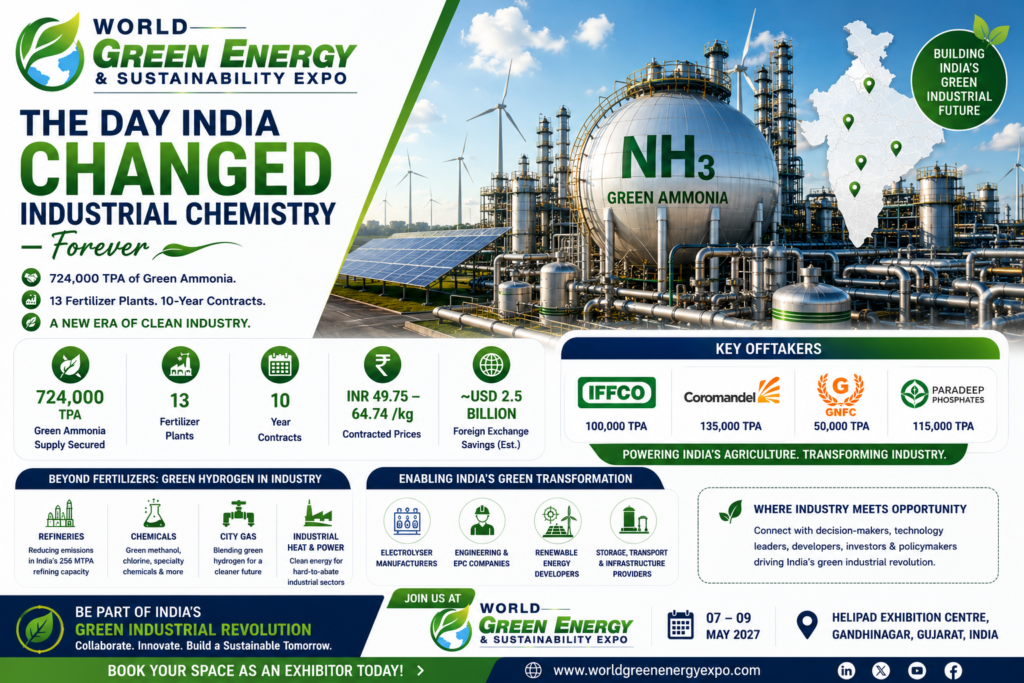
IFFCO, Paradeep (Odisha): 100,000 tonnes per year supplied by ACME Cleantech at INR 49.75 per kilogram – the lowest price in the entire tender, reflecting Odisha’s proximity to ACME’s planned Gopalpur mega-project.
Coromandel International, Kakinada (Andhra Pradesh): 85,000 tonnes per year supplied by Jakson Green and OCIOR at INR 50.75 per kilogram.
Coromandel International, Visakhapatnam (Andhra Pradesh): 50,000 tonnes per year supplied by ACME Cleantech at INR 51.89 per kilogram.
Paradeep Phosphates, Paradeep (Odisha): 75,000 tonnes per year supplied by ACME Cleantech at INR 55.75 per kilogram.
Paradeep Phosphates, Zuarinagar (Goa): 25,000 tonnes per year supplied by ACME Cleantech at INR 62.84 per kilogram.
Paradeep Phosphates, Mangalore (Karnataka): 15,000 tonnes per year supplied by SCC Infrastructure at INR 57.65 per kilogram.
Krishna Phoschem, Meghnagar (Madhya Pradesh): 70,000 tonnes per year supplied by NTPC Renewable Energy at INR 51.80 per kilogram.
Madhya Bharat Agro, Sagar (Madhya Pradesh): 60,000 tonnes per year supplied by Oriana Power at INR 52.25 per kilogram.
Madhya Bharat Agro, Dhule (Maharashtra): 70,000 tonnes per year supplied by SCC Infrastructure at INR 53.05 per kilogram.
GNFC, Bharuch (Gujarat): 50,000 tonnes per year supplied by Onix Renewable at INR 52.50 per kilogram.
Indorama, Haldia (West Bengal): 20,000 tonnes per year supplied by ACME Cleantech at INR 64.74 per kilogram – the highest price in the tender, reflecting Haldia’s distance from major renewable energy production corridors.
Mangalore Chemicals and Fertilizers (Karnataka): 15,000 tonnes per year supplied by SCC Infrastructure at INR 57.65 per kilogram.
ACME alone took approximately half the total volume – 370,000 tonnes per year – across six of the thirteen awards, confirming its position as India’s largest commercial green ammonia developer by committed supply volume.
ACME’s announcement framed the achievement with appropriate emphasis: its Green Hydrogen and Ammonia Business has signed a ten-year binding Green Ammonia Purchase Agreement with SECI for 370,000 tonnes per annum capacity, with an estimated contract value of INR 20,000 crore over the ten-year period. This marks a historic milestone in India’s transition to low-carbon industrial feedstocks in the fertilizer sector. ACME will establish a green ammonia facility in Odisha, supplying to six major fertilizer facilities across India, ensuring long-term demand visibility and supply stability.
Bikesh Ogra, Vice Chairman and Global CEO of Jakson Green, confirmed that SCC Infrastructure has partnered with renewable energy developer InSolare Energy to sign an agreement with SECI for renewable ammonia supply totaling 85,000 tonnes per year across two fertilizer producers, with a total contract value of approximately USD 398 million. Oriana Power through TrueRE has signed a 60,000 tonne, USD 334 million GAPA to supply Madhya Bharat Agro Products.
Taken together, the new agreements cover ten of the thirteen awarded renewable ammonia producers from September 2025. One more GAPA is anticipated, as are firm supply commencement dates. The commercial scale of what was signed on March 30, 2026 is extraordinary: ten-year binding contracts, approximately INR 20,000 crore in committed contract value from ACME alone, covering fertilizer plants spread across Odisha, Andhra Pradesh, Karnataka, Gujarat, Maharashtra, Madhya Pradesh, and West Bengal – geographically spanning essentially the entire Indian subcontinent.
GNFC and Gujarat – The Home State Connection
Of particular significance to the World Green Energy & Sustainability (WGES) Expo 2027 audience is the GNFC agreement – Gujarat Narmada Valley Fertilizers and Chemicals, headquartered in Bharuch, Gujarat – which signed for 50,000 tonnes per year of green ammonia supply from Onix Renewable at INR 52.50 per kilogram. GNFC’s Bharuch complex is one of India’s most integrated chemical manufacturing facilities, producing ammonia, urea, methanol, formic acid, nitric acid, and a range of nitrogen-based chemicals and specialty products. Its green ammonia offtake commitment is not simply a fertilizer story – it is a chemical industry decarbonization story that spans multiple product lines.
GNFC’s participation in India’s first structured green ammonia procurement program signals that Gujarat’s chemical industry – traditionally one of the most energy-intensive in the country – is beginning its transition toward green hydrogen as a feedstock. For the broader Gujarat chemicals ecosystem – including the Dahej and Ankleshwar chemical zones, the Nandesari industrial estate, and the rapidly expanding Dholera Special Investment Region – GNFC’s commitment represents a leading indicator of where chemical industry procurement will move over the coming decade.
For World Green Energy & Sustainability (WGES) Expo 2027 – hosted in Gandhinagar, Gujarat – this connection between the state’s most important chemical company and India’s green hydrogen supply chain is direct and commercially immediate.
IFFCO – India’s Largest Fertilizer Cooperative Leads the Transition
The presence of IFFCO – Indian Farmers Fertilizer Cooperative Limited – as the single largest volume off-taker in the SECI green ammonia tender carries significance that goes well beyond the 100,000 tonnes per year of supply it has contracted. IFFCO is not merely a fertilizer company. It is the world’s largest fertilizer cooperative, the backbone of agricultural input supply to India’s 150 million farming households, and one of the most politically and economically significant institutions in Indian agriculture. When IFFCO commits to green ammonia procurement under a ten-year binding agreement, it is not making an experimental gesture toward sustainability – it is making a structural procurement decision that will influence the agricultural input supply chain for the rest of this decade.
IFFCO’s Paradeep plant in Odisha, which will receive 100,000 tonnes per year from ACME Cleantech, is one of India’s largest ammonia-to-fertilizer conversion facilities. Its green ammonia supply contract creates a direct physical demand for the Gopalpur production facility that ACME is developing in Odisha – creating geographic co-location between supply and demand that reduces transport costs and logistics complexity.
Beyond its own direct green ammonia procurement, IFFCO’s imprimatur on the SIGHT program’s fertilizer demand aggregation gives the program commercial credibility that encourages other fertilizer producers to follow – accelerating the shift from grey to green ammonia procurement across the broader industry.
Coromandel International – The Private Sector Leader
Coromandel International’s participation across two plants – Kakinada and Visakhapatnam in Andhra Pradesh – makes it the most active private sector fertilizer company in India’s green ammonia transition. Coromandel International Limited is scheduled to sign for two Andhra Pradesh units. Its Kakinada plant will receive 85,000 tonnes per year from Jakson Green and OCIOR, while its Visakhapatnam unit will get 50,000 tonnes per year from ACME Cleantech.
Together, Coromandel’s two green ammonia commitments total 135,000 tonnes per year – the largest commitment by any single private fertilizer company in the program. Its Kakinada plant sits geographically adjacent to AM Green’s 1 million tonne per year green ammonia production facility currently under construction at Kakinada port – creating what is potentially the world’s most concentrated green ammonia production and consumption cluster when both projects reach commercial scale.
Coromandel’s dual-plant commitment signals something important about the commercial calculus that India’s private fertilizer companies are making. At INR 50.75 and INR 51.89 per kilogram, the green ammonia prices it has contracted are approximately 40 to 60% higher than conventional grey ammonia at current international prices. That premium is being paid partly because the SIGHT program’s government subsidy structure makes it commercially viable, and partly because Coromandel is positioning itself ahead of the ESG and carbon pricing pressures that will eventually make grey ammonia procurement the more expensive option rather than the cheaper one.
Paradeep Phosphates – The Multi-Plant Commitment
Paradeep Phosphates Limited’s participation across three plants – Paradeep in Odisha, Zuarinagar in Goa, and Mangalore in Karnataka – makes it the most geographically diverse fertilizer company in the program. Paradeep Phosphates will sign for three units. Its Paradeep plant will receive 75,000 tonnes per year from ACME Cleantech, its Zuarinagar unit will get 25,000 tonnes per year from ACME Cleantech, and its Mangalore unit will be supplied 15,000 tonnes per year by SCC Infrastructure.
The geographic spread of Paradeep Phosphates’ commitments – spanning the east coast of India through Odisha, the west coast through Goa, and the south-west through Karnataka – reflects the logistical challenge that green ammonia supply chains must solve: getting green ammonia produced in renewable energy-rich states to fertilizer plants located across India’s coastal industrial belt. This logistical challenge is itself a major business opportunity for shipping companies, port infrastructure developers, ammonia storage tank manufacturers, and pipeline engineering firms – all of whom are needed to connect green ammonia production sites with fertilizer plant consumption points in a commercially competitive way.
The Chemical Industry Beyond Fertilizers – Green Hydrogen in Refineries and Petrochemicals
The fertilizer industry’s structured green ammonia program is the most commercially advanced application of green hydrogen in Indian industry right now – but it is not the only one. India’s refining and petrochemical industries represent the second major demand corridor, and their transition to green hydrogen is proceeding on a parallel track.
India’s refining sector represents the world’s fourth-largest hub, with 22 operable refineries featuring a combined crude processing capacity of about 256.8 million tonnes per year. IOCL, BPCL, and HPCL control more than 60% of India’s total refining capacity – with 31.4% belonging solely to IOCL. According to data from industry sources, IOCL’s refineries combined consume about 794,000 tonnes per year of hydrogen. Most hydrogen consumed by Indian refineries is grey hydrogen, produced from natural gas without using carbon-abatement technologies.
The government has issued strategic letters to IOC and BPCL requiring them to incorporate green hydrogen into refining processes, making them priority off-takers. This is not a voluntary commitment – it is a regulatory mandate backed by the same National Green Hydrogen Mission framework that governs the fertilizer program.
Indian Oil Corporation (IOC) – India’s Largest Refinery Group
Indian Oil Corp plans to begin operations at its 7,000 tonne per year green hydrogen facility at Panipat in Haryana by 2025-26. Future plans include setting up green hydrogen plants at all its refineries. IOC has launched plans to set up a 10,000 tonne per year green hydrogen plant at its Panipat refinery in Haryana. IOC is developing green hydrogen production facilities at its refineries to progressively replace grey hydrogen, reducing the carbon footprint of India’s petroleum refining industry. IOC’s strategy focuses on establishing production capacity at refinery locations where hydrogen demand exists, minimising transportation costs.
IOC has received strategic letters from the government to incorporate green hydrogen into refining processes, making it a priority off-taker. The company is exploring partnerships with technology providers for electrolyser systems and with renewable energy developers for captive clean power supply.
Bharat Petroleum Corporation (BPCL) – Pioneer Commissioning in 2025
BPCL commissioned a 5 MW green hydrogen plant at the Bina Refinery in Madhya Pradesh in April 2025, representing the company’s first and one of India’s largest operational hydrogen production projects, producing over 780 tonnes of hydrogen per year. The facility was constructed and the electrolysers installed in approximately 15 months – a commissioning timeline that, if replicated at scale, suggests India’s refinery green hydrogen program can move faster than the most conservative estimates. BPCL also plans to set up a 20 MW electrolyser plant to produce green hydrogen at its Kochi refinery in Kerala. BPCL’s Kochi refinery stands out as a pinnacle of efficiency in 2026 and is leading in green hydrogen projects by replacing traditional grey hydrogen in its desulphurization units to meet the 2026 green energy mandate.
On 8th April 2025, BPCL and Sembcorp announced their joint venture agreement to develop renewable energy and green hydrogen projects across India, focusing on producing green hydrogen and its derivatives such as green ammonia, and implementing solutions that reduce emissions in port operations. Recently, BPCL has also partnered with the Bhabha Atomic Research Centre to develop alkaline electrolyser technology. The company is looking to scale up the production of electrolysers for commercial use, particularly in refineries.
Hindustan Petroleum Corporation (HPCL) – Visakhapatnam Scale-Up
Hindustan Petroleum Corporation is setting up a green hydrogen plant at its Visakhapatnam refinery with a capacity of 7,300 tonnes per year by 2025. HPCL is positioned as the fastest-evolving OMC, closing the technology gap through its massive Vizag and Barmer initiatives.
GAIL India – The Pipeline to Green
GAIL’s 10 MW green hydrogen plant in Vijaipur, Madhya Pradesh, is producing 4.3 tonnes of clean hydrogen daily for blending into city gas networks. GAIL is also setting up a polymer electrolyte membrane electrolyser at Guna in Madhya Pradesh with the capacity to produce 4.3 tonnes per day of hydrogen.
GAIL’s city gas blending program is particularly significant because it demonstrates a distributed demand pathway for green hydrogen that does not require large industrial plants as the demand anchor. As GAIL’s pipeline network expands across India, every city gas distribution system it serves becomes a potential consumption point for green hydrogen blended into natural gas – creating a geographically distributed demand structure that complements the concentrated industrial demand from refineries and fertilizer plants.
NTPC Green Energy – The Public Sector Hub Model
NTPC Green Energy’s role in India’s green hydrogen industrial transformation deserves particular attention because it bridges the fertilizer supply program and the broader green molecule export strategy in a single institutional framework. On 8th January 2025, Prime Minister Narendra Modi laid the foundation stone for NTPC Green Energy Limited’s Green Hydrogen Hub Project at Pudimadaka near Visakhapatnam, Andhra Pradesh. This project is considered the first Green Hydrogen Hub under the National Green Hydrogen Mission and will include developing 20 GW of renewable energy projects that will produce 1,500 tonnes per day of green hydrogen and 7,500 tonnes per day of green hydrogen derivatives such as green urea, sustainable aviation fuel, and green methanol. The project is built with an investment of INR 1.85 lakh crore.
On 9th December 2024, NTPC Green Energy announced it is in talks with global shipping major A.P. Møller-Mærsk to supply green methanol to its ships. As part of this, NTPC is planning to build a hub in Andhra Pradesh that will host green molecules including green methanol, green ammonia, and green urea, along with green hydrogen. NTPC’s participation as a green ammonia producer in the fertilizer SIGHT program – supplying Krishna Phoschem’s Meghnagar plant in Madhya Pradesh at INR 51.80 per kilogram – connects its public sector production ambitions directly to the domestic fertilizer demand structure that the program has created.
The Chemical Industry’s Broader Transition – Methanol, Specialty Chemicals, and Beyond
The green hydrogen transformation of Indian industry does not stop at ammonia and fertilizers. The chemical industry’s use of hydrogen spans a far wider range of products and processes, and each of them represents a future demand corridor for green hydrogen as costs continue to fall.
Green methanol – produced from green hydrogen and captured carbon dioxide – is emerging as the next major green chemistry product after green ammonia. ReNew Power is spearheading a 300,000 tonne per year green ammonia project in Paradip, Odisha, alongside a green methanol project in the same region, both geared towards export markets in Europe and South Asia. NTPC Green Energy is simultaneously pursuing green methanol for maritime fuel supply to Maersk.
The broader chemical industry application of green hydrogen spans hydrogenation reactions in fine chemicals and pharmaceuticals, methanol production as a chemical feedstock for plastics and resins, green chlorine production through hydrogen chloride electrolysis, and direct reduction of metal oxides in specialty metallurgy. Each of these applications is at an earlier stage of commercial development than fertilizers and refining, but each represents a future demand increment that compounds the total industrial green hydrogen market in India over the coming decades.
Historically, refineries and fertilizer industries have been major consumers of hydrogen, primarily grey hydrogen, yet the potential for increased demand is emerging notably in transportation via HCNG and fuel cell electric vehicles, steel manufacturing for cleaner production methods, methanol production as a critical component, and power generation utilizing hydrogen as an energy carrier and storage medium. These sectors exhibit a growing inclination towards green hydrogen, indicative of its versatile applications and its role in fostering sustainable, low-emission practices across diverse industries.
The Companies Building India’s Green Hydrogen Industrial Supply Chain
The commercial landscape of India’s green hydrogen industrial transformation spans producers, technology companies, engineering contractors, and the industrial companies that are simultaneously buyers and decarbonization targets.
ACME Cleantech is India’s largest commercial green ammonia developer by committed supply volume, with 370,000 tonnes per year of binding GAPA commitments. ACME’s planned Gopalpur, Odisha facility will be one of the largest single-site green ammonia production facilities in India, directly serving four of the country’s most important fertilizer companies.
L&T Green Manufacturing is applying decades of petrochemical and refining engineering expertise to green hydrogen infrastructure. L&T manufactures electrolysers through partnerships, builds green hydrogen plants and pipelines, and executes turnkey projects across the hydrogen value chain. L&T is building hydrogen-ready infrastructure for industrial clients including refineries, steel plants, and chemical manufacturers transitioning from grey to green alternatives.
L&T incorporated Panipat Green Hydrogen Private Limited as a wholly-owned subsidiary in July 2025, dedicated to large-scale green hydrogen and clean ammonia projects in India, and secured land in Kandla, Gujarat – positioning itself directly adjacent to the Deendayal Port Green Hydrogen Hub.
Reliance Industries is applying its Jamnagar New Energy complex – with a 3 GW electrolyser gigafactory under construction – to serve not only green hydrogen export markets but also the enormous grey hydrogen demand within its own Jamnagar refining and petrochemical complex. Replacing Jamnagar’s grey hydrogen with green hydrogen from on-site electrolysis would be one of the largest single-site industrial decarbonization projects in India.
Jakson Green brings its EPC solar heritage directly into the green hydrogen supply chain through its role as a green ammonia supplier to Coromandel International’s Kakinada plant. Its GAPA commitment is valued at approximately USD 398 million over ten years – transforming what was previously an EPC company into a long-term clean molecule supplier.
Waaree Clean Energy Solutions is developing electrolyser-based hydrogen projects for industrial customers as a direct extension of its core solar manufacturing business. Waaree Clean Energy Solutions will design, engineer, supply, install, commission, own, and operate a 2.5 MW alkaline electrolyser system to be manufactured at its Dungri plant in Gujarat – a demonstration project that validates its integrated solar-to-hydrogen capability for industrial customers.
The Business Opportunity – Who Benefits and How
The transformation of India’s fertilizer and chemical industries through green hydrogen creates distinct and commercially specific opportunities across multiple value chain segments.
For green ammonia producers and developers: The SIGHT program has created ten-year, binding, government-mediated demand at discovered prices for 724,000 tonnes per year across thirteen fertilizer plants. This is the most commercially de-risked green hydrogen demand that has ever been structured in India – and the next phase of the program is expected to extend this model to additional fertilizer plants, refineries, and potentially steel manufacturers as Phase II of the National Green Hydrogen Mission gains momentum from 2026-27 onward.
For electrolyser manufacturers: Every tonne of green ammonia supplied under the SECI GAPA program requires electrolysers to produce the green hydrogen feedstock. At approximately 0.18 tonnes of hydrogen per tonne of ammonia, the 724,000 tonnes per year of committed supply requires approximately 130,000 tonnes per year of green hydrogen production – which at typical electrolyser load factors and efficiency represents approximately 800 MW to 1,000 MW of electrolyser capacity currently under development as a direct consequence of these agreements.
For renewable energy developers: Every megawatt of electrolyser capacity producing green hydrogen for fertilizer plants needs a megawatt of dedicated solar or wind generation. The GAPA-committed supply pipeline creates direct and immediately visible demand for dedicated renewable energy projects across Odisha, Andhra Pradesh, and the renewable energy corridors of Rajasthan and Gujarat.
For engineering, procurement, and construction companies: Green ammonia plants are large, technically complex process facilities combining electrolysis systems, air separation units, Haber-Bosch synthesis loops, ammonia storage tanks, and loading facilities. Every GAPA-awarded project requires an EPC contractor with specific process plant construction experience in high-pressure chemistry – a skill set that sits at the intersection of the renewable energy and petrochemical engineering industries.
For industrial chemical companies: The green ammonia pricing discovered through India’s SECI tender – between INR 49.75 and INR 64.74 per kilogram – provides the first genuine market reference for what domestically produced green ammonia costs in India at structured commercial scale. For chemical companies evaluating whether to transition from grey to green feedstocks, this pricing data is foundational information that was simply unavailable a year ago.
For component and materials suppliers: Ammonia storage tanks, pressure vessels, heat exchangers, compressors, pumps, pipelines, and safety systems are needed at every green ammonia production facility and at every fertilizer plant receiving green ammonia. The program creates a procurement pipeline for industrial equipment suppliers that spans from electrolyser balance-of-plant components through to the fertilizer plant integration equipment needed to handle green ammonia alongside or in replacement of conventional grey ammonia.
The Challenges – What Must Be Resolved for the Program to Scale
A real assessment of this market requires acknowledging the genuine challenges that stand between the commercial commitments signed on March 30, 2026 and the fully decarbonized Indian fertilizer industry that the program ultimately envisions.
The cost gap with grey ammonia remains real. Delivered green ammonia prices in the SECI GAPA program range from INR 49.75 to INR 64.74 per kilogram, compared to conventional grey ammonia at approximately INR 30 to 35 per kilogram at current international prices including freight to Indian ports. The program’s government subsidy structure – SIGHT Mode 2 subsidies and state government incentives – bridges much of this gap, but the cost gap means the program depends on continued government support until renewable energy and electrolyser cost reductions close it structurally.
Supply commencement timelines are uncertain. ACME’s Gopalpur facility, NTPC’s Pudimadaka hub, and Jakson Green’s production project are all in development. The binding commitments create contractual obligations to supply by specific dates – but the construction timelines for gigawatt-scale green ammonia facilities are inherently complex, and the GAPA commencement dates are not yet publicly confirmed for most agreements.
Logistics infrastructure is still being built. Getting green ammonia from production sites in Odisha, Andhra Pradesh, and Rajasthan to fertilizer plants in Goa, Karnataka, Maharashtra, and West Bengal requires ammonia transport infrastructure – road tankers, rail wagons, pipelines, or coastal shipping – that is not yet configured for the GAPA-committed volumes.
Water availability for electrolysis at production sites is a non-trivial engineering and environmental consideration. Coastal sites have access to seawater for desalination but add cost. Inland sites in renewable energy-rich states may face freshwater constraints that require careful water management engineering.
None of these challenges invalidates the program’s commercial structure or its long-term trajectory. Each of them is being actively addressed by the developers, the government agencies supporting them, and the engineering companies building the production infrastructure.
Why World Green Energy & Sustainability (WGES) Expo 2027 Is the Platform for India’s Green Industrial Transformation
The green hydrogen transformation of India’s fertilizer and chemical industries creates a new category of buyer and seller relationship that did not exist in organized form three years ago. Fertilizer companies that have signed binding ten-year green ammonia supply agreements are now buyers of a commodity that requires entirely new production infrastructure, new supply chain logistics, and new quality assurance frameworks. The developers supplying them are building production facilities that require electrolysers, renewable energy, process engineering, and long-term operations partnerships. The engineering companies constructing these facilities are procuring pressure vessels, heat exchangers, compressors, storage tanks, and control systems at a scale the Indian process industry has not seen in a generation.
Every party in this value chain – buyer, producer, technology provider, equipment supplier, financier, and government agency – needs the same thing: trusted relationships with counterparties who understand the specific requirements of green hydrogen industrial supply chains.
Gujarat’s GNFC Bharuch facility – one of the thirteen GAPA signatories – is located approximately 180 kilometres from Gandhinagar where World Green Energy & Sustainability (WGES) Expo 2027 is held.
Gujarat’s Deendayal Port Green Hydrogen Hub at Kandla is directly connected to the export infrastructure that makes India’s green ammonia competitive internationally. L&T’s electrolyser manufacturing facility at Hazira Gujarat, Waaree’s electrolyser facility at Valsad Gujarat, and Onix Renewable’s role as GNFC’s green ammonia supplier all connect directly to the Gujarat clean energy ecosystem that World Green Energy & Sustainability (WGES) Expo 2027 is designed to serve.
For green ammonia producers seeking engineering partners, for fertilizer companies evaluating their next phase of green feedstock procurement, for electrolyser manufacturers positioning for India’s next tender tranche, for process equipment suppliers targeting the GAPA-driven construction pipeline, and for renewable energy developers seeking industrial offtake partnerships – World Green Energy & Sustainability (WGES) Expo 2027 is where India’s green hydrogen industrial community comes together in the state that sits at the geographic and commercial centre of this transformation.
World Green Energy & Sustainability (WGES) Expo 2027 in Gandhinagar, Gujarat, is your fastest and most direct route to those relationships.
Register as an exhibitor at the World Green Energy & Sustainability (WGES) Expo 2027 today. Secure your position in front of India’s most active solar buyers, developers, investors, and policymakers – all in one place, at the moment the market is moving fastest.
For more details: contact us at info@adexexhibitions.com | +91 81770 53335 | +91 91528 96078
For Exhibitor Registration: If you have not registered, you may also fill out this Exhibitor Registration Form.