
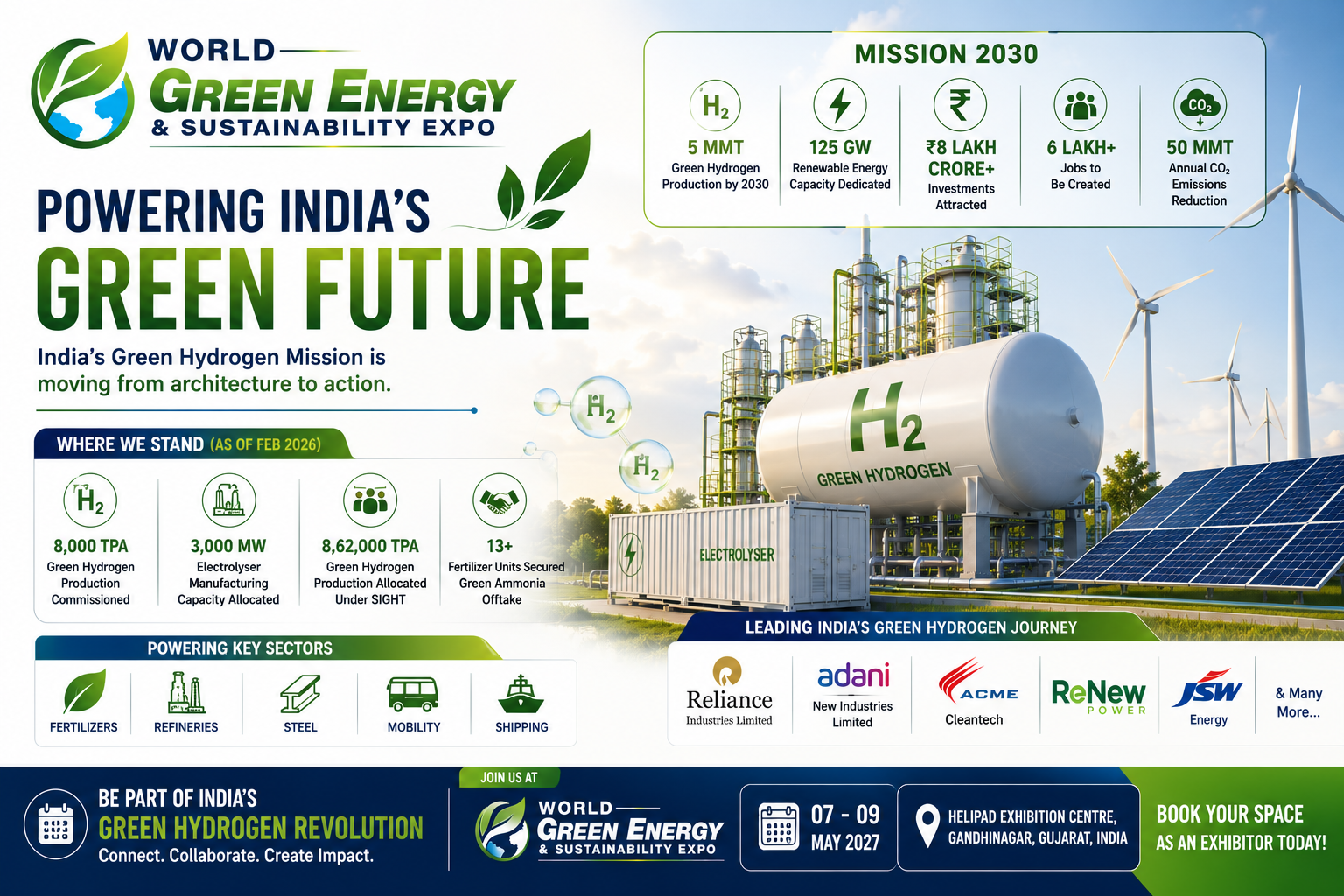
India’s Green Hydrogen Mission Is Moving from Architecture to Action
Every major policy program passes through two distinct phases. The first is architecture – the vision statements, budget approvals, incentive scheme designs, and regulatory frameworks that create the structure within which investment can flow. The second is action – the point where companies actually commit capital, build plants, sign offtake agreements, and put electrolysers to work splitting water into hydrogen and oxygen at commercial scale.
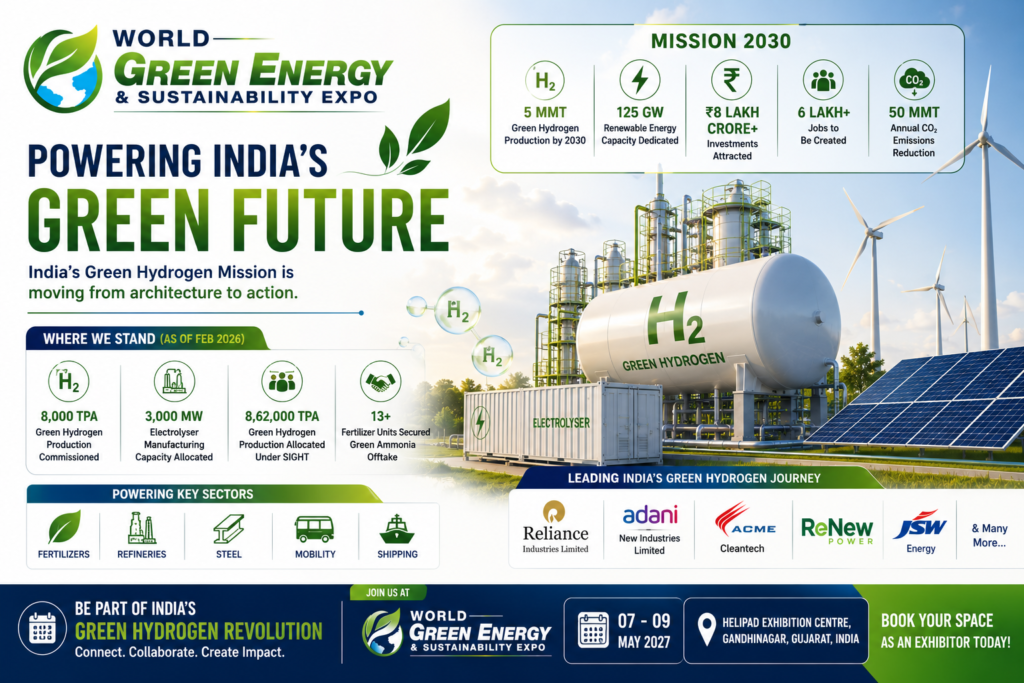
India’s National Green Hydrogen Mission spent most of 2023 and 2024 in the architecture phase. In 2025 and into 2027, it is – with both remarkable progress and honest gaps still to close – firmly in the action phase. The Mission carries an approved outlay of INR 19,744 crore. India targets 5 Million Metric Tonnes of annual green hydrogen production by 2030, supported by 125 GW of dedicated renewable energy capacity. The Mission aims to attract INR 8 lakh crore in investments, create 6 lakh jobs, and reduce carbon emissions by 50 million tonnes annually.
As of May 2025, 19 companies hold a cumulative annual green hydrogen production allocation of 8,62,000 tonnes under SIGHT. Fifteen firms carry awards for 3,000 MW of annual electrolyser manufacturing capacity. On the demand side, SECI has discovered prices for 7,24,000 metric tonnes per annum of green ammonia supply to 13 fertilizer units. As of February 2026, India had commissioned approximately 8,000 tonnes per annum of green hydrogen production capacity under the National Green Hydrogen Mission.
That gap between 8,000 tonnes commissioned and 5 million tonnes targeted is the central commercial fact about India’s green hydrogen mission in 2027. It is simultaneously a measure of how much work remains and a measure of how large the business opportunity genuinely is for every company in this value chain – electrolyser manufacturers, renewable energy developers, engineering contractors, component suppliers, logistics companies, and industrial buyers – over the next three to four years.
This article gives you the complete, data-backed picture of where India’s green hydrogen mission actually stands, what the real business opportunities are, and what every company operating in this space needs to know heading into 2027.
The National Green Hydrogen Mission – What It Is and What It Covers
The National Green Hydrogen Mission was approved by India’s Union Cabinet on 4th January 2023 under the chairmanship of Prime Minister Narendra Modi. It is the most comprehensive clean hydrogen policy framework ever launched by an emerging economy, covering production incentives, electrolyser manufacturing support, demand creation, pilot projects, export infrastructure, research and development, and standards and certification – all within a single integrated program.
The Mission will facilitate demand creation, production, utilization and export of Green Hydrogen. Under the Strategic Interventions for Green Hydrogen Transition Program – SIGHT – two distinct financial incentive mechanisms targeting domestic manufacturing of electrolysers and production of Green Hydrogen will be provided. The Mission will also support pilot projects in emerging end-use sectors and production pathways. Regions capable of supporting large-scale production and utilization of hydrogen will be identified and developed as Green Hydrogen Hubs. An enabling policy framework will be developed to support establishment of a Green Hydrogen ecosystem.
The initial outlay for the Mission will be INR 19,744 crore, including an outlay of INR 17,490 crore for the SIGHT program, INR 1,466 crore for pilot projects, INR 400 crore for R&D, and INR 388 crore towards other Mission components.
The Mission is structured across two phases with distinct objectives.
Phase I from 2022-23 to 2025-26 focuses on creating demand and supply for Green Hydrogen by incentivizing domestic electrolyser production, with initial deployment in existing hydrogen-using sectors like refineries, fertilizers, and city gas. This phase includes pilot projects for steel, mobility, and shipping, and establishing regulatory frameworks. Phase II from 2026-27 to 2029-30 anticipates Green Hydrogen becoming cost-competitive with fossil fuels, leading to expanded production and exploration of commercial-scale projects in new sectors such as steel, mobility, shipping, railways, and aviation, alongside intensified R&D for continuous product development and deep decarbonization of the economy.
India is now entering Phase II – the commercial scale-up phase – with the institutional architecture of Phase I largely in place and the challenge shifting from framework-building to delivery. The scale of the Mission’s ambition is best understood through its five headline outcomes.
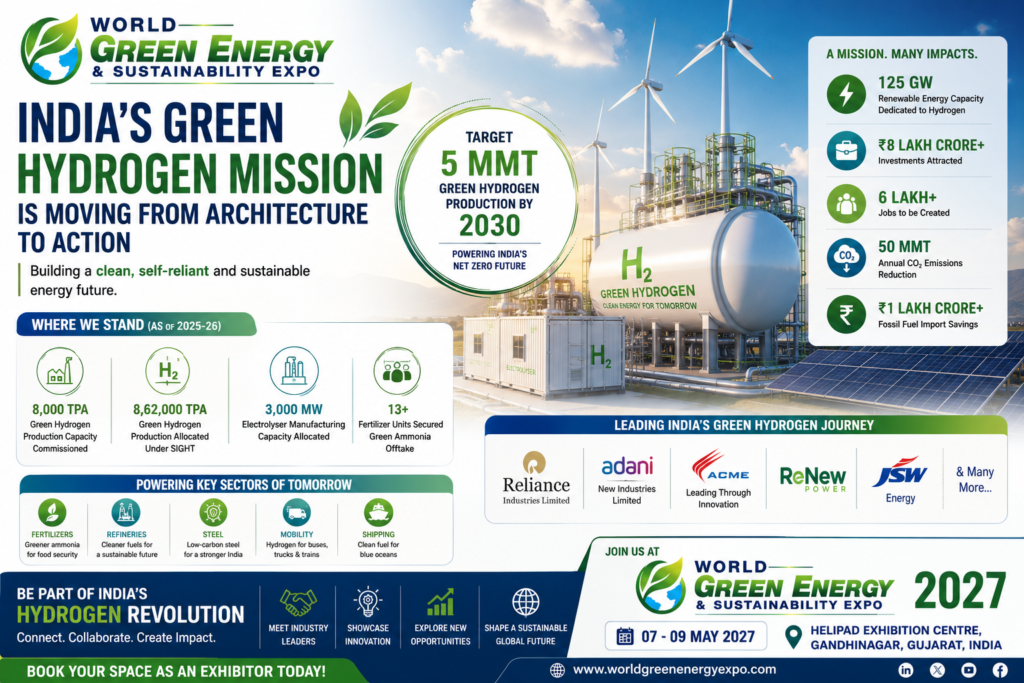
A green hydrogen production capacity of at least 5 MMT per year by 2030. An addition of approximately 125 GW of renewable energy capacity dedicated to hydrogen production. Over INR 8 lakh crore in total investments. Creation of over six lakh jobs. A reduction in fossil fuel imports exceeding INR 1 lakh crore. Averting nearly 50 MMT of annual greenhouse gas emissions. India’s current hydrogen consumption stands at around 6 million tonnes annually, with the fertilizer industry and refineries being the primary consumers. By 2050, the demand for hydrogen is expected to surge to 28 million tonnes, with the goal to meet 80% of this demand with green hydrogen.
The SIGHT Program – India’s Most Powerful Green Hydrogen Incentive
The Strategic Interventions for Green Hydrogen Transition program – universally abbreviated as SIGHT – is the financial engine of the National Green Hydrogen Mission. It operates through two distinct incentive mechanisms, one targeting electrolyser manufacturing and one targeting green hydrogen production, and it has already awarded incentives at a scale that few observers predicted when the Mission was first approved. Incentives have already been awarded for 8,62,000 MTPA of green hydrogen production capacity under the SIGHT Program. The Ministry reported that incentives have been awarded to 15 companies to establish 3,000 MW per annum of domestic electrolyser manufacturing capacity.
Scheduled commercial dates under Tranche 1 run from August 2026 and under Tranche 2 from March 2027, as per the National Green Hydrogen Mission portal. Three ports have been recognized as Green Hydrogen Hubs: the Deendayal Port Authority in Gujarat, the V.O. Chidambaranar Port Authority in Tamil Nadu, and the Paradip Port Authority in Odisha. Their designation in October 2025 is the mission’s most concrete step toward an export architecture. The demand-side achievements of SIGHT are particularly significant for industrial companies evaluating green hydrogen procurement.
SECI has discovered prices for 7,24,000 metric tonnes per annum of green ammonia supply to 13 fertilizer units. A further 20,000 tonnes per annum has been awarded for Indian Oil Corporation, BPCL, and HPCL refineries and 10,000 tonnes per annum for Numaligarh Refinery in Assam.
Green hydrogen produced under the Mission’s competitive bidding process currently costs INR 397 per kilogram for supply to Indian Oil Corporation’s refineries inclusive of 18% GST. For BPCL and HPCL refineries, the discovered price is INR 387 per kilogram. These are government-negotiated procurement prices established through the SIGHT scheme’s Mode 2 demand aggregation process.
The carbon market integration is also advancing. In March 2025, the Bureau of Energy Efficiency released Version 1 of the Detailed Procedure for the Offset Mechanism, and the Ministry of Power approved green hydrogen production through electrolysis as an eligible activity under the Carbon Credit Trading Scheme domestic offset mechanism. First Carbon Credit Certificate trades are expected by mid-2026.
A carbon price that raises the effective cost of grey hydrogen for obligated industrial users would create a demand signal for green hydrogen that no amount of subsidy can replicate – because it makes the cost of doing nothing with fossil hydrogen progressively more expensive rather than making green hydrogen artificially cheap. The carbon trading mechanism, once operational, is potentially the most commercially transformative single policy element within the entire Mission framework.
The Green Hydrogen Certification Portal – India’s Quality Framework
One of the most recent and practically significant developments in India’s green hydrogen policy framework is the launch of the Green Hydrogen Certification Portal of India.
The launch of the Green Hydrogen Certification Portal of India establishes a national mechanism for verifying green hydrogen production and compliance, while providing an update on implementation progress under the National Green Hydrogen Mission. Six states have notified dedicated Green Hydrogen Policies, while seven states have incorporated hydrogen provisions into existing policy frameworks. This indicates that green hydrogen policy is gradually moving from a centrally driven Mission to a broader federal implementation effort involving state-level infrastructure, industrial planning, and investment promotion.
To strengthen the innovation ecosystem, MNRE announced a INR 100 crore support fund for green hydrogen startups. An initial set of nine startups has been approved for funding support, while 21 research projects are being supported through a broader R&D program.
The certification framework matters commercially for several reasons. For Indian producers seeking to export green hydrogen or green ammonia to European markets under the EU’s RFNBO (Renewable Fuels of Non-Biological Origin) framework, having a credible national certification system is a prerequisite for commercial viability – without it, Indian green hydrogen cannot be verified as meeting the EU’s carbon intensity requirements and therefore cannot access European market premiums. For domestic industrial buyers, certification provides assurance that what they are purchasing as green hydrogen actually meets the definition – which matters for their own carbon accounting and ESG reporting.
The Real Progress Picture – Where India Stands
Any assessment of India’s green hydrogen mission must acknowledge both what has been achieved and the gap between targets and current delivery – because that gap defines the shape and timing of the business opportunity more accurately than either uncritical optimism or unwarranted pessimism. As of February 2026, India had commissioned approximately 8,000 tonnes per annum of green hydrogen production capacity. That is 0.16% of the 2030 target with four years remaining. The gap between what the Mission projects and what the market has delivered is structural. It has three components: a cost problem, a demand problem, and a spending problem.
The cost problem is straightforward. Green hydrogen produced at scale in India today costs between approximately INR 387 and INR 397 per kilogram through government tendering – roughly USD 4.60 to USD 4.75 per kilogram at current exchange rates. Grey hydrogen produced from natural gas in India costs approximately USD 1.50 to USD 2.00 per kilogram. The cost gap is real and it requires either subsidy support, carbon pricing, or continued technology cost reduction to close.
Electrolyser prices are falling rapidly, contributing to projections that green hydrogen costs in India could drop nearly 50% by 2030, from current levels around USD 4 to 6 per kilogram to USD 2 to 3 per kilogram, driven by cheaper renewables and scale.
The demand problem is also real. The SIGHT scheme has created structured demand through fertilizer company offtake agreements and refinery supply contracts – but structured, government-mediated demand is not the same as commercially self-sustaining demand that persists without ongoing subsidy. The Mission’s Phase II objective – green hydrogen reaching cost competitiveness with fossil fuels – is the condition that unlocks self-sustaining demand, and that condition is not yet met.
The spending problem reflects implementation velocity rather than intent. INR 19,744 crore was approved for the Mission, but capital deployment into actual projects has proceeded more slowly than the framework suggests, partly because the certification, standards, and grid connectivity frameworks needed for large projects were only finalized in late 2025 and early 2026.
What puts all three of these challenges in proper context is the trajectory. Each of them is improving – costs are falling, structured demand is building, and spending is accelerating as the Phase II commercial scale-up begins. The 8,000 tonnes per annum commissioned today will look very different when the SIGHT Tranche 1 plants begin commercial operations from August 2026 onward.
The Sector-by-Sector Opportunity – Where Green Hydrogen Will Be Used in India
The Mission will identify and develop regions capable of supporting large-scale production and utilization of Hydrogen as Green Hydrogen Hubs. Other target areas include: decentralized energy applications, hydrogen production from biomass, hydrogen storage technologies, and pilot projects for low-carbon steel, mobility, and shipping.
Fertilizers – The Largest and Most Immediate Market
India’s fertilizer sector is the largest single consumer of hydrogen in the country — and the most immediately accessible market for green hydrogen at scale. India’s fertilizer plants collectively consume approximately 5 to 6 million tonnes of grey hydrogen annually to produce ammonia for nitrogen fertilizer production. Replacing even a fraction of that grey hydrogen with green hydrogen would represent enormous demand.
SECI has already discovered prices for 7,24,000 metric tonnes per annum of green ammonia supply to 13 fertilizer units under the SIGHT program, establishing the first structured commercial demand corridor for green hydrogen derivatives in India. The companies supplying these fertilizer offtake agreements – ACME Cleantech, NTPC Renewable Energy, Oriana Power, and SCC Infrastructure – represent the first wave of commercial-scale green hydrogen production projects in India, and their project execution over the next two to three years will be the most closely watched indicator of whether India’s 2030 production targets are achievable.
Refineries – The Second Largest User
India’s oil refining sector consumes approximately 2 million tonnes of grey hydrogen annually – used primarily for hydrocracking and hydrotreating to produce cleaner petroleum products. The Indian government has mandated that PSU oil companies – Indian Oil Corporation, BPCL, and HPCL – source a portion of their hydrogen from green sources, creating the structured demand that SIGHT’s Mode 2 mechanism has formalized through competitive tendering.
JSW Energy has commissioned the country’s largest operational green hydrogen plant in Vijayanagar, Karnataka, supplying around 3,800 tonnes per annum to JSW Steel. GAIL’s 10 MW green hydrogen plant in Vijaipur, Madhya Pradesh, is producing 4.3 tonnes of clean hydrogen daily for blending into city gas networks.
Steel – The Deepest Decarbonization Opportunity
The Mission has allocated INR 455 crore up to 2029-30 for low-carbon steel projects. India is the world’s second-largest steel producer and its steel sector is one of the most carbon-intensive industrial activities in the country. Green hydrogen-based direct reduction of iron ore – replacing the coking coal currently used in blast furnaces – offers the only technically viable pathway to carbon-neutral steel production at scale.
JSW Energy’s green hydrogen supply to JSW Steel at Vijayanagar is the most advanced current demonstration of this pathway in India, producing 3,800 tonnes per annum for blending into the steelmaking process. While this is a small fraction of total steel sector hydrogen demand, it is the proof-of-concept that underpins the much larger commercial deployment expected through Phase II of the Mission.
Mobility – Hydrogen in Transportation
The Mission has allocated INR 496 crore up to 2025-26 for mobility pilot projects. India’s hydrogen mobility program covers fuel cell buses, hydrogen-powered trucks, hydrogen trains, and hydrogen refueling infrastructure. NTPC has deployed hydrogen fuel cell buses in Leh, demonstrating hydrogen mobility in one of India’s most challenging high-altitude environments. Several state governments are evaluating hydrogen bus procurement for urban transit applications.
Shipping – A Growing Pilot Market
INR 115 crore has been allocated up to 2025-26 for shipping pilot projects. India’s shipping sector – particularly its coastal and inland waterway fleet – represents a growing opportunity for hydrogen fuel cells and green ammonia as zero-emission maritime fuels. The designation of Deendayal Port in Gujarat as a Green Hydrogen Hub directly connects India’s hydrogen ambitions to its maritime trade infrastructure.
India’s Three Green Hydrogen Export Hubs – The Export Architecture
One of the most commercially significant developments in India’s green hydrogen program in the second half of 2025 was the designation of three port-based Green Hydrogen Hubs – a decision that transforms the Mission from a domestic industrial decarbonization program into a genuine international clean energy molecule export strategy.
Three ports have been recognized as Green Hydrogen Hubs: the Deendayal Port Authority in Gujarat, the V.O. Chidambaranar Port Authority in Tamil Nadu, and the Paradip Port Authority in Odisha. Their designation in October 2025 is the Mission’s most concrete step toward an export architecture.
Each of these three hubs has distinct geographic and industrial logic.
Deendayal Port, Gujarat connects India’s most advanced renewable energy development corridor – the Kutch and Saurashtra regions of Gujarat, which host some of the world’s largest solar and wind parks – with the shipping lanes serving the Middle East, Europe, and East Asia. Gujarat is also home to Reliance Industries’ Jamnagar New Energy complex and the AM Green Ammonia project that connects to European offtake through Uniper and RWE. The port’s existing liquid chemical and bulk handling infrastructure provides a credible foundation for green hydrogen and green ammonia export operations.
V.O. Chidambaranar Port, Tamil Nadu connects Tamil Nadu’s strong wind energy resources – the state has consistently been one of India’s top two wind energy states – with shipping routes to Southeast Asia, Japan, and South Korea, which are among the most active green hydrogen import markets globally. Tamil Nadu’s offshore wind potential in the Gulf of Mannar adds a longer-term renewable energy supply dimension to the port hub’s competitive position.
Paradip Port, Odisha connects the eastern coast of India – less developed in renewable energy than Gujarat and Tamil Nadu today, but with significant long-term solar potential – with shipping routes to Southeast Asia and East Asia. Odisha’s proximity to India’s largest steel production cluster in Jharkhand and Odisha creates a natural demand anchor for green hydrogen used in steelmaking alongside the export opportunity.
For international companies – whether engineering firms designing hydrogen terminal infrastructure, equipment manufacturers supplying electrolyser systems and ammonia synthesis plants, or shipping companies evaluating green ammonia as a fuel – these three port hubs are the most commercially specific locations within India’s broader green hydrogen geography.
State-Level Green Hydrogen Policies – Where Individual States Are Leading
Six states have notified dedicated Green Hydrogen Policies, while seven states have incorporated hydrogen provisions into existing policy frameworks.
Andhra Pradesh is the most active state in India’s green hydrogen story by project activity, hosting AM Green’s landmark 1 million tonne per year Kakinada green ammonia facility – currently under construction and one of the largest renewable ammonia projects in the world. Andhra Pradesh’s combination of coastal renewable energy resources, existing port and chemical industry infrastructure, and progressive state investment promotion policies makes it the leading Indian state for international green hydrogen and green ammonia project development.
Gujarat sits at the centre of India’s green hydrogen geography through the Deendayal Port Hub designation, Reliance Industries’ Jamnagar electrolyser gigafactory, the KP Group’s green hydrogen development ambitions, and the state’s unmatched renewable energy development scale. Gujarat’s state government has been among the most proactive in developing a state-level green hydrogen investment framework aligned with the National Mission.
Rajasthan combines India’s best solar resources with proximity to the industrial demand centres of north India, making it a natural location for green hydrogen production facilities targeting both the fertilizer sector in the Gangetic plain and export through Gujarat’s ports. Several electrolyser manufacturers awarded under the SIGHT scheme have identified Rajasthan as a preferred production location.
Tamil Nadu is leveraging its strong wind energy base and the V.O. Chidambaranar Port Hub designation to attract green hydrogen project developers targeting East Asian export markets. The state government’s green hydrogen policy provides land allocation, electricity banking provisions, and investment promotion support for qualifying projects.
Karnataka is home to JSW Energy’s operational green hydrogen plant at Vijayanagar – India’s most advanced steel-sector green hydrogen project – and is actively positioning itself as a hub for hydrogen mobility pilot programs.
Odisha is developing its green hydrogen opportunity primarily through the Paradip Port Hub designation and a state policy framework targeting both industrial decarbonization of its steel and aluminum sector and export to East Asian markets.
The Companies Leading India’s Green Hydrogen Economy
India’s green hydrogen commercial landscape is populated by a mix of large industrial conglomerates making multi-decade strategic bets, specialist clean energy developers building the first generation of commercial projects, and international companies seeking entry into what they correctly identify as one of the most consequential hydrogen markets of the 2030s.
Reliance Industries Ltd
Reliance Industries is making the largest single private sector commitment to green hydrogen in India and arguably one of the largest in the world.
Reliance Industries’ Jamnagar New Energy ecosystem is building an electrolyser giga-factory targeting 3 GW of annual manufacturing capacity by late 2026, backed by a USD 10 billion commitment.
Reliance’s approach is characteristic of how it has entered every industry it has targeted – with vertical integration from manufacturing through production to end-use, at a scale that immediately positions it as the defining player in the sector. Its electrolyser gigafactory will not just supply Reliance’s own green hydrogen projects – it will be a major domestic supplier to independent project developers across India, reducing the import dependence that currently inflates project capital costs.
Adani New Industries Ltd
Adani New Industries Limited is the clean energy manufacturing and green hydrogen arm of the Adani Group – itself India’s largest renewable energy developer. Adani New Industries Limited is investing USD 50 billion over ten years, targeting 1 million tonnes per annum of green hydrogen production before 2030.
Adani’s green hydrogen ambition is directly integrated with its solar manufacturing scale – it is one of the few companies globally capable of developing the complete value chain from solar panel production through renewable electricity generation to electrolyser operation and green hydrogen production within a single corporate group.
ACME Cleantech
ACME Cleantech has secured the largest allocation under India’s SIGHT fertilizer green ammonia tender. ACME Cleantech revealed an investment of INR 27,000 crore to establish a green hydrogen production facility in India with a capacity of 1.10 MMTPA. ACME’s combination of domestic fertilizer offtake commitments and international green ammonia projects – including its Oman facility delivering 300 tonnes per day from 2026 – makes it the most operationally advanced green hydrogen developer in India by current production and near-term commissioning pipeline.
ReNew Power
ReNew Power has committed INR 26,400 crore for a green hydrogen project in Karnataka targeting 0.22 MMTPA production capacity. ReNew expressed its commitment with a substantial investment of INR 26,400 crore for a green hydrogen project, targeting a production capacity of 0.22 Million Metric Tons per Annum in Karnataka. ReNew’s NASDAQ listing and established track record in large-scale renewable development give it the financial credibility to attract the long-term project finance that green hydrogen projects at this scale require.
Waaree Energies
Waaree Energies is diversifying from its core solar manufacturing business into the green hydrogen value chain. Waaree invests INR 551 crore in hydrogen and INR 2,073 crore in batteries, reflecting a broader strategic positioning across the renewable energy storage and clean fuel value chain.
Hygenco Green Energies
Hygenco Green Energies has become India’s most internationally credentialed pure-play green hydrogen developer following its landmark funding round.
International Finance Corporation, Siemens Financial Services, and the Fullerton Carbon Action Fund signed definitive agreements on June 5, 2026 to co-lead a collective USD 105 million equity investment in Hygenco Green Energies. Under the structure of the deal, IFC and Siemens are each contributing approximately USD 25 million, while Fullerton is committing up to USD 30 million, for a combined USD 80 million in direct equity. The remaining USD 25 million comes through two blended-finance facilities managed by IFC – USD 20 million from the Clean Technology Fund under the Climate Investment Funds program, and USD 5 million from the German-government-backed Frontier Opportunities Fund.
The involvement of IFC, Siemens Financial Services, and the Climate Investment Funds in a single transaction signals something important about where sophisticated international capital sees risk-adjusted opportunity in India’s green hydrogen market – not in the largest, most complex gigascale projects, but in demonstrated, commercially operational mid-scale projects with credible off-take and experienced management.
JSW Energy
JSW Energy has moved beyond green hydrogen planning into commercial operation. JSW Energy has commissioned the country’s largest operational green hydrogen plant in Vijayanagar, Karnataka, supplying around 3,800 tonnes per annum to JSW Steel – a direct industrial off-take relationship that eliminates the off-take risk that most green hydrogen projects still face.
GAIL
GAIL India is advancing the hydrogen blending pathway through its operational plant in Vijaipur. GAIL’s 10 MW green hydrogen plant in Vijaipur, Madhya Pradesh, is producing 4.3 tonnes of clean hydrogen daily for blending into city gas networks – demonstrating the city gas blending route that could create distributed demand for green hydrogen across India’s expanding piped natural gas network.
IREDA
IREDA – India Renewable Energy Development Agency is providing the financial backbone for green hydrogen project development across the country. IREDA diversifies into green hydrogen across 23 states, making it the single most geographically widespread financial institution in India’s green hydrogen ecosystem and the primary debt provider for projects that cannot access commercial bank financing independently.
Technology Trends and Cost Reduction – The Path to Competitiveness
The commercial viability of India’s green hydrogen ambitions ultimately depends on cost reduction – both in electrolyser technology and in the renewable electricity that powers it. The trajectory on both fronts is genuinely encouraging, though honest assessment requires acknowledging that cost competitiveness with grey hydrogen by 2030 is ambitious rather than guaranteed. Advancements in 2025 to 2026 focus on cost reduction and efficiency. Electrolyser prices are falling rapidly, contributing to projections that green hydrogen costs in India could drop nearly 50% by 2030, from current levels around USD 4 to 6 per kilogram to USD 2 to 3 per kilogram, driven by cheaper renewables and scale.
Innovative approaches include biomass sugars for cheaper production and waste-based electrolysis, which could slash costs by USD 4.63 per kilogram, making it competitive with grey hydrogen. AI integration is accelerating progress.
The electrolyser manufacturing development under SIGHT is particularly significant for long-term cost reduction. Domestic electrolyser manufacturing, once operational at scale, reduces the import dependence that currently inflates project capital costs. Fifteen firms hold awards for 3,000 MW of annual electrolyser manufacturing capacity.
India currently imports most of its electrolyser equipment – primarily from China and Europe. Building a domestic electrolyser manufacturing industry reduces not just the capital cost of individual projects but also the supply chain risk and the foreign exchange exposure that currently makes project finance more expensive. SIGHT’s electrolyser manufacturing incentive is therefore strategically important not just for the companies receiving the awards but for the entire ecosystem of projects that will use their equipment.
The strategic hydrogen innovation partnership – SHIP – underpins the R&D dimension. A public-private partnership framework for R&D – the Strategic Hydrogen Innovation Partnership – will be facilitated under the Mission. R&D projects will be goal-oriented, time-bound, and suitably scaled up to develop globally competitive technologies.
An initial set of nine startups has been approved for funding support under the INR 100 crore startup support fund, while 21 research projects are being supported through a broader R&D program. These initiatives are intended to accelerate technology development, reduce production costs, and strengthen domestic capabilities across the hydrogen value chain.
The Business Opportunity – Segment by Segment
For any company evaluating how to position in India’s green hydrogen economy, the opportunity breaks down clearly across several distinct value chain segments – each with different timelines, risk profiles, and capital requirements.
Electrolyser manufacturers and suppliers face the most immediate and largest near-term opportunity. With 3,000 MW of annual electrolyser manufacturing capacity being established under SIGHT and SIGHT Tranche 1 commercial commissioning beginning from August 2026, the demand for electrolyser stacks, components, membranes, and ancillary equipment is moving from tendering to physical procurement. International electrolyser companies – including John Cockerill, Nel ASA, ITM Power, ThyssenKrupp Nucera, and Sungrow Hydrogen – are all actively competing for a share of India’s growing project pipeline.
Renewable energy developers providing the electricity that electrolysers consume are in the most structurally advantaged position of any value chain participant.
Green hydrogen’s cost is primarily determined by the cost of renewable electricity – typically representing 60 to 70% of total production cost. India’s world-class solar and wind resources, combined with its renewable electricity costs that are among the lowest in the world, give it a genuine long-run production cost advantage over most competing hydrogen-producing nations. Every greenfield green hydrogen project in India requires a renewable energy supply agreement – creating direct procurement opportunity for solar and wind developers.
Engineering, procurement, and construction companies with hydrogen plant construction experience are facing growing demand as SIGHT-awarded projects move from financial close to construction. Ammonia synthesis plant construction – for the green ammonia projects that represent the largest segment of current SIGHT production awards – requires specialist engineering capability in high-pressure process plant design, pressure vessel fabrication, and cryogenic storage system construction.
Component and materials suppliers serving the electrolyser manufacturing industry – membrane manufacturers, bipolar plate producers, balance-of-plant equipment suppliers, power electronics companies – are entering an Indian market where domestic manufacturing incentives create strong preference for locally produced components and sub-systems.
Financial institutions and investors are the most active current participants, with IFC, Siemens Financial Services, Brookfield, and multiple domestic institutions including IREDA actively deploying capital. The Hygenco USD 105 million round demonstrates that blended finance structures combining multilateral development bank equity, commercial investor equity, and climate finance facility concessional capital are viable for Indian green hydrogen projects of demonstrated commercial feasibility.
Industrial buyers in fertilizers, refining, and steel who are currently consuming grey hydrogen face a combination of regulatory pressure – through the Carbon Credit Trading Scheme – and commercial incentive – through SIGHT demand aggregation pricing – to begin transitioning procurement toward green hydrogen. For these companies, World Green Energy & Sustainability (WGES) Expo 2027 provides a direct route to engaging with green hydrogen producers, technology providers, and policy experts who can help structure transition roadmaps.
The Challenges – What Every Company Must Navigate
India’s green hydrogen opportunity is real, large, and growing. The challenges are equally real and require acknowledgement from any company evaluating this market.
The cost gap between green and grey hydrogen remains significant and will not close completely within this decade without either carbon pricing or continued subsidy support. Companies building business models that depend on green hydrogen achieving grey hydrogen cost parity by 2027 or 2028 are likely to be disappointed. Companies building business models that assume green hydrogen needs structured government support through the mid-2030s are more likely to be right.
The infrastructure gap is substantial. Hydrogen pipelines, storage terminals, refueling stations, and port export infrastructure are all at early stages of development in India. Until this infrastructure exists at commercial scale, the market for green hydrogen will remain concentrated in large point-to-point industrial supply arrangements rather than commodity market trading.
The skills gap in electrolyser operation, hydrogen safety, and green hydrogen plant management is real and will need to be addressed through training programs that do not yet exist at the scale India’s 2030 targets require.
Regulatory execution risk exists across multiple dimensions – grid connectivity for renewable energy plants powering electrolysers, port infrastructure development for export hubs, and the time taken to translate policy intent into actionable permits and approvals at the state and district level.
None of these challenges are unique to India – they are the common challenges of scaling a new clean energy technology in a large, complex economy. All of them are being actively addressed and all of them represent business opportunities for the companies with solutions to offer.
Why World Green Energy & Sustainability (WGES) Expo 2027 Is Where India’s Green Hydrogen Business Gets Done
India’s National Green Hydrogen Mission is entering the phase of its lifecycle where institutional architecture gives way to commercial reality – where tenders become projects, projects become plants, and plants become the foundation of a new clean energy industry. The companies that will capture the largest share of this commercial opportunity are the ones building relationships, demonstrating technologies, and establishing supply chain and off-take partnerships in India right now – in 2026 and 2027 – before the procurement decisions for the next wave of SIGHT projects are made and before the Phase II commercial scale-up fully gathers momentum.
Gujarat sits at the absolute centre of this story – home to the Deendayal Port Green Hydrogen Hub, Reliance’s Jamnagar electrolyser gigafactory, and India’s most advanced renewable energy development infrastructure across solar, wind, and hybrid. World Green Energy & Sustainability (WGES) Expo 2027, held in Gandhinagar in the heart of Gujarat’s clean energy corridor, brings together the developers, technology providers, equipment manufacturers, financiers, and industrial buyers who are collectively building India’s green hydrogen economy.
Multilateral development institutions and industrial financiers are increasingly viewing India as one of the most attractive destinations for clean molecule investment, given its large renewable energy base, supportive policy architecture under the National Green Hydrogen Mission, and rising industrial demand for decarbonized feedstock in steel, fertilizers, refining, and chemicals.
For electrolyser manufacturers targeting India’s 3,000 MW domestic manufacturing build-out, for renewable energy developers seeking green hydrogen offtake partnerships, for EPC contractors bidding on ammonia synthesis and electrolysis plant construction, for component manufacturers entering India’s growing electrolyser supply chain, for industrial companies evaluating green hydrogen procurement, and for investors deploying capital into India’s clean molecule economy – World Green Energy & Sustainability (WGES) Expo 2027 is where the conversations that matter are happening.
World Green Energy & Sustainability (WGES) Expo 2027 in Gandhinagar, Gujarat, is your fastest and most direct route to those relationships.
Register as an exhibitor at the World Green Energy & Sustainability (WGES) Expo 2027 today. Secure your position in front of India’s most active solar buyers, developers, investors, and policymakers – all in one place, at the moment the market is moving fastest.
For more details: contact us at info@adexexhibitions.com | +91 81770 53335 | +91 91528 96078
For Exhibitor Registration: If you have not registered, you may also fill out this Exhibitor Registration Form.