
Wind Energy Just Had Its Biggest Year in History
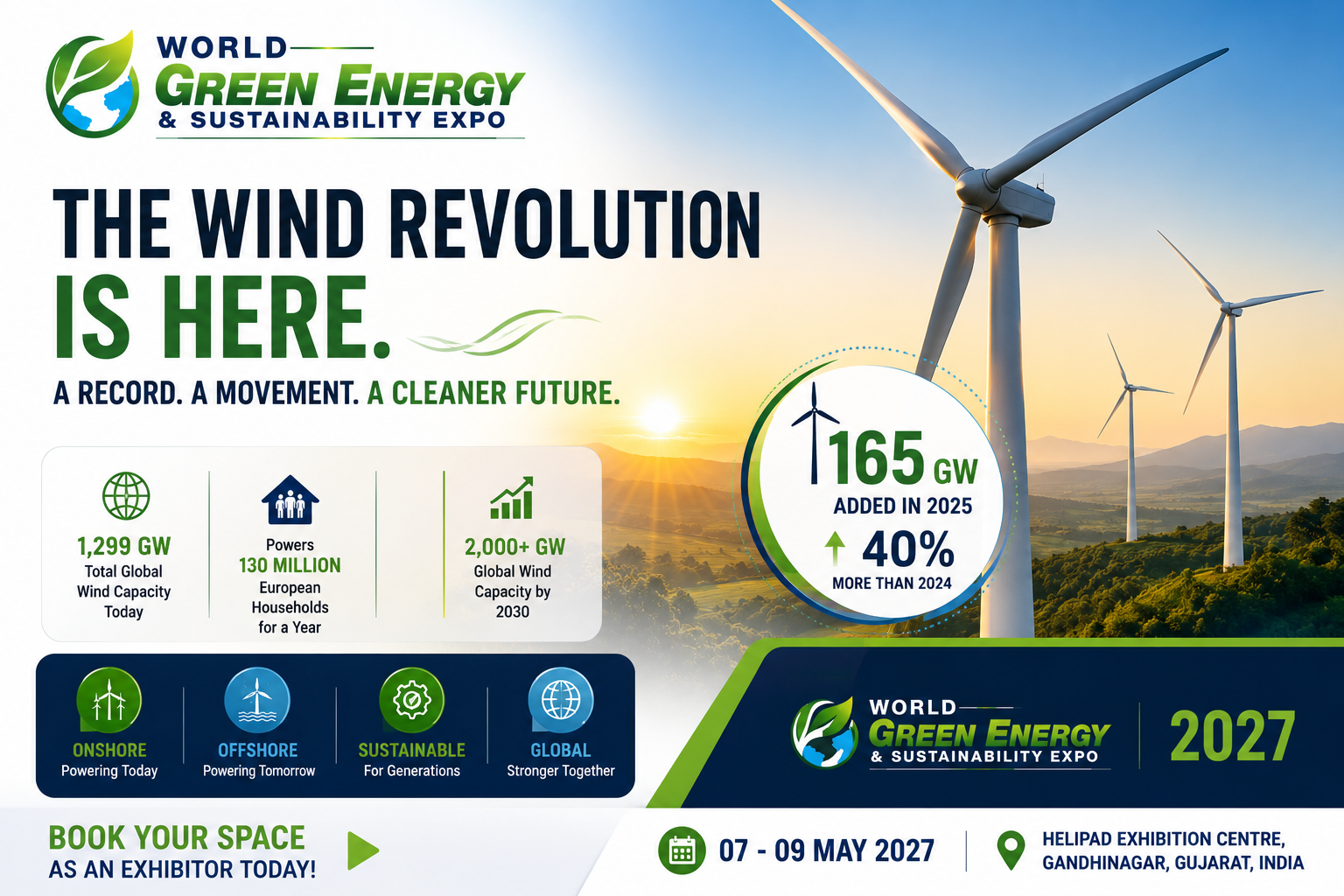
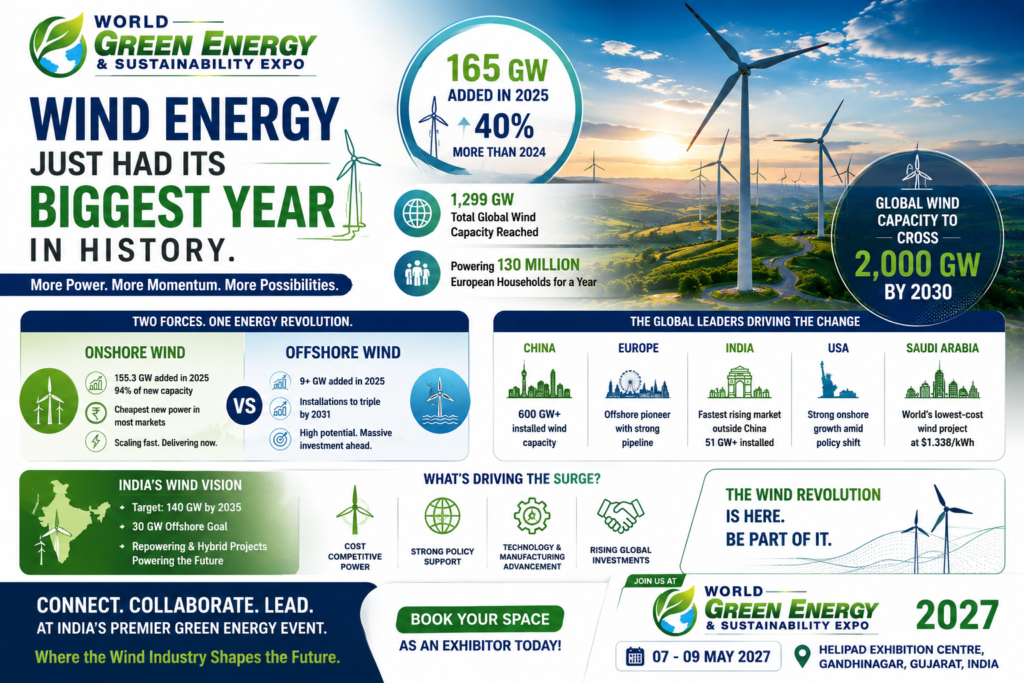
There is a number buried in the Global Wind Energy Council’s 2026 annual report that deserves far more attention than it has received in mainstream energy coverage. Wind power added 165 GW of capacity to the grid in 2025 – the highest ever for the wind industry, up 40% on 2024, which was itself the previous record-breaking year. This brings global cumulative capacity of wind energy to 1,299 GW, spread across all continents, with 57 countries installing wind turbines.
Forty percent growth in a single year. In an industry that was already deploying at record pace. On top of a record-breaking prior year. To grasp what that number means physically, consider this: the wind capacity added in 2025 alone could power approximately 130 million average European households for a full year. In a single twelve-month period.
The Global Wind Energy Tracker, comprising over 33,000 operating and prospective wind Energy projects worldwide, now covers 1 terawatt of operating utility-scale wind power, with a further 2.7 terawatts of wind in announced, pre-construction and construction phases. Yet beneath these extraordinary headline numbers, a fundamental strategic question is shaping every investment decision in the industry: where is the money actually going – onshore or offshore? The answer in 2027 is nuanced, geographically uneven, and commercially significant for every wind turbine manufacturer, developer, EPC contractor, component supplier, and infrastructure investor in this sector.
The Global Wind Market in Numbers – 2025 and the Road to 2030
The scale of what has already been built, and what is being planned, defines the commercial opportunity in wind energy more precisely than any single market size figure can. Last year’s growth – a record 155.3 GW of new onshore wind, up 42%, plus 9.3 GW of new offshore wind, up 16% – brings global cumulative capacity of wind energy to 1,299 GW. In the next five years between 2026 and 2030, GWEC Market Intelligence projects a total of 969 GW of new wind capacity to be commissioned, averaging approximately 194 GW per year.
Between 2026 and 2030, nearly 365 GW of onshore wind is planned to become operational alongside around 200 GW of offshore wind. However, even if this capacity becomes operational on time, worldwide wind capacity is still short of global tripling goals by 1 terawatt.
The offshore wind story carries particularly striking forward momentum. With over 50 GW of offshore wind projects currently under construction around the world, annual installations are expected to double in 2026, triple by 2031, and exceed 50 GW per year by 2035. Offshore wind is projected to achieve a compound average annual growth rate of 24% between 2026 and 2030, positioning it as one of the fastest-growing mainstream energy technologies globally.
According to IEA projections, global wind capacity is expected to nearly double to over 2,000 GW by 2030, with approximately 730 GW of onshore and 140 GW of offshore additions. Wind is projected to account for nearly one-third of all renewable electricity growth through 2030, second only to solar photovoltaic. On the market valuation side, offshore wind’s financial scale is already enormous. The offshore wind energy market size was USD 76.9 billion in 2025, projected to reach USD 109 billion in 2026 and USD 307.5 billion by 2035, growing at a CAGR of 12.2%.
Onshore Wind – Still Where Most of the Money Goes
Despite offshore wind’s momentum and media profile, the honest picture of where global wind investment flows in 2027 starts with a simple fact: onshore wind still accounts for the overwhelming majority of both annual installations and total investment.
Onshore wind accounted for 155.3 GW of new capacity in 2025, representing 94% of all wind additions globally. China dominated new onshore wind installations in 2025, adding more than 110 GW, or 73% of the global total. Project developers brought 169 GW of wind turbines online in 2025, representing a 38% jump from 2024. Onshore wind accounted for 161 GW, or 95% of global wind additions.
The economics behind this dominance are straightforward. Onshore wind is significantly cheaper per megawatt-hour than offshore wind in virtually every market – requiring no specialist marine installation vessels, no subsea cabling, no offshore foundation engineering, and no complex corrosion management systems. The levelized cost of onshore wind has fallen below the cost of new fossil fuel generation in most major markets, making it the cheapest new electricity source available in many parts of the world without subsidy support. The levelized cost of onshore wind has fallen below fossil fuels in many markets, making it one of the cheapest electricity sources available. Global installed capacity exceeded 1,015 GW by the end of 2023, with China dominating at over 40% of worldwide capacity. Onshore wind dominates at 93% of total capacity.
Technology is still moving forward in this segment. Current global manufacturing capacity for wind components – nacelles, towers, blades – reaches approximately 170 to 180 GW annually. According to announced expansion plans, this could increase to 205 to 260 GW by 2026 to 2027. Turbines are getting taller, rotors are getting larger, and capacity factors are improving. A modern 5 to 6 MW onshore turbine on a 160-metre tower in a good wind resource location achieves capacity factors above 40% – competitive with many combined cycle gas plants in annual generation terms.
However, onshore wind faces growing constraints in its most mature markets. New onshore wind capacity awarded worldwide through wind-specific, technology-neutral, renewable and hybrid auctions was 32.8 GW – 39% lower than 2024. More than half of this was in Europe and around one-third in the Asia-Pacific region, primarily in India. The drop in new auction awards signals that permitting delays, community opposition, and grid connection constraints in established markets are beginning to create a ceiling on how fast onshore deployment can grow, even when the economics are compelling.
Offshore Wind – The Technology With the Most Investment Momentum
If onshore wind is where the volume is, offshore wind is where the investment narrative and long-term strategic positioning are concentrated in 2027.
In 2025, more than 9 GW of new offshore wind capacity was connected to power grids worldwide, sufficient to supply electricity to over 10 million households. That year ranked as the third highest for new installations, pushing the cumulative global total to 92.5 GW, equivalent to powering more than 100 million homes. China led annual installations for the eighth straight year, adding 6.6 GW in 2025. Europe commissioned nearly 2 GW across three markets: the UK at 1.0 GW, Germany at 0.5 GW, and France at 0.4 GW.
The global offshore market expanded at an average annual rate of 10% over the past decade, with the 92.5 GW installed representing 7.1% of total global wind capacity. China holds 52% of the global offshore wind market, having surpassed the UK in 2021. Germany, the Netherlands, and Taiwan round out the top five. In Europe, total offshore wind installations exceeded 38 GW, representing 42% of global offshore wind capacity.
Turbine technology is scaling dramatically in this segment. The average turbine size installed in the offshore wind sector in 2025 was 10.3 MW, crossing the 10 MW threshold for the first time. Within a decade, the average offshore turbine has grown from 3 to 4 MW to over 10 MW – with leading manufacturers including Vestas, Siemens Gamesa, CSSC Haizhuang, and MingYang developing 15 to 18 MW turbines that are beginning to enter commercial deployment. Each additional megawatt of turbine capacity reduces the number of foundations, installation vessel trips, and grid connections required per gigawatt of installed capacity – dramatically improving project economics.
Vestas Wind Systems has strengthened its offshore wind position through its V236-15.0 MW turbine, securing major offshore wind contracts in Europe and Asia Pacific. In December 2025, the company received a 390 MW order for the Shinan-Ui offshore wind project in South Korea, including 26 V236-15.0 MW offshore wind turbines as well as a 20-year service agreement.
The structural case for offshore wind’s long-term growth is compelling. Many of the world’s largest electricity demand centres – the eastern seaboard of the United States, the North Sea coast of Europe, the coastlines of China, South Korea, Japan, Taiwan, and India – are geographically close to high-quality offshore wind resources and well-served by existing transmission infrastructure at coastal connection points. Offshore wind removes the land acquisition and community opposition constraints that increasingly slow onshore development in densely populated regions. However, offshore wind is not without serious challenges in 2027. The amount of offshore wind procured through auctions in 2025 stood at 11.4 GW, only one-fifth of the record set in 2024. Roughly 25 GW of projects outside China are still awaiting financial investment decisions, classified as ready to build after receiving consent and planning approval – held up by grid connections, auction results, or subsidy arrangements.
The auction shortfall reflects a genuine tension between the cost of offshore wind projects in an inflationary environment and the price caps that many government auction frameworks impose. Several European auction rounds in 2024 and 2025 failed to attract bids because developers could not make projects stack up financially at the government-set strike price. Resolving this tension – either through higher strike prices, inflation indexing, or supply chain cost reductions – is one of the industry’s most pressing commercial challenges.
China – The Country That Changes Every Calculation
No discussion of the global wind market is honest without acknowledging the extraordinary and distorting scale of China’s position. China passed 600,000 megawatts of installed wind capacity in 2025 and reached an installed capacity of 691,750 MW at the end of 2025. The country added 130,258 MW – over 130 GW – after 86,892 MW in 2024 and 79,370 MW in 2023. With this impressive new capacity, China accounts for 77% of the global market for new wind turbines – a steady increase from 72% in 2024, 65% in 2023, and 58% in 2022.
China is expected to reach 1,000,000 MW of installed wind capacity in 2027 or 2028 – one terawatt from a single country, in a technology that barely existed commercially before 2000. China’s offshore wind story is equally dominant. China led annual offshore installations for the eighth consecutive year, commissioning 6.6 GW in 2025, bringing its total to 48.4 GW by end of 2025 and holding 52% of global offshore wind capacity.
Chinese turbine manufacturers continued to rely heavily on their home market, with domestic installations accounting for 93% of all capacity added by these companies in 2025, down from 99% in 2024 – indicating that their export push is beginning to gain traction. Envision Energy and Goldwind led installations outside mainland China. This moment marks the emergence of Chinese manufacturers as true global players, as their commissioned capacity abroad increased eightfold over a single year.
The emergence of Chinese turbine manufacturers as global exporters is one of the most commercially significant developments in the wind industry right now – directly comparable to what happened when Chinese solar module manufacturers began exporting aggressively around 2010, and with similar long-term implications for market structure and pricing in every market they enter.
Europe – The Offshore Pioneer Facing a Delivery Gap
Europe invented offshore wind. It built the first commercial offshore wind farm in 1991, developed the technology across two decades of North Sea deployment, and created the regulatory and financial frameworks that enabled it to scale. In 2027, it remains the most sophisticated offshore wind market in the world – and also the one most visibly struggling to translate ambition into delivery.
In Europe, total installed wind power capacity passed the 300 GW threshold. The continent installed its second highest volume of new wind capacity, at 19.1 GW – up 16% on the previous year – driven in part by strong growth in Germany and Turkey. The EU-27 installed 15.1 GW, up 17%, although this is still lower than the annual average growth needed for the EU to meet its 2030 energy and climate targets. Key emerging European markets include Poland, which targets 11 GW of offshore wind by 2040. Baltic Sea countries including Sweden and Finland will further contribute to business momentum. The Netherlands will grow owing to favorable North Sea conditions, including consistent high wind speeds and relatively shallow waters along the coast.
The European offshore pipeline is large and visible. Orsted, the world’s largest offshore wind developer and operator, signed an agreement with Copenhagen Infrastructure Partners in 2026 to divest its entire European onshore business, further supporting its strategic priority to refocus on offshore wind in its core European markets. This strategic concentration on offshore – from the company that pioneered the technology – signals where Europe’s most sophisticated renewable energy investors believe the long-term value lies.
The United States – Policy Uncertainty Versus Market Momentum
The United States presents the most complex and contradictory wind market story of any major economy in 2027. The United States saw around 50% more growth in 2025 than in 2024, adding slightly less than 6.3 GW after 4.2 GW, resulting in almost 161 GW of total capacity. As the Trump administration has not only announced but already implemented several decisions clearly against new wind farms, the future of the US market is at stake. After courts upheld land use approvals, the US government paid investors for not building wind farms. However, a rush in new installations is expected in 2026 and 2027 which may bring the US back as the second largest market for these two years, still based on old rules.
The onshore wind market in the United States remains fundamentally sound from an economic perspective – wind power is now the cheapest form of new electricity generation in most of the country’s best wind resource areas, regardless of federal policy. The political risk is concentrated in offshore wind, where federal permitting, leasing, and interconnection processes depend on government cooperation that is currently inconsistent. The US offshore wind energy market was valued at USD 3.1 billion in 2025 and is expected to grow at a CAGR of 8.5% from 2026 to 2035, though this projection carries wider uncertainty than most comparable forecasts given the current policy environment.
Saudi Arabia, Middle East and Africa – The New Frontier
Africa and the Middle East saw another record year for installations in 2025, primarily driven by renewed growth in South Africa and unprecedented growth in Saudi Arabia. The 1,500 MW Dawadmi windfarm in Saudi Arabia set a new world record in 2025 for the lowest-cost wind project at just USD 1.338 per kilowatt-hour. With new manufacturing facilities planned in Saudi Arabia and Oman, the Middle East is now expected to add more than 18 GW of onshore wind capacity between 2026 and 2030.
The Saudi Arabia world record deserves particular attention. A wind project at USD 1.338 per kWh – approximately 11 rupees per kilowatt-hour – is cheaper than virtually any other form of electricity generation anywhere in the world, including coal. It demonstrates what happens when high average wind speeds, vast flat land, proximity to major electricity demand, and government support for renewable energy converge in a single location.
India – The World’s Fastest Rising Wind Energy Market
India’s wind energy story in 2026 and 2027 is one of the most consequential developments in the global wind industry – and one that receives far less international attention than it deserves given its scale and pace.
India almost doubled annual wind installations to build a record 6.3 GW of new capacity in 2025. For the first time since wind power emerged as a major global force, India edged out the United States and Germany to become the largest wind market outside mainland China in 2025. India’s rise has been driven by complex auctions that typically require developers to integrate multiple renewable technologies or oversize projects beyond their contracted capacity. India’s current installed capacity of 51 GW as of May 2025 makes it the world’s fourth-largest market. This foundation is now being leveraged to pursue an official government target of 140 GW by 2030. Achieving that goal would require nearly 100 GW of new installations over the next five years – a monumental task that underscores the sheer scale of the opportunity.
With an overall capacity of 54.5 GW, India surpassed 50,000 megawatts of installed capacity in 2025 and is expected to reach more than 60 GW in 2026. Given the country’s ambitious targets, India is expected to remain fourth in terms of overall capacity in the coming years. India’s onshore wind geography is highly concentrated in a handful of states. Onshore capacity accounted for the entire India wind energy market in 2025. Gujarat led 2024 installations with 1,250 MW, followed by Karnataka at 1,135 MW and Tamil Nadu at 980 MW, as these states maintained clear land and grid processes.
The turbine technology mix is also upgrading rapidly. By turbine capacity, units rated up to 3 MW captured 59.5% of the India wind energy market in 2025, whereas the 3 MW to 6 MW class is projected to grow at a 21.4% CAGR through 2031, driven by independent power producers seeking superior economics in Gujarat’s Kutch and Tamil Nadu’s Tirunelveli districts.
India’s Domestic Turbine Manufacturing – A Market Increasingly Owned by Indian Companies
India’s domestic wind turbine manufacturers have turned a structural policy advantage into genuine market dominance, and the pace of that dominance is accelerating. India’s turbine orders rose 60% in 2024 to 8 GW and reached 7 GW by December 2025. Domestic firms Suzlon and Inox Wind have captured over 50% of annual turbine contract volumes for the past three years.
Suzlon Energy and Inox Wind seized approximately 70% of 2025 turbine contracts, benefiting from 20 to 25% cost advantages due to local component sourcing and lower logistics outlays. Around 75% localization has been achieved with strong domestic manufacturing capacity for wind energy turbines and their components in the country. The booming market has attracted Chinese majors Envision and Sany, which have replaced Western manufacturers such as GE and Siemens Gamesa. In 2025, MNRE tightened localization norms further, requiring upstream components like generators, bearings, and blades to be sourced only from approved domestic manufacturers.
Suzlon Energy – India’s Wind Giant
Suzlon Energy Limited is the largest wind turbine manufacturer in India, with an installed capacity of 14.8 GW from over 111 wind energy farms. Suzlon was founded in 1995 to power its founder’s textile industry and now has a global installed capacity of 20.05 GW across nine states including Rajasthan and Gujarat. The technological assistance provided includes SCADA, offering remote monitoring of more than 9,700 wind turbines worldwide.
Inox Wind – The Challenger Rising Fast
Inox Wind’s 3.3 MW model with a 137-metre rotor offers 15% higher annual energy production than its 3 MW predecessor while fitting the same foundation footprint. Repowering rules mandating a 1.5 times uplift effectively push developers to 3 MW to 5 MW units with 120-metre hubs, and Suzlon’s S144 turbine sells briskly into this niche.
KP Energy – Gujarat’s Leading Wind EPC Company
KP Energy, the wind energy EPC and IPP arm of the KP Group, is one of the most important and frequently overlooked names in India’s wind energy story – particularly relevant to the WGES 2027 community given the group’s Gujarat base and deep integration across both wind and solar.
KP Energy is Gujarat’s leading wind energy EPC company, specializing in development of utility-scale wind power generation infrastructure, siting of wind farms, land acquisition, EPCC of wind projects, and balance of plant infrastructure. GWEC’s wind demand outlook for India projects 122 GW of wind demand by 2030, with a new taskforce established to drive clean energy market development – in this context, Gujarat-based wind EPC specialists like KP Energy are positioned at the exact intersection of state resource availability and national demand growth.
KP Group’s three-entity structure gives it a distinctive position in the wind value chain. KP Energy handles wind EPC and IPP development. KPI Green Energy manages the broader renewable portfolio including captive solar, hybrid, and BESS projects. KP Green Engineering manufactures the steel wind lattice towers, transmission infrastructure, and mounting structures that wind and solar projects require. This integrated manufacturing-to-commissioning capability across a single corporate group is genuinely rare in India’s wind sector and provides structural cost and coordination advantages that pure EPC companies cannot match.
The KP Group’s expansion beyond Gujarat – with project development entities established in Rajasthan, Madhya Pradesh, Odisha, Maharashtra, and Andhra Pradesh – positions it to capture wind opportunities across India’s strongest wind resource states as national auction volumes increase through the rest of this decade.
India’s Offshore Wind – The Next Frontier
India has set a target of installing 30 GW of offshore wind projects by 2030. The government estimates that Gujarat and Tamil Nadu alone have around 70 GW of potential for offshore wind power, enough to power over 50 million homes. Offshore contributes none of the installed base today, yet a 1 GW funded pilot – 500 MW each in Gujarat and Tamil Nadu – targets commissioning by 2028 once the Power Grid evacuation link activates. National seabed surveys suggest 70 GW of technical potential at moderate depths.
New impetus in India is expected to come from repowering and from offshore wind, which is expected to start in the next few years. The honest picture of India’s offshore wind is one of enormous long-term potential meeting near-term execution challenges. The 2028 pilot commissioning target depends on grid evacuation infrastructure – specifically a 2,000 MW HVDC link – that is itself in development. Until that infrastructure is ready, capital will continue to favor onshore and hybrid projects.
India’s offshore wind journey began with the 500 MW Gulf of Khambhat demonstration zone commissioned in 2025 to 2027 and the 1 GW Gujarat offshore wind project in phased commissioning from 2027 to 2029. By 2030, cumulative installed offshore wind capacity in India is projected to reach 5 to 7 GW.
The Global Companies Leading Wind Energy in 2027
Mainland China’s booming onshore wind sector underpinned most of the growth in 2025, becoming the first market to add more than 100 GW in a single year. Danish turbine maker Vestas remained the largest supplier of commissioned projects outside mainland China, commissioning projects in 28 markets last year.
The wind division of Siemens Energy topped the offshore wind market for the second consecutive year. Chinese turbine manufacturers continued to dominate globally, with their commissioned capacity abroad increasing eightfold over the last year – facing razor-thin margins at home, Chinese suppliers are leveraging lower-cost production and faster delivery to enter new markets and challenge established rivals.
Vestas Wind Systems remains the most globally diversified wind turbine manufacturer outside China, with projects commissioned in 28 markets in 2025. Its V236-15.0 MW offshore turbine is the largest commercially available offshore wind turbine in Western manufacturing, and its global service network – covering over 55 GW of installed capacity – generates recurring revenue that provides financial stability independent of new turbine sales cycles.
Siemens Gamesa Renewable Energy leads the offshore wind market globally for the second consecutive year, with its SG 14-236 DD turbine setting the benchmark for European and Asian offshore projects. Its merger integration with Siemens Energy continues, with the combined entity offering one of the most comprehensive wind energy technology portfolios from turbines through grid connection systems.
Goldwind and Envision Energy are China’s two most internationally active wind turbine manufacturers, increasingly winning projects in Southeast Asia, Latin America, South Africa, and India. Their cost competitiveness in markets with less stringent domestic content requirements is significant – and growing.
MingYang Smart Energy is developing what it claims will be the world’s largest wind turbine – a 22 MW offshore floating wind turbine – targeting deep-water offshore deployment beyond the range of conventional fixed-foundation technology.
Nordex and Enercon serve the European onshore market with competitive mid-size turbine platforms, benefiting from permitting and grid connection processes in Germany, France, and Northern Europe where their established supply chains and service networks provide advantages over Chinese entrants.
GE Vernova remains a significant force across both onshore and offshore markets, with its Haliade-X 13 MW offshore turbine deployed in the world’s largest offshore wind projects and its onshore platform maintaining competitive positions in the United States, Latin America, and India.
Wind Solar Hybrid – The Technology Reshaping Indian Wind Investment
One of the most commercially significant developments in India’s wind market over the past two years is the rapid growth of wind-solar hybrid projects – a configuration that is increasingly the default structure for large-scale renewable energy procurement. The Ministry of New and Renewable Energy has implemented the National Wind-Solar Hybrid Policy, with the objective of encouraging new technologies, methods, and approaches involving combined operation of wind and solar PV plants.
The economics behind hybrid projects are compelling. Wind and solar generation profiles are naturally complementary – wind is typically stronger at night and in winter, while solar peaks in the afternoon and in summer. Combining both on the same site using the same grid connection reduces curtailment, improves the overall capacity utilization factor of the transmission infrastructure, and delivers a more consistent power supply that grid operators value highly.
Projects in Rajasthan and Andhra Pradesh now serve dedicated green hydrogen complexes, with hybrid renewable profiles reducing electrolyser downtime and improving hydrogen output per installed megawatt of renewable capacity. This creates a direct connection between India’s wind energy market and its green hydrogen and green ammonia ambitions – with hybrid renewable projects serving as the renewable power source for the next generation of clean industrial fuels.
Policy shifts toward hybrid renewable auctions and data localization rules are strengthening domestic supply chains but raising operational complexity for developers. India’s wind energy market is not just growing – it is scaling from a solid base toward a vast, long-term horizon.
The Challenges – What Every Wind Energy Company Must Navigate in 2027
An honest assessment of the global wind market requires addressing the genuine structural challenges that sit alongside the extraordinary growth story.
Supply chain constraints are the most immediate operational bottleneck. Meeting the IEA’s Net Zero Scenario would require roughly 60% more manufacturing capacity than currently announced by 2030. Accelerating manufacturing investment while navigating supply chain disruptions, material costs, and skilled labor shortages represents a significant industry challenge.
Permitting delays remain the most consistent drag on deployment in mature markets. Wind projects face lengthy permitting processes in many jurisdictions. Streamlining environmental reviews while maintaining proper safeguards is essential for deployment speed. Community acceptance varies – while surveys show 70 to 80% public support for wind power generally, local opposition can delay or block specific projects.
Grid infrastructure is increasingly the binding constraint on how fast new wind capacity can be connected and utilized. Even as the wind industry growth is accelerating, there is no escaping that global growth remains uneven, and the world is still not on track to triple renewable capacity as pledged at COP28.
India-specific challenges include grid bottlenecks in the highest-wind resource states, land acquisition processes that have become more complex in some states, and the transmission waiver expiry that affects project economics for wind farms commissioned after June 2025. Many projects face bottlenecks after reaching financial investment decision, with OEMs and EPC contractors blocked from premium land sites or facing tighter margins.
Where Is the Money Going in Wind Energy Industry
Having laid out the global and India-specific picture across onshore, offshore, and hybrid wind, the answer to this article’s central question is both clear and nuanced. In absolute investment volume, the money is going into onshore wind – because that is where most projects are being built, most turbines are being installed, and most revenue is being generated. Onshore wind’s lower cost, faster deployment, and global applicability means it will continue to dominate total investment flows through the rest of this decade.
In growth rate and strategic positioning, the money is going into offshore wind – because that is where the most ambitious projects, the highest-value technology, and the longest-term energy security implications sit. Governments in Europe, China, Japan, South Korea, India, and the United States are all making multi-decade commitments to offshore wind as critical national infrastructure, and those commitments translate into investment flows that compound over time.
In India specifically, the money is going into onshore hybrid wind-solar – because that is the configuration that delivers the best project economics, the most consistent power supply, and the clearest pathway to grid interconnection under India’s current infrastructure constraints. Offshore wind in India is a 2027 to 2030 story, not a 2026 story, but the companies establishing technology partnerships, supply chain relationships, and project development capabilities now will be best positioned when that market opens.
Why World Green Energy & Sustainability (WGES) Expo 2027 Is the Right Platform for the Wind Energy Industry
Wind energy sits at the direct centre of World Green Energy & Sustainability (WGES) Expo 2027‘s exhibitor and visitor community. KP Energy – one of India’s leading wind EPC companies – is based in Surat, Gujarat, the host city of World Green Energy & Sustainability (WGES) Expo 2027. Gujarat leads India’s wind installations by a significant margin. The state is home to India’s most ambitious offshore wind pilot project in the Gulf of Khambhat. And the wind-solar hybrid projects being developed across Gujarat’s Kutch region represent some of the most commercially significant renewable energy investments in India right now.
For wind turbine manufacturers from India, China, Europe, and the United States seeking to engage with India’s fastest-growing state wind market, World Green Energy & Sustainability (WGES) Expo 2027 provides direct access to the project developers, EPC contractors, state utility officials, and infrastructure investors who are making procurement decisions in that market right now.
For wind tower manufacturers, blade producers, gearbox suppliers, bearing manufacturers, and nacelle component companies, the Indian wind market’s 70% localisation requirement creates a sustained procurement opportunity from domestic project developers – and World Green Energy & Sustainability (WGES) Expo 2027 is where those procurement relationships are built.
For offshore wind technology companies – foundation engineers, cable manufacturers, installation vessel operators, and offshore survey companies – India’s 1 GW Gujarat offshore pilot and 30 GW 2030 target represent the largest emerging offshore wind market opportunity in South Asia, and World Green Energy & Sustainability (WGES) Expo 2027 is where the first serious commercial conversations about that market are beginning.
Register as an exhibitor at the World Green Energy & Sustainability (WGES) Expo 2027 today. Secure your position in front of India’s most active solar buyers, developers, investors, and policymakers – all in one place, at the moment the market is moving fastest.
For more details: contact us at info@adexexhibitions.com | +91 81770 53335 | +91 91528 96078
For Exhibitor Registration: If you have not registered, you may also fill out this Exhibitor Registration Form.