
The Most Important Decision You Will Make on Any Solar Project
Every solar project begins the same way. A developer, an industrial company, a government agency, or a private investor decides to generate solar power. They secure land or rooftop space. They arrange financing. They navigate regulatory approvals. And then, at the point where all of that planning has to translate into physical panels generating actual electricity, they face what is quietly the most consequential single decision of the entire project lifecycle.
Who builds it?
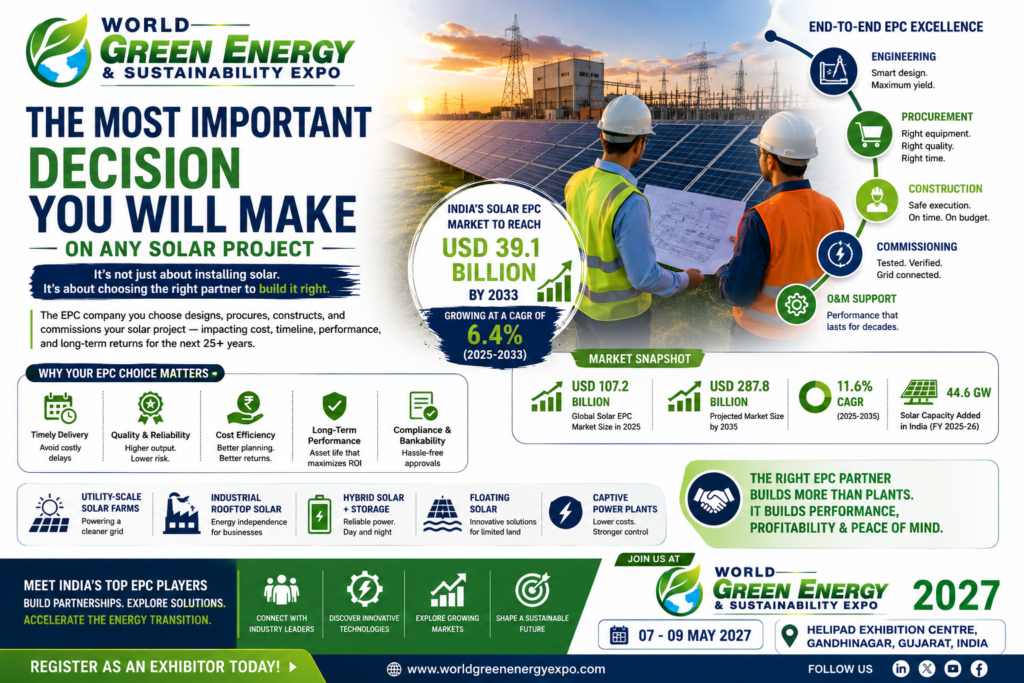
The EPC company – the Engineering, Procurement, and Construction company – is the organization that turns a financial model and a set of technical drawings into a functioning power plant. They design the system. They source every major component. They manage the civil work, the electrical installation, the inverter commissioning, the grid connection, and the final testing and handover. A strong EPC company does all of that on time, on budget, and to a standard that delivers the energy yield the project economics depend on.
A weak EPC company does the opposite. Project delays cost money in interest, in lost generation revenue, and in contractual penalties. Component substitutions that were not approved can void module warranties. Poor civil engineering can create drainage problems that damage tracker foundations years later. Inadequate grid connection documentation can delay commissioning by months. These are not hypothetical risks. They are documented patterns that have played out on real projects across India and globally, and they are why the selection of an EPC company deserves far more rigorous evaluation than it typically receives.
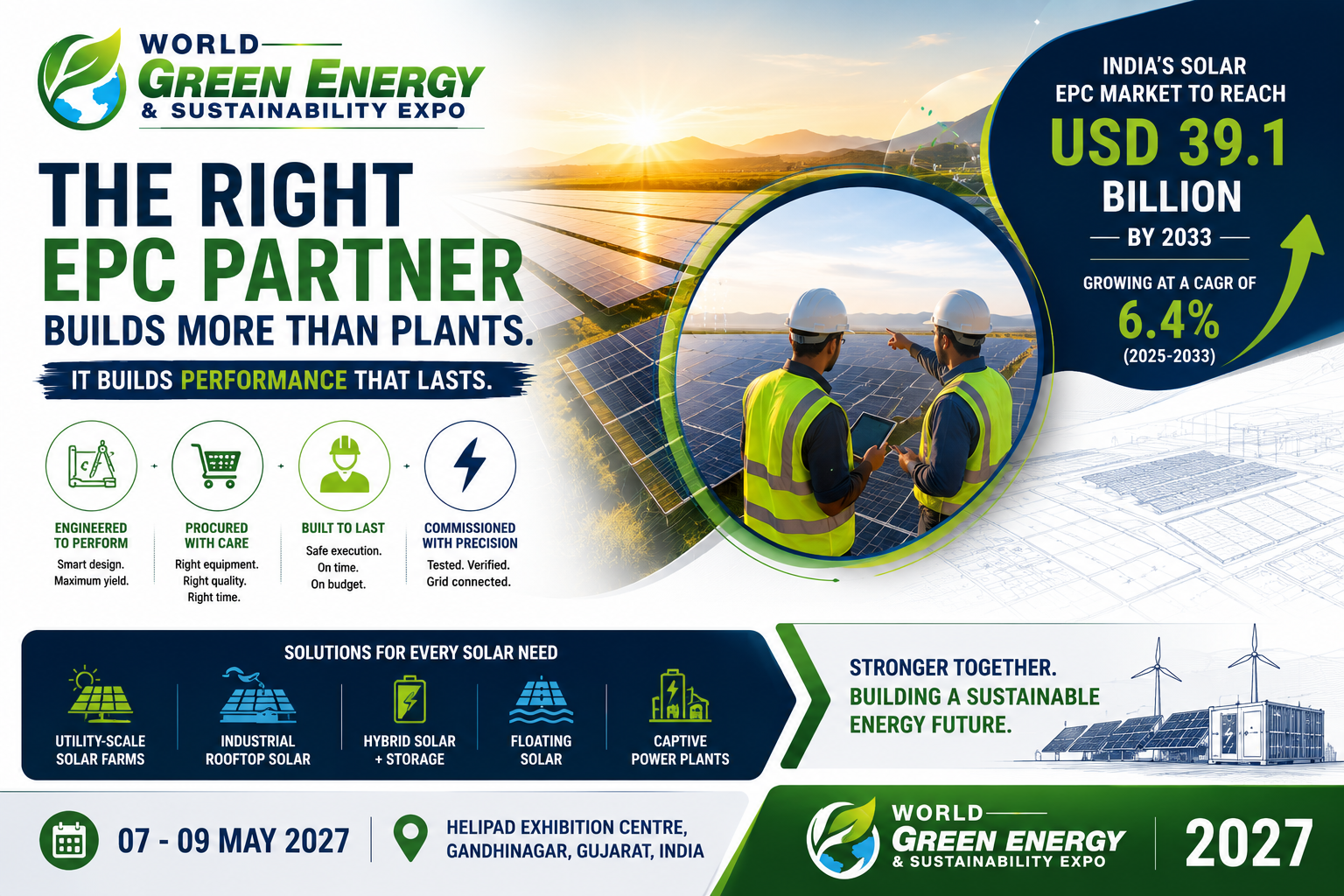
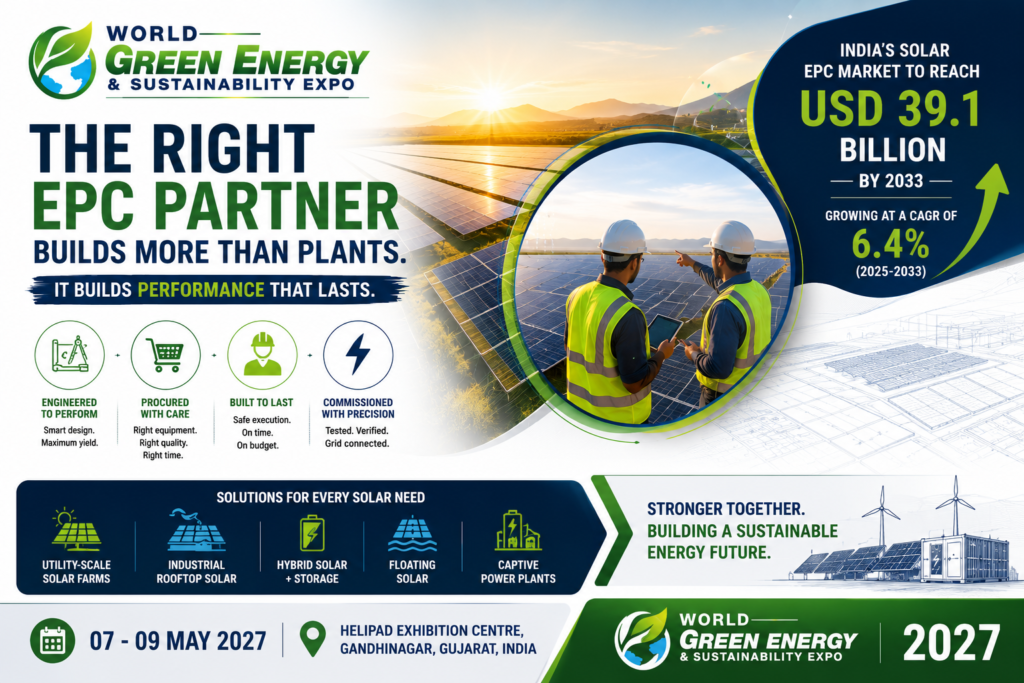
The solar EPC market size was valued at USD 107.2 billion in 2025 and is projected to reach USD 287.8 billion by the end of 2035, rising at a CAGR of 11.6% during the forecast period. In 2026, the industry size of solar EPC is estimated at USD 119.6 billion. The India power EPC market size reached USD 22.4 billion in 2024. The market is expected to reach USD 39.1 billion by 2033, exhibiting a growth rate of 6.4% during 2025 to 2033, driven by increasing renewable energy projects, rising energy storage investments, and government initiatives.
This article is a practical guide to navigating that choice correctly – built from the latest market data, real project experience, and the specific conditions of India’s rapidly scaling solar EPC market in 2027.
What an EPC Company Actually Does – and Why It Matters More Than You Think
EPC stands for Engineering, Procurement, and Construction. Each word represents a distinct phase of project delivery, and each phase carries its own specific risks and expertise requirements.
Engineering covers everything from the initial feasibility assessment and site survey through detailed system design, layout optimization, shadow analysis, structural calculations for mounting systems, electrical single-line diagrams, grid interconnection design, and the documentation required for regulatory approvals. Good engineering means your system generates maximum energy from your specific site conditions. Poor engineering means you are leaving yield on the table every day for the next 25 years.
Procurement covers the sourcing of every major component – modules, inverters, mounting structures, cables, transformers, SCADA systems, switchgear, and balance-of-system equipment. Procurement is where the financial risk of the project is concentrated, because it involves committing large sums to equipment that must arrive on schedule, meet technical specifications, and carry warranties that will actually be honored. A contractor that substitutes lower-quality components to protect its margin – without your knowledge or approval – is one of the industry’s most persistent problems.
Construction covers the physical transformation of a site from empty land or rooftop to a commissioned, grid-connected power plant. This encompasses civil works, foundation construction, rack and module installation, AC and DC electrical works, transformer installation, grid connection, commissioning, testing, and documentation handover. Construction is where project timelines either hold or collapse, and where quality control in execution determines how the system performs over its operating life.
A full-service EPC provider handles the complete lifecycle of a utility-scale project -reliable procurement ensures lower downtime and high generation, and a 25-year performance guarantee stability is what separates a genuine EPC partner from a simple contractor. Beyond these three core phases, most serious EPC companies also offer Operations and Maintenance services after commissioning – monitoring system performance, scheduling preventive maintenance, responding to faults, and managing warranty claims on components. The decision to bundle O&M with EPC or separate them is one of the most consequential structural choices in any solar project procurement strategy.
The Indian Solar EPC Market in 2027 – Scale, Competition, and Opportunity
India’s solar EPC market in 2027 is unlike anything that existed even three years ago. The scale of what is being built, the pace at which it is being built, and the financial and technical sophistication of the companies building it have all changed fundamentally.
India’s renewable energy sector saw explosive growth in FY 2025-26, adding 44.6 GW of solar and 6 GW of wind power, bringing cumulative capacity to 275 GW by March 2026. India has become the world’s third-largest country for installed renewable energy capacity, driven by record solar expansion and a major boom in domestic manufacturing. The India ground mounted solar EPC market is estimated at approximately USD 8 to 12 billion in 2026, with annual installed capacity additions of 15 to 20 GW. Growth is projected at a CAGR of 12 to 16% through 2035, driven by aggressive capacity auctions and corporate PPA demand.
India’s solar EPC market size will exceed USD 12 billion by 2026, driven by corporate PPA adoption, hybrid project demand, and the rapid expansion of industrial rooftop installations. The pipeline feeding this market is enormous. There are 169.40 GW of projects underway and 65.06 GW tendered, indicating India is steadily advancing toward its 500 GW renewable target for 2030, hence denoting an optimistic solar EPC market opportunity. India recorded its highest-ever annual solar capacity addition in the calendar year 2025, installing 36.6 GW – a 43% increase over the 25.6 GW added in 2024. In 2025, the country installed 29.5 GW of large-scale solar capacity, a 31% increase from the previous year.
The market is shifting structurally in ways that matter for anyone evaluating EPC partners. The market is shifting from simple fixed-tilt installations toward complex, tracker-based, and hybrid solar-plus-storage configurations, reflecting grid requirements for dispatchable renewable energy. India’s solar EPC market is highly competitive, with large engineering firms, renewable energy specialists, and new players all vying for market share. Major domestic and international companies are leveraging strategic alliances to expand their capabilities. Competition focuses on project execution timelines, quality standards, and pricing, as developers look for reliable, cost-effective solutions to meet India’s ambitious solar targets.
The cost benchmarks in this market are now well-established and worth knowing before entering any EPC negotiation. In 2026, the typical EPC price for a large-scale fixed-tilt project is INR 3.5 to 4.0 crore per MW, while single-axis tracker projects command INR 4.0 to 4.5 crore per MW. Any bid that comes in significantly below these ranges deserves careful scrutiny – it may reflect genuine efficiency, or it may reflect component substitution, inadequate contingency, or a contractor whose financial position means it cannot honor its obligations if the project hits trouble.
The Types of Solar EPC Contracts – Understanding What You Are Signing
Before evaluating individual contractors, you need to understand the contract structures available to you, because the type of EPC contract you sign determines the risk allocation between you and your contractor more fundamentally than any individual clause within it.
Full Turnkey EPC
This is the standard structure for utility-scale solar projects in India and globally. The EPC contractor takes full responsibility for engineering, procurement, construction, and commissioning – delivering a fully tested, grid-connected power plant against a fixed-price, fixed-timeline contract. You specify the output requirements. They deliver the plant. Price and time risk sits primarily with the contractor. This structure works well when you want maximum certainty on cost and timeline, when you do not have internal engineering capability to manage a more hands-on approach, and when you are dealing with an EPC contractor whose financial strength means they can genuinely absorb the risks they are taking on.
EPCM (Engineering, Procurement, and Construction Management)
In this structure, the contractor manages engineering and procurement on your behalf rather than taking principal risk on them. You retain more control – and more risk – than in a full turnkey contract. EPCM is used more often in complex or bespoke industrial projects than in standard solar farms and is less common in India’s utility-scale solar market.
Hybrid or Split EPC
Some large developers split the EPC scope – handling procurement of major components like modules and inverters directly through frame agreements with manufacturers and contracting separately for civil and electrical EPC. This approach can reduce module procurement risk (since the developer controls the supply chain) and potentially improve module pricing through scale, but it also creates interface risk between the procurement and construction contracts that requires sophisticated in-house management.
O&M Bundled vs Separate
The decision whether to bundle Operations and Maintenance with the EPC contract or procure it separately is consequential. Bundling creates a single point of accountability and aligns the EPC contractor’s interest in construction quality with long-term plant performance – a contractor who knows they are managing the plant for 10 years will not cut corners in installation. Separate O&M procurement allows competitive tendering for maintenance and can reduce long-term cost but removes that alignment incentive.
The Top Solar EPC Companies in India – Who Is Leading the Market
Understanding who the leading EPC companies are – and what differentiates them – is the starting point for any serious contractor evaluation.
Tata Power Solar, Jakson Green, KPI Green (KP Group), Sterling and Wilson, Amara Raja Infra, and HARTEK were the top utility-scale solar engineering, procurement, and construction service providers in 2025. The top five utility-scale solar EPC service providers together accounted for 64% of the market share in 2025, indicating moderate market consolidation and highlighting the importance of execution strength, access to large projects, and timely delivery.
Tata Power Solar – Market Leader
Tata Power Solar emerged as the leading utility-scale solar EPC company in 2025 with a 19% market share. Growth was driven by the execution of large central government projects, which significantly increased its commissioned capacity. In January 2026, Tata Power Renewable Energy Limited reported that it had achieved a major milestone by commissioning 10 GW of EPC projects, which include 9.7 GW solar and 290 MW wind. In FY26’s first nine months, it added 1.88 GW capacity, which is a 33% rise over FY25, with Q3 FY26 marking its highest-ever quarterly addition of 941 MW.
Tata Power Solar is one of the oldest and most trusted EPC companies in India. The company has been working on solar energy for more than 30 years, with a strong brand reputation, end-to-end solar solutions, extensive experience in both rooftop and utility-scale projects, and robust R&D capabilities.
Jakson Green
Jakson Green secured its position in this list with a 15% market share in 2025, supported by the execution of utility-scale projects. During the year, Jakson Green and Blue Leaf Energy announced a partnership to develop a 1 GW solar project in Rajasthan, representing an investment of INR 34.85 billion – approximately USD 400 million.
Sterling and Wilson Renewable Energy
Sterling and Wilson accounted for 12% of the utility-scale solar EPC installation market share in 2025, supported by improved project conversion and faster execution timelines. The company also secured a INR 13.81 billion solar EPC order from Adani Green. Sterling and Wilson brings genuine global pedigree to its India EPC business. With over 21.4 GW of solar projects completed across 28 countries – including the 1,177 MW Sweihan project in Abu Dhabi, which was the world’s largest single-location solar PV plant when commissioned – it brings international best-practice execution to Indian projects at a scale that few domestic competitors can match.
In November 2025, Sterling and Wilson Renewable Energy stated that they secured a turnkey EPC contract for a 240 MW AC solar PV project in South Africa, valued at approximately USD 147 million, demonstrating the international reach that makes it one of the more bankable contractors for projects requiring internationally recognized EPC track records.
Amara Raja Infra
Amara Raja Infra ranked fourth on the utility-scale solar EPC list, entering the top ten in 2025 and expanding its solar EPC presence through its infrastructure execution experience. Amara Raja Infra’s parent company is one of India’s leading battery manufacturers – giving the group a unique combination of solar EPC and BESS manufacturing capability that positions it well for the growing hybrid solar-plus-storage project segment.
HARTEK Group
HARTEK rounded off the top five EPC service providers in 2025, accounting for almost 9% of the market share. HARTEK’s rapid rise to the top five in a single year reflects both the quality of its project execution and the sheer scale of India’s project pipeline – which is large enough to elevate strong regional players into national prominence quickly when they execute consistently.
KPI Green Energy (KP Group) – Gujarat’s Most Versatile Full-Service EPC Player
KPI Green Energy occupies a genuinely unique position in India’s solar EPC landscape – and one that deserves far more recognition than it typically receives in national market coverage that tends to focus exclusively on the largest pan-India contractors.
KPI’s catalogue is best understood as renewable power products and project-development services: solar IPP projects, wind and hybrid IPP, captive solar, wind and hybrid plants for customers, balance-of-system and EPC services for large developers, floating solar, standalone BESS, an early-stage green hydrogen prototype, and licensed power trading. KPI’s manufacturing-like capability is construction integration – turning bought equipment into a commissioned plant.
What distinguishes KPI Green Energy from most EPC companies on this list is the breadth of its capability across every solar sub-segment simultaneously. Ground-mounted utility-scale. Captive power for industrial buyers. Rooftop. Floating solar. Balance-of-plant supply to major developers. And now standalone BESS. Very few companies anywhere in India serve all of these segments from a single platform.
During FY26-27, KPI Green Energy secured a 102 MW floating solar EPC contract from Gujarat State Electricity Corporation Limited. It also received a letter of intent for a 445 MW public solar project supported by viability gap funding. In addition, the company received balance-of-plant supply and on-site services orders from Adani Green Energy for 305 MW of capacity. KPI Green Energy’s captive power producer order book increased to 2.572 GW in FY26-27, up from 2.426 GW in the previous quarter, reflecting sustained inflows.
The GSECL floating solar contract is particularly significant – not just for its scale but for what it signals about the company’s direction. KPI Green Energy received a work order from Gujarat State Electricity Corporation Limited for the engineering, procurement, and construction of a 142 MW DC and 110 MW AC floating solar photovoltaic project at the reservoir of the Kadana Dam in Mahisagar district of Gujarat. The project involves full turnkey scope – design, engineering, procurement, construction, and installation of the floating PV system, along with grid-connection infrastructure including a 33 kV underground transmission line to the pooling station and 33/220 kV bays at the Kadana substation. The project is slated for completion within 18 months and includes a comprehensive 10-year operation and maintenance contract.
On securing this project, Dr. Faruk G. Patel, Chairman and Managing Director of KP Group, said: “Winning the 110 MW floating solar EPC contract from GSECL is a major milestone for KPI Green Energy and the KP Group. It expands our portfolio into next-gen floating solar technology, reinforces our full-service EPC credentials, and underscores our commitment to driving India’s energy transition. We look forward to executing this project safely, on time, and to the highest quality standards.”
The company’s large developer relationships also deserve attention. KPI Green Energy emerged victorious in Coal India’s auction for a 300 MW grid-connected solar project at Kutch’s Khavda Solar Park in December 2024, valued at INR 1,311 crore. Prior to that, in July 2024, the company won letters of intent totaling 917 MW DC across solar and hybrid projects under Gujarat Urja Vikas Nigam Limited auctions, including 250 MW solar and 370 MW wind-solar hybrid projects. KPI Green’s captive and EPC order book stood at approximately 1.76 GW in mid-2025, with an additional 1.5 GW pipeline in the Independent Power Producer segment. The company’s revenues and profits have been on a strong upward trajectory – Q4 FY25 reported a net profit of INR 99 crore and nearly doubled revenues to INR 569 crore year-on-year. KPI Green aims to replicate its 60 to 70% annual growth trajectory in the medium term.
KP Green Engineering – the group’s infrastructure manufacturing arm – adds a further dimension that strengthens the EPC capability. It manufactures solar module mounting structures, wind lattice towers, transmission towers, substations, and switchgear – meaning KPI Green EPC projects can draw on in-house manufactured balance-of-plant components rather than being entirely dependent on external suppliers. This manufacturing-backed EPC integration gives KP Group a structural cost and quality control advantage that most Gujarat EPC competitors cannot match.
Why KPI Green Energy matters for World Green Energy & Sustainability (WGES) Expo 2027:
KPI Green Energy is the most naturally aligned EPC company with the World Green Energy & Sustainability (WGES) Expo 2027 audience for a simple reason – it is headquartered in Surat, Gujarat, operates its entire project development and EPC business from Gujarat, and serves the precise mix of industrial captive power buyers, state utilities, and large developers who are the core visitor and exhibitor community at World Green Energy & Sustainability (WGES) Expo 2027.
For industrial companies in Gujarat and across India seeking a captive solar EPC partner that understands the state’s regulatory environment, DISCOM relationships, and grid connectivity landscape better than virtually any competitor, KPI Green Energy is the first domestic name to evaluate.
For equipment manufacturers – module suppliers, inverter companies, mounting structure providers, BESS integrators – seeking to establish supply relationships with one of Gujarat’s fastest-growing EPC buyers, KPI Green’s growing order book and multi-segment procurement needs make it an immediate and relevant procurement target.
Larsen and Toubro Power
Larsen and Toubro’s renewable energy division has become a major solar EPC company in India. With a portfolio of 22 GWp of renewable EPC experience, L&T is not just a big player in India but a leading player globally. L&T brings something most specialist EPC companies cannot match: the full engineering and manufacturing resources of one of India’s largest industrial conglomerates behind every project, including in-house substation manufacturing, civil construction capability, and financial strength that eliminates virtually any concern about contractor insolvency.
Waaree Renewable Technologies
In January 2026, Waaree Renewable Technologies Limited announced its board approval to acquire a 55% stake in Associated Power Structures Limited for INR 1,225 crore, making ASPL a subsidiary once completed. Waaree’s EPC division has a structural advantage that no other Indian EPC company currently matches: direct access to India’s largest solar module manufacturing base. A Waaree EPC project can be supplied with ALMM-listed, domestically manufactured modules at competitive pricing through a related entity – eliminating one of the biggest supply chain uncertainties that external EPC contractors face.
The Eight Criteria That Separate a Great EPC Partner from a Dangerous One
This is the core of this article – the practical evaluation framework that every developer, industrial buyer, and project investor should apply before signing an EPC contract.
Criterion 1: Proven Track Record at Your Project Scale
This is not a general question about total EPC portfolio size. It is a specific question: has this contractor successfully delivered projects at the same scale as yours – in terms of megawatts, site complexity, grid voltage level, and technology configuration? An EPC company that has delivered 500 residential rooftop systems is not automatically qualified to build a 100 MW utility-scale ground-mounted project. An EPC company that has built ground-mounted projects in flat terrain may not have the experience to manage a complex hilly terrain site with non-standard mounting configurations.
Solar EPC companies play a vital role in India’s clean energy growth by managing complete solar projects, including engineering, procurement, and construction, to ensure high quality and cost-efficient execution of megawatt-scale solar projects. Look for experience, completed projects, quality of components, warranty terms, financial stability, after-sales support, and customer reviews and NPS ratings.
Ask for a list of reference projects at comparable scale. Call the developers who commissioned those projects. Ask specifically about schedule adherence, equipment quality, response to problems during construction, and the contractor’s behavior when something went wrong. Every EPC company looks good in their own marketing material. Reference calls reveal the reality.
Criterion 2: Financial Strength and Balance Sheet Stability
An EPC contractor that cannot financially sustain a project through difficulties – equipment delivery delays, weather events, labor disruptions, or client payment delays – is a contractor that will either cut corners or abandon the project at the moment you can least afford it. Request audited financial statements for the last three years. Look for consistent revenue, manageable debt levels relative to equity, and adequate working capital to fund the project’s procurement and mobilization phases before your payment milestones trigger.
Access to affordable financing is still a hurdle for smaller EPC contractors, who often struggle to secure long-term capital. This matters directly to you as a project developer or buyer, because an EPC contractor with a weak balance sheet may require front-loaded payment terms that shift financing risk onto you, or may struggle to post the performance bonds and bank guarantees that a properly structured EPC contract requires.
Criterion 3: Component Procurement Quality and Transparency
Where does this contractor source its modules, inverters, and mounting structures? Are they procuring from BloombergNEF-listed, ALMM-compliant manufacturers? Do they disclose their supply chain to you as the client, or is procurement treated as opaque? Will they allow you or your lender’s technical advisor to inspect components at the factory or at the port before installation?
Import dependence remains a structural challenge – despite production-linked incentives, India remains structurally dependent on imported solar cells and modules, with domestic cell manufacturing meeting only 30 to 40% of demand in 2026, creating supply chain risk for EPC contractors. The ALMM requirement is now a binary compliance issue for any project seeking to benefit from government programs or to sell power to government utilities. Your EPC contractor must demonstrate that every module and cell in your system is sourced from an ALMM-listed manufacturer and must maintain that documentation as part of the project record.
Criterion 4: Engineering Capability and Design Quality
The quality of engineering directly determines the energy yield of your system – and yield is revenue. An optimally designed 10 MW system outperforms a poorly designed 10 MW system by 5 to 10% or more in annual generation, which on a 25-year project lifetime represents an enormous difference in total return. Ask to see sample engineering documentation from previous projects – layout drawings, shading analysis reports, single-line diagrams, and energy yield assessments. Compare their yield predictions against actual performance data from those projects. Sustainable contractors with genuine engineering depth will show you this; those relying on project management rather than engineering substance will deflect the question.
Digital technologies like BIM, IoT, and AI have improved project efficiency by 20 to 30%, reduced errors, enhanced safety monitoring, and enabled predictive maintenance across the EPC lifecycle. Leading EPC companies in 2027 are using Building Information Modelling for site layout optimization, drone surveys for site assessment, and digital project management platforms that give clients real-time visibility into project progress, procurement status, and quality inspection records.
Criterion 5: ALMM Compliance and Regulatory Knowledge
India’s regulatory framework for solar projects has become significantly more complex over the past two years, and an EPC contractor that does not understand it in detail will create compliance problems that fall on you as the project owner. India’s utility-scale solar EPC market in 2025 was driven by the commissioning of large central and state projects, along with accelerated project execution ahead of the implementation of the ALMM List II for solar cells from June 2026. This upcoming policy requirement created a time-bound execution window, leading developers and EPC players to accelerate project timelines to avoid potential supply constraints and compliance requirements.
Beyond ALMM, your EPC contractor needs detailed working knowledge of net metering regulations applicable to your DISCOM, open access rules and banking regulations in your state, grid interconnection technical standards, environmental clearance requirements, and the specific documentation requirements for any government subsidy or incentive program your project is accessing.
Criterion 6: Grid Connection and Utility Interface Experience
Grid connection is consistently cited as one of the most significant causes of project delays in India. An EPC contractor with established working relationships with the relevant STU, DISCOM, or PGCIL, and with documented experience in navigating grid connectivity agreements, injection point specifications, and metering equipment installation, is worth a significant premium over one that treats grid connection as an afterthought.
KPI Green Energy’s track record with GSECL, GUVNL, and Coal India project auctions – covering ground-mounted, hybrid, and floating solar formats – is a concrete example of what deep state utility interface experience looks like in practice. Their GSECL Kadana Dam floating solar project, which includes design and construction of a 33/220 kV substation bay as part of the EPC scope, demonstrates the level of grid infrastructure capability that complex projects genuinely require.
The lack of robust transmission infrastructure in certain regions of India can lead to bottlenecks, affecting the smooth delivery of solar energy to the grid. An experienced EPC contractor identifies grid connectivity risks early in project development – ideally before EPC contracts are even awarded – and builds the timeline and budget to manage them rather than discovering them mid-construction.
Criterion 7: O&M Capability and Long-Term Support
The best predictor of how a system will perform over its 25-year operating life is the quality of operations and maintenance it receives. An EPC contractor that can credibly offer long-term O&M – with a trained technical workforce, digital monitoring platforms, spare parts inventory, and performance guarantee commitments – gives you not just a built system but an ongoing performance partnership. Most top solar EPC firms offer O&M services such as monitoring, preventive maintenance, cleaning, troubleshooting, and warranty support. When evaluating O&M capability, look specifically at the contractor’s monitoring platform, their average response time to fault alerts, their approach to module cleaning in your specific climate, and whether they can provide performance ratio guarantees backed by liquidated damages for underperformance.
Criterion 8: Safety Culture and HSE Standards
Construction site safety is both an ethical requirement and a commercial risk management consideration. Accidents cause project delays, create legal liability, and signal poor site management capability that typically correlates with poor quality control in construction work more broadly. Ask for the contractor’s Lost Time Injury Rate and Total Recordable Incident Rate for the past three years. Visit an active construction site if at all possible – the physical condition of the site, the use of personal protective equipment, and the quality of traffic and plant management tell you more about a contractor’s actual safety culture than any policy document.
Red Flags – Warning Signs Every Buyer Must Recognize
Beyond the positive criteria, there are specific warning patterns that should make any buyer reconsider a contractor regardless of how competitive their price appears.
Unusually low bids without explanation – A bid that is 20% below the market range of INR 3.5 to 4.5 crore per MW for ground-mounted projects in 2026 needs a specific, verifiable explanation. If the contractor cannot explain the cost gap through documented sourcing advantages or genuine scope differences, the most likely explanation is that something is being underpriced – either margin, contingency, or quality.
Reluctance to disclose component brands – A contractor who will not name their module and inverter suppliers before contract signing is concealing something. This is a hard stop, not a negotiating point.
No track record at your project scale – Every EPC company has to execute their first large project at some point. That project should not be yours unless you have a specific reason to accept higher execution risk and have structured the contract accordingly.
Weak contractual protections – An EPC contract without adequate performance guarantees, liquidated damages for delay, retention money, performance bonds, equipment warranty pass-through, and defects liability period provisions is not a real EPC contract. It is a construction management letter with your capital at risk.
Poor reference call responses – If reference checks reveal past clients who are not willing to use the contractor again – even if they cannot say so directly – that reluctance is the most important signal in the entire evaluation process.
How the EPC Market Is Evolving – What Changes Everything in 2027
The solar EPC market of 2027 is structurally different from the market of 2022, and those differences directly affect how you should evaluate and contract with EPC partners.
Hybrid solar-plus-storage is becoming standard. The market is shifting from simple fixed-tilt installations toward complex, tracker-based and hybrid solar-plus-storage configurations, reflecting grid requirements for dispatchable renewable energy. An EPC contractor that does not have demonstrated experience in integrating BESS systems with solar generation – including the battery management systems, power conversion systems, and grid-interface protection relays that hybrid projects require – is structurally limited in the types of projects it can credibly deliver in 2027 and beyond.
Digital project delivery is now table stakes. Technological improvements and digitalization – advancements in solar technologies, high-efficiency PV panels, bifacial modules, energy storage integration, and digital project management tools – are improving project performance and efficiently driving the solar EPC market growth. Leading EPC companies are using drone-based site surveys, digital twins for construction monitoring, cloud-based quality inspection records accessible to clients in real time, and AI-based yield optimization tools in their engineering workflows. These are not premium add-ons – they are increasingly the baseline expectation for professionally managed projects.
Vertical integration is a competitive differentiator. Geographic expansion, vertical integration with manufacturing, and long-term O&M contracts are the main strategies opted for by players to maintain their leading position in the solar EPC market. EPC companies with in-house module manufacturing, mounting structure production, or inverter supply capabilities have procurement certainty advantages that become commercially significant during periods of component shortages or price volatility.
Consolidation is accelerating. The market will likely see consolidation as larger players absorb smaller ones, attracting more international investment and expertise. For buyers, consolidation is broadly positive – it means the EPC partners you choose from are increasingly financially stable, technically capable, and held to professional standards. For smaller EPC companies, it means the window to scale independently is narrowing.
EPC for Different Project Types – What Changes Across Segments
The evaluation criteria described above apply across all project types, but their relative weighting shifts depending on the specific segment.
Utility-Scale Ground Mounted (10 MW and above)
This is the most demanding EPC environment in terms of project management complexity, procurement scale, and regulatory navigation. The market is effectively served by a small number of large, financially strong contractors — the top five dominating 64% of market share tells you exactly how concentrated this segment is.
Developers like Adani Green, ReNew Power, Tata Power, and Ayana Power are the largest project owners, awarding EPC contracts to specialized contractors. For any buyer in this segment, bankability – the comfort that lenders and insurers have with your EPC contractor’s track record and financial strength – is a first-order consideration, not a secondary one. Many project finance structures require lender approval of the EPC contractor as a condition of financial close.
Commercial and Industrial Rooftop (100 kW to 5 MW)
This segment has the broadest contractor landscape – from large companies like Tata Power Solar and Waaree serving mid-to-large C&I clients, to thousands of regional and local EPC companies serving smaller industrial and commercial buyers. The evaluation criteria shift toward local service capability, faster turnaround timelines, DISCOM net metering relationship, and price competitiveness.
For C&I buyers, the most common mistake is selecting a contractor primarily on price without adequately evaluating the ALMM compliance of their module supply chain – which becomes critical if the buyer intends to claim accelerated depreciation benefits or access any government-supported tariff structure.
Residential Rooftop (1 kW to 20 kW)
The residential EPC market under PM Surya Ghar is unlike any other segment because the government subsidy framework defines the procurement rules. For commercial and industrial installations, most projects take around 4 to 12 weeks, depending on system size, approvals, and site conditions. For residential buyers, MNRE empanelment of the installer under PM Surya Ghar is a non-negotiable requirement for subsidy eligibility. Beyond empanelment, evaluate local presence, warranty terms, monitoring capability, and references from nearby installations in similar conditions to yours.
The Questions You Must Ask Every EPC Contractor Before Signing
Translated from the evaluation criteria above, here are the specific questions every buyer should put to every EPC contractor they are seriously evaluating.
- What is your largest single solar project successfully commissioned, and can you provide the contact details of the developer?
- What is your current order book, and what is your capacity to take on new projects without compromising execution quality or timeline?
- Which module, inverter, and mounting structure brands are you proposing for this project, and are they ALMM-listed?
- What are your actual financial results for the past three financial years, and what is your current working capital position?
- What are your LTIR and TRIR safety statistics for the past three years?
- What project management platform will you use, and will we as the client have real-time access to construction progress, procurement records, and quality inspection documentation?
- What performance guarantee will you provide on energy yield, and what are the liquidated damages provisions if the system underperforms?
- What are your O&M capabilities, and what specifically are you offering in terms of monitoring frequency, response time to fault alerts, and performance ratio commitments?
- How many projects have you completed that include battery energy storage integration alongside solar?
- What specific experience do you have with the DISCOM and grid connection process in the state where our project is located?
A contractor who provides confident, specific, and verifiable answers to all of these questions deserves serious consideration. A contractor who deflects, generalizes, or becomes evasive on any of them is telling you something important about how they will behave when things get difficult on your project.
Why World Green Energy & Sustainability (WGES) Expo 2027 Is Where You Find the Right EPC Partner
The single most consistent piece of advice from experienced solar developers about EPC contractor selection is to evaluate multiple contractors, build relationships before procurement starts, and make your decision based on demonstrated capability rather than the best-looking proposal document. That relationship-building process — evaluating multiple contractors, understanding their capabilities, assessing their financial position, and beginning the technical dialogue that precedes a formal tender — is exactly what World Green Energy & Sustainability (WGES) 2027 is designed to facilitate.
Gujarat, the host state of World Green Energy & Sustainability (WGES) 2027, is home to India’s most active solar EPC ecosystem. From Adani Solar’s procurement operation and Waaree’s manufacturing base to HARTEK’s northern India construction teams and Sterling and Wilson’s Gujarat project pipeline, the state concentrates more solar EPC activity per square kilometer than virtually anywhere else in the country.
KPI Green Energy – with its Surat headquarters, 2.572 GW active order book, and rapidly expanding EPC capability across ground-mounted, captive, floating solar, and BESS segments – is one of the most significant Gujarat-based players whose procurement relationships, technology partnerships, and project pipeline are directly relevant to every exhibitor & visitor category at World Green Energy & Sustainability (WGES) 2027.
As the solar EPC sector matures, partnerships between global developers and Indian EPC firms are likely to define the next decade of solar infrastructure in the country. Those partnerships begin with conversations – at technical conferences, exhibition stands, and networking sessions where developers meet EPC companies, EPC companies meet module and inverter suppliers, and international companies meet Indian partners who can help them navigate the specific requirements of India’s regulatory and procurement landscape.
For developers seeking EPC partners for India’s 169 GW project pipeline, for EPC companies seeking equipment suppliers for their growing order books, for international companies seeking Indian EPC execution partners for joint project development, and for industrial buyers evaluating their first rooftop or open-access solar investment – World Green Energy & Sustainability (WGES) 2027 is where these conversations start and where the partnerships that define the next decade of Indian solar are formed.
World Green Energy & Sustainability (WGES) Expo 2027 in Gandhinagar, Gujarat, is your fastest and most direct route to those relationships.
Register as an exhibitor at the World Green Energy & Sustainability (WGES) Expo 2027 today. Secure your position in front of India’s most active solar buyers, developers, investors, and policymakers – all in one place, at the moment the market is moving fastest.
For more details: contact us at info@adexexhibitions.com | +91 81770 53335 | +91 91528 96078
For Exhibitor Registration: If you have not registered, you may also fill out this Exhibitor Registration Form.