
The Molecule That Could Decarbonize Everything From Farming to Shipping
Ammonia has been one of the most industrially important chemicals on earth for over a century. It feeds the world – roughly half of all the nitrogen atoms in the human body passed through an ammonia molecule at some point on their journey from the atmosphere into food. It powers global shipping in an experimental but growing capacity. It stores and transports energy more efficiently than compressed hydrogen. And it is one of the most heavily traded commodity chemicals in global markets, with approximately 185 million tonnes produced and consumed every year.
There is one serious problem with all of that. Conventional ammonia production is among the most carbon-intensive industrial processes on the planet. The Haber-Bosch process – the century-old chemistry that synthesizes ammonia from hydrogen and nitrogen – consumes approximately 2% of global energy supply and generates roughly 2% of global carbon dioxide emissions. Almost all of the hydrogen currently fed into that process comes from natural gas through steam methane reforming, making conventional ammonia production as fossil fuel-dependent as any refinery.
Green ammonia changes that equation fundamentally. By replacing fossil-derived hydrogen with green hydrogen – produced through electrolysis powered entirely by renewable electricity – ammonia synthesis becomes a genuinely carbon-free industrial process from beginning to end. The molecule is the same. The chemistry is the same. The infrastructure for storage, shipping, and end use is largely the same. What changes is the carbon footprint, which drops from approximately 2.4 tonnes of CO2 per tonne of ammonia to effectively zero.
That combination – familiar molecule, proven chemistry, enormous existing infrastructure, zero carbon emissions – is why green ammonia has moved from a fringe clean energy concept to one of the most actively developed and invested sectors in the global energy transition within the space of about three years.
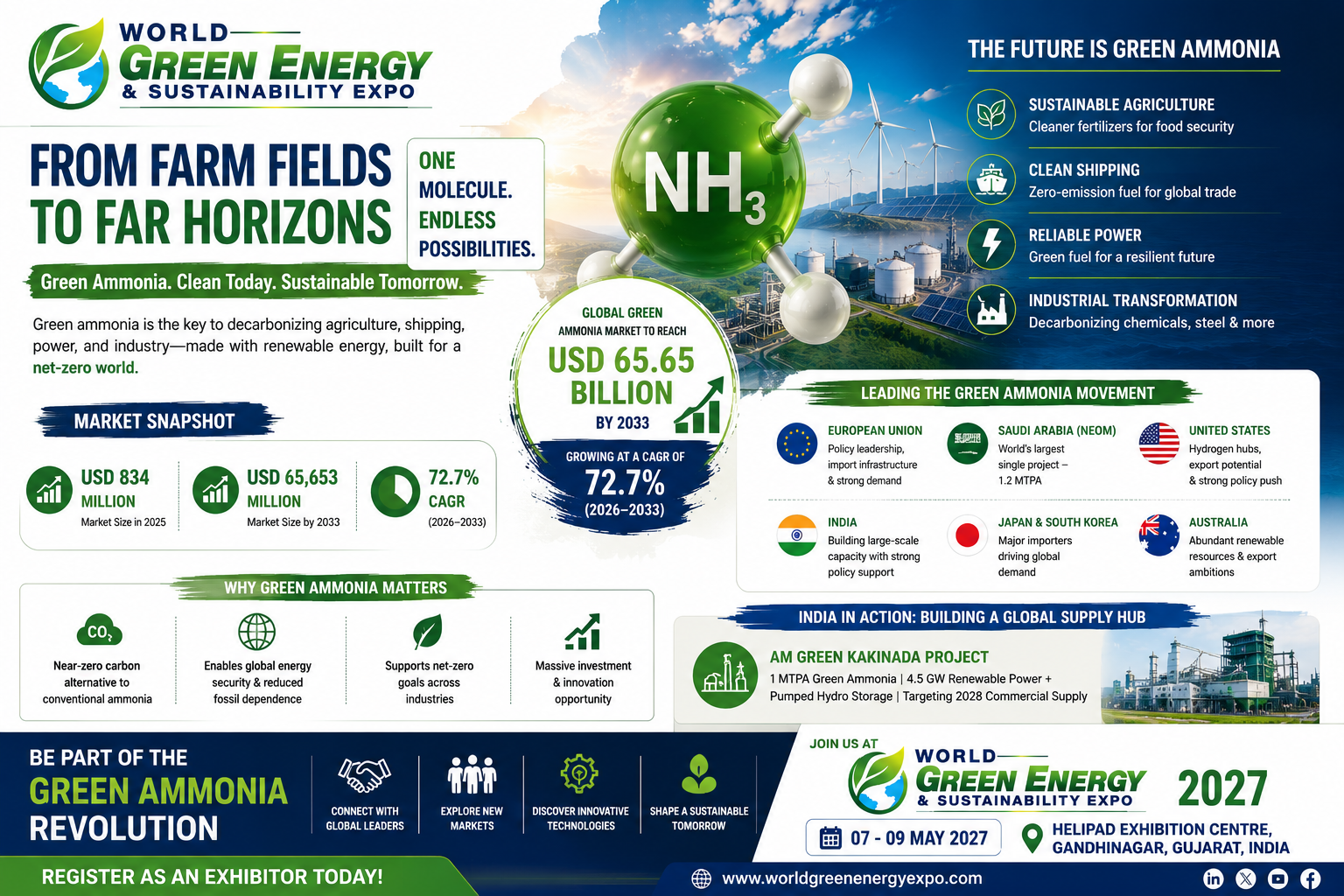
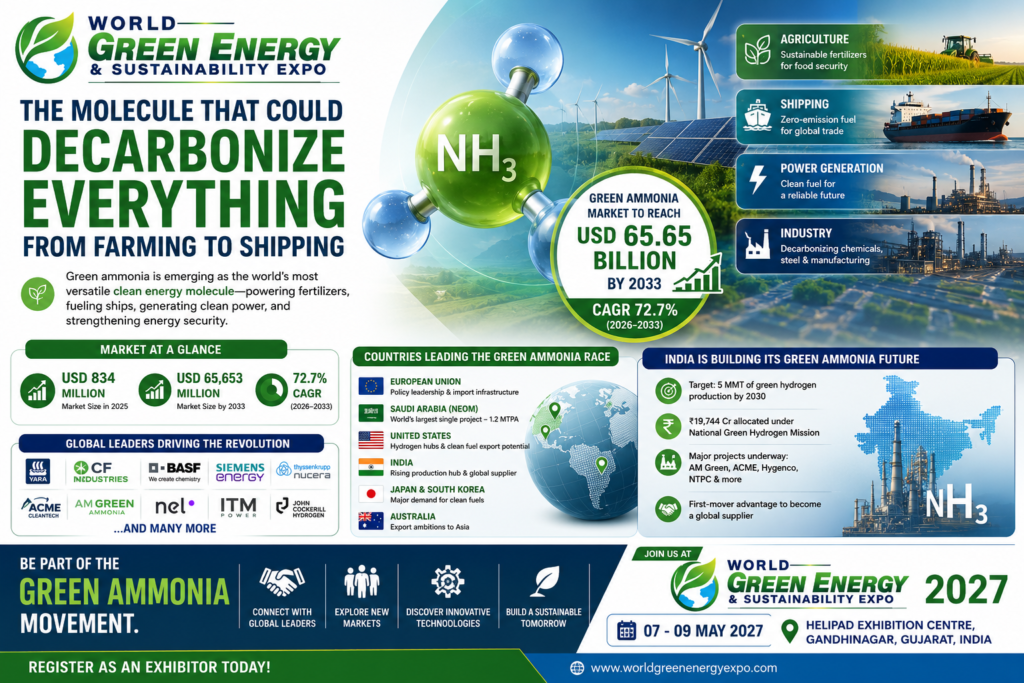
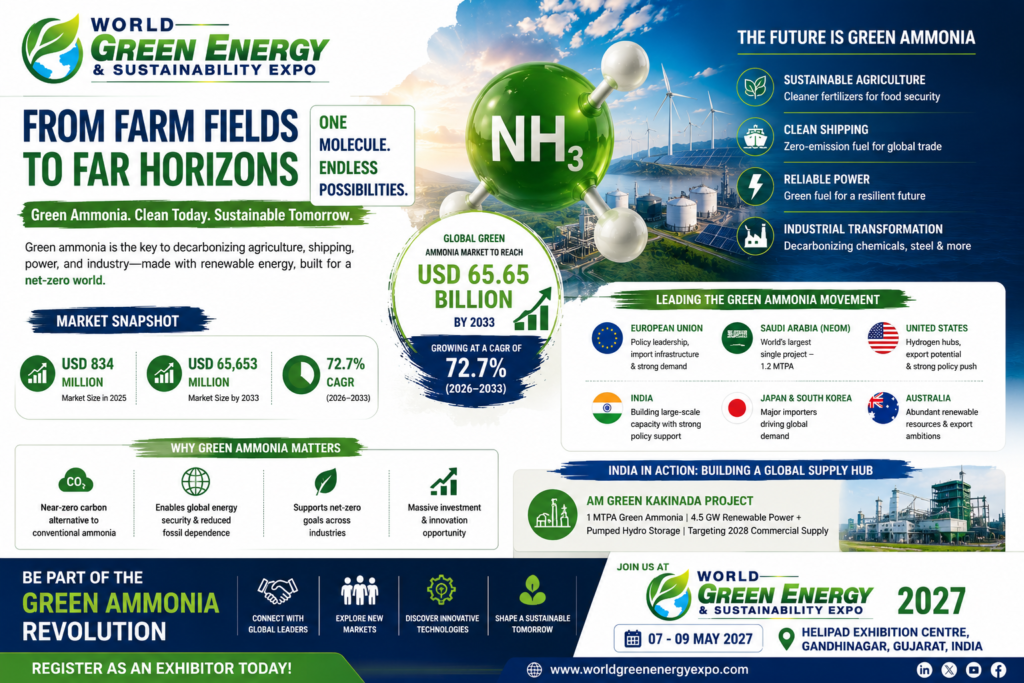
The global green ammonia market reached USD 834 million in 2025 and is projected to grow to USD 65,653 million by 2033, growing at a strong CAGR of 72.7% during the forecast period from 2026 to 2033. For industrial companies in fertilizers, chemicals, shipping, power generation, and food processing – and for the electrolyser manufacturers, renewable energy developers, engineering companies, and financial investors serving them – green ammonia is not a distant future opportunity. It is an active, capital-intensive, commercially real market right now.
The Global Green Ammonia Market – Where It Stands and Where It Is Going
Market sizing for green ammonia varies considerably across research houses, reflecting genuine uncertainty about the pace of project commissioning and the speed of cost reduction. But across every credible forecast, the direction and the growth rate are consistent – this is one of the fastest-expanding clean energy markets anywhere.
The green ammonia market size was valued at USD 0.52 billion in 2025 and is expected to reach USD 124.15 billion by 2035, growing at a CAGR of 72.9% over the forecast period of 2026 to 2035. The global green ammonia market trend reflects a structural shift in ammonia production from fossil-fuel-based steam methane reforming toward water electrolysis powered by renewable energy, driven by tightening carbon regulations, national net-zero commitments, and growing demand for green fertilizers and clean maritime fuel.
The global green ammonia market size was valued at USD 722.0 million in 2025 and is expected to reach USD 46,630.8 million by 2034, exhibiting a growth rate of 58.90% from 2026 to 2034. The green ammonia market growth is driven by increasing demand for sustainable energy solutions and the global push towards carbon-neutral industrial practices. The global green ammonia market is forecasted to reach USD 2.8 billion in 2026 and expand to USD 18.3 billion by 2036, advancing at a CAGR of 20.7%. Growth reflects increasing reliance on renewable-based ammonia production as industries seek alternatives to conventional fossil fuel-dependent processes.
Across all these projections, three application segments consistently drive the majority of demand. By application, the fertilizer segment accounted for the leading share of nearly 46% in 2025, and the transportation segment is expected to register the highest growth with a CAGR of 78.5%.
Fertilizers hold the largest market share of 40.3% in 2026, driven by growing demand from the agriculture industry. Ammonia is a key ingredient used to produce nitrogen fertilizers that are essential for maximizing agricultural yields to feed the world’s growing population.
The power generation segment is expected to grow at a CAGR of 91% during the forecast period. Renewable energy can be stored and reused for power generation at consumption sites with green ammonia production, improving the efficiency and long-term viability of renewable energy generation.
The growth rates in shipping and power generation are so high because they start from near zero – green ammonia as a maritime fuel and power generation feedstock barely existed commercially in 2023. The fertilizer segment’s growth is lower in percentage terms because it starts from a larger base, but in absolute volume terms it remains the largest end market by far through the end of this decade.
Why Green Ammonia Matters More Than Green Hydrogen for Industrial Scale
This is a point that receives far less attention than it deserves in most clean energy discussions, because hydrogen tends to capture the narrative while ammonia quietly solves the practical problems that hydrogen struggles with.
Green hydrogen – the foundation of green ammonia – is an extraordinary energy carrier. It has one of the highest energy densities by weight of any fuel. But it is notoriously difficult to handle at scale. It must be compressed to extremely high pressures or cooled to cryogenic temperatures of minus 253 degrees Celsius to be stored and transported as a liquid. It leaks through metal infrastructure. It causes hydrogen embrittlement in pipelines designed for other gases. And it requires entirely new storage, shipping, and distribution infrastructure wherever it needs to go.
Green ammonia solves most of these problems without solving all of them. Ammonia liquefies at minus 33 degrees Celsius – cold, but manageable with existing industrial refrigeration technology. It has approximately 1.7 times the hydrogen storage density of liquid hydrogen by volume. The global infrastructure for ammonia storage, tanker shipping, and port handling already exists across dozens of major industrial ports. And where green ammonia’s destination is fertilizer production, the ammonia simply goes directly into the existing production process without needing to be converted back to hydrogen at all.
Green ammonia is gaining traction as a low-carbon alternative for fertilizers, maritime fuel, and hydrogen storage, driven by net-zero targets, stricter emission regulations, and government incentives. Rising demand for sustainable fertilizers and ammonia-powered vessels, along with advancements in electrolyser efficiency and ammonia synthesis, are making it more viable. Additionally, its role as a hydrogen carrier supports the broader hydrogen economy, with countries like Japan, Germany, and the United States investing heavily in its commercialization.
For industrial companies evaluating the practical pathway from fossil-fuel-based operations to carbon-neutral production, green ammonia offers something that pure green hydrogen cannot: a route that uses mostly existing infrastructure, existing chemistry, and existing supply chain relationships, while eliminating essentially all the direct carbon emissions from the process. That combination of radical environmental improvement and practical commercial continuity is enormously attractive to the industrial sector, and it explains why so much of the most serious green hydrogen investment globally is flowing into green ammonia rather than pure hydrogen applications.
The Technology Behind Green Ammonia – From Electrolyser to Haber-Bosch
Understanding how green ammonia is made is essential for any company seeking to position itself in this supply chain.
The production process has two distinct stages. The first is green hydrogen production through electrolysis – splitting water into hydrogen and oxygen using electricity generated from renewable sources. The second is ammonia synthesis through the Haber-Bosch process – combining that green hydrogen with nitrogen extracted from air to produce ammonia under high pressure and temperature.
The Haber-Bosch process itself is over a century old and remains largely unchanged in its fundamentals. It operates at pressures between 150 and 300 atmospheres and temperatures between 400 and 500 degrees Celsius, using an iron-based catalyst. The process is well-understood, well-documented, and served by a mature engineering and equipment supply chain. Decarbonizing it requires only a change in hydrogen feedstock – from natural gas-derived to electrolysis-derived – without rebuilding the synthesis plant.
Electrolysis, however, is where the primary technological competition and cost reduction action is happening.
By technology, alkaline water electrolysis held the largest share of approximately 48.56% in 2025, and the solid oxide electrolysis segment is expected to register the highest growth with a CAGR of 31.7%. The solid oxide electrolysis segment is driven by its substantially higher electrical efficiency compared to conventional electrolysers, its ability to operate in co-electrolysis mode, and its compatibility with waste heat integration from the exothermic Haber-Bosch ammonia synthesis loop that improves overall system efficiency by 20 to 30%.
The alkaline water electrolysis segment has dominated the market with a 47.4% share in 2025. The low capital cost of the alkaline water electrolysis system is primarily driving segment growth. The solid oxide electrolysis segment is expected to witness significant growth at a CAGR of 73% during the forecast period.
The choice between electrolyser technologies has direct commercial implications for project economics. Alkaline electrolysis – the most established technology – has lower upfront capital costs and is available at the gigawatt scale needed for large green ammonia projects. PEM electrolysis responds faster to variable renewable electricity inputs, making it better suited to projects relying on solar or wind power without long-duration storage backing. Solid oxide electrolysis operates at high temperatures and can integrate the waste heat from the Haber-Bosch loop to improve overall system efficiency – potentially reducing energy consumption by 20 to 30% versus alkaline systems, but at higher equipment cost and lower commercial maturity.
The electrolysis segment is estimated to contribute the highest market share of 40.2% in 2026. As renewable energy costs decline worldwide, electrolysis is proving more economical than fossil fuel-based ammonia production. Manufacturers are ramping up large-scale electrolysis projects to capitalize on rising green ammonia demand.
The key performance challenge for any large-scale green ammonia project is electrolyser utilization rate – how many hours per year the electrolysers actually run at capacity. Haber-Bosch synthesis plants are designed for continuous operation and do not respond well to intermittent supply. This means projects relying purely on variable solar or wind without storage face a fundamental tension: more renewable curtailment reduces cost but also reduces electrolyser utilization and therefore production economics. The most innovative projects globally – including India’s AM Green – are solving this with long-duration energy storage that smooths renewable supply and maintains high electrolyser utilization rates.
Country-by-Country – Who Is Leading the Global Green Ammonia Race
European Union
The European region has dominated the market share accounting for 34% in 2025. The presence of green hydrogen projects particularly in Germany and the Netherlands are driving the regional green ammonia market growth. Supportive government initiatives and policies are supporting the production of green hydrogen for achieving energy transition goals and maintaining energy-intensive industries. Europe’s dominance in the green ammonia industry is attributed to supportive policies, a strong climate vision, and the use of cutting-edge technology. The EU vision is geared towards a climate-neutral Europe by the year 2050 through the European Green Deal and EU Climate Law.
Countries like France, the Netherlands, and Germany are building ammonia cracking terminals and storage hubs to support import and export needs. Industry leaders like Siemens, Ørsted, Thyssenkrupp, and ITM Power are collaborating to develop advanced electrolysers and modular production facilities. In May 2026, BASF, the German chemical giant, produced its first batch of green ammonia at its Verbund site in Ludwigshafen, using certified renewable hydrogen.
Germany is positioning itself specifically as the world’s largest green ammonia importer – not producer – because its renewable energy resources cannot support the scale of green ammonia production its industrial sector will need. In a significant move toward a sustainable future, Germany has awarded a tender to UAE-based Fertiglobe to purchase a minimum of 259,000 metric tons of green ammonia between 2027 and 2033. This contract, which marks the first of several global tenders aimed at importing green hydrogen derivatives, is a crucial step in Germany’s strategy to reduce emissions in hard-to-electrify industrial sectors and decrease its dependence on fossil fuel imports.
Saudi Arabia – NEOM and the World’s Largest Single Project
Saudi NEOM, backed by Air Products and ACWA Power, involves 4 GW of renewables feeding electrolysis to produce approximately 1.2 million tonnes per year of green ammonia from 2026. This single project – embedded within the NEOM smart city development in northwest Saudi Arabia – represents one of the largest individual green energy infrastructure investments in history. Its scale is enabled by Saudi Arabia’s exceptional solar irradiance, vast land availability, and strategic decision to diversify export revenues from fossil fuels toward clean energy molecules.
United States
The US green ammonia market is estimated at USD 0.23 billion in 2025 and is expected to reach USD 54.19 billion by 2035, growing at a CAGR of 73.4% from 2026 to 2035. The United States is positioned as both a significant production hub and a potential exporter of green ammonia, supported by the Inflation Reduction Act’s clean hydrogen production tax credit of up to USD 3 per kilogram, regional hydrogen hub designations that include ammonia as an end use, and abundant wind and solar resources in the Gulf Coast, Midwest, and Southwest. CF Industries’ Donaldsonville complex in Louisiana and OCI’s Beaumont facility in Texas represent the initial wave of US large-scale low-carbon ammonia capacity targeting international markets.
On 7 May 2025, a long-term contract was signed by ExxonMobil to provide Japanese trading company Marubeni with 250,000 metric tons of low-carbon ammonia per year. This is the first client contract for ExxonMobil’s proposed low-carbon hydrogen plant in Baytown, Texas, which is intended to be the biggest in the world.
Australia
Australia is investing in green ammonia export infrastructure alongside its green hydrogen development, targeting Japan and South Korea as primary long-term buyers. The country’s exceptional solar and wind resources – particularly in Western Australia and Queensland – support some of the lowest projected green ammonia production costs globally, below USD 500 per tonne at optimal sites by the early 2030’s.
Japan and South Korea – The Buyers
Both countries are approaching green ammonia as an import commodity rather than a domestic production opportunity, driven by their limited land area for renewable energy and their enormous industrial and power generation demand for low-carbon fuels.
On 7 May 2025, ExxonMobil signed a long-term contract to provide Japanese trading company Marubeni with 250,000 metric tons of low-carbon ammonia per year, demonstrating the establishment of long-term supply corridors between producing and consuming nations. Japan’s government has committed to using ammonia as a co-firing fuel in its coal power plants – a controversial but commercially significant bridging strategy that creates enormous near-term import demand for low-carbon ammonia.
South Africa and Namibia
Hive Energy and Linde in Nelson Mandela Bay, South Africa, are targeting the world’s largest green ammonia export plant, targeting 800,000 to 900,000 tonnes per year, with phase 1 online in 2025 and full operation by late 2026. Africa’s green ammonia potential is enormous – the continent has vast renewable energy resources and a strategic location between European demand markets and the Middle East – but infrastructure and financing constraints continue to slow project development relative to what the resource endowment alone would suggest.
North America Overall
North America dominates the overall market with an estimated share of 43.7% in 2026 owing to advances in electrolyser and synthesis technology. North America has established a strong market for green hydrogen, with major projects like EverWind Fuels’ USD 6 billion green ammonia project in Nova Scotia and Ohmium International’s 343 MW green hydrogen electrolysers in Mexico.
India’s Green Ammonia Story – From Vision to Construction
India’s position in the global green ammonia industry deserves particular and detailed attention, because it is simultaneously one of the largest potential production markets in the world and the host country of World Green Energy & Sustainability (WGES) Expo 2027.
The Government of India has allocated INR 19,744 crore for the National Green Hydrogen Mission, targeting the production of at least 5 million metric tonnes of green hydrogen annually by 2030. The mission aims to position India as a global hub for green hydrogen and its derivatives while supporting a low-carbon economy.
Green ammonia sits at the absolute centre of this mission, for two reasons. First, India imports approximately 50% of its fertilizer needs – much of it as ammonia or ammonia-derived products – spending tens of thousands of crores of foreign exchange annually and creating a significant energy security vulnerability. Domestically produced green ammonia would eliminate that import dependence while simultaneously decarbonizing the fertilizer supply chain.
Second, India’s combination of world-class solar and wind resources, large coastal sites with access to export shipping routes, and competitive engineering and construction costs gives it genuinely strong economics for green ammonia production at scale – not just for domestic use but for export to Germany, Japan, South Korea, and the broader European and East Asian markets that are actively seeking green ammonia supply.
India’s SIGHT Program – The Policy Framework
India’s Strategic Interventions for Green Hydrogen Transition program, universally called SIGHT, provides direct financial incentives for green hydrogen and green ammonia production. On the basis of ten-year fixed contracts, Indian fertilizer producers will offtake 724,000 tonnes per year of renewable ammonia from domestic production projects. secured over half of this capacity, with 370,000 tonnes per year. The average delivered price from the auctions was USD 609 per tonne, with government subsidies under the SIGHT program already included in the price, namely USD 106 per tonne in the first year, USD 85 per tonne in the second year, and USD 85 per tonne in the third year, and additional subsidies from respective local governments.
Participating companies in India’s green ammonia fertilizer agreements include Indian Farmers Fertilizer Cooperative Limited, Coromandel International Limited, Paradeep Phosphates Limited, and Indorama India Private Limited. Developers involved in supplying green ammonia include ACME Cleantech, NTPC Renewable Energy, Oriana Power Limited, and SCC Infrastructure Pvt. Ltd.
AM Green – India’s Most Advanced Green Ammonia Project
The most significant single green ammonia project currently under construction in India – and one of the most technically sophisticated in the world – is the AM Green Ammonia AMGA-K1 project in Kakinada, Andhra Pradesh.
AM Green is focused on producing renewable hydrogen and converting it into renewable ammonia at scale. AM Green is developing a portfolio of renewable ammonia plants in India across Kakinada, Tuticorin, and Kandla with a targeted total production capacity of 4 million tonnes per year of renewable ammonia. The first plant of this portfolio, AMGA-K1, with 1 million tonnes per year capacity, is under construction in Kakinada, Andhra Pradesh, and achieved Final Investment Decision in 2024. The project reached another important milestone recently as its first major equipment was erected, making it one of a select few large-scale, RFNBO-compliant renewable ammonia plants under construction globally, aiming for commercial ammonia supply in 2028.
The technical architecture of AM Green’s project is genuinely innovative. AM Green has created a unique architecture for stable operations of the renewable ammonia plant based on integration of renewable energy capacity with long-duration pumped hydro storage. By integrating approximately 4.5 GW of combined wind and solar capacity with Greenko’s pumped hydro plant at Pinnapuram, a baseload supply of renewable electricity will be transmitted to the facility. The 1.68 GW and 10.8 GWh pumped hydro facility in Pinnapuram is in the same province of Andhra Pradesh, avoiding any issues with geographical correlation for RFNBO compliance. Combining renewables with pumped hydro storage allows the electrolysers to operate at over 85% utilization rate, decreasing production costs.
John Cockerill will supply a total of 1.3 GW of alkaline electrolysers for AM Green’s under-development renewable ammonia plant in Kakinada. John Cockerill and Technip Energies joint venture Rely will provide full engineering and commissioning services, with ammonia production due to begin in late 2026. BASF and AM Green will explore offtake of 100,000 tonnes per year of renewable ammonia from India. RWE Supply and Trading will offtake 250,000 tonnes per year of AM Green Ammonia’s RFNBO-compliant ammonia from production sites in India, with delivery expected from 2027.
The international off-take agreements secured by AM Green confirm India’s emergence as a credible global green ammonia supplier. Uniper and AM Green signed a long-term offtake agreement for the purchase of up to 500,000 tonnes of renewable ammonia annually from India. Shipment will commence in 2028 from the company’s 1 MTPA Kakinada facility. This agreement – described by Uniper CEO Michael Lewis as “one of the first large-scale supply corridors between India and Europe” – represents a defining milestone in establishing India’s commercial role in the global green energy molecule trade.
India’s National Committee on Transmission approved AM Green Ammonia’s application for general access to India’s inter-state electricity transmission system. AM Green Ammonia made the application requesting access to transmit 700 MW and 1,300 MW of renewable electricity from July 2026 and January 2027, respectively.
ACME Cleantech – The Other Giant
In January 2025, Sungrow Hydrogen signed an agreement to supply water electrolysis equipment for ACME’s 320 MW green ammonia project in Oman, with deliveries set for completion in 2025. The project, expected to begin operations in 2026, will initially produce 300 tonnes of green ammonia per day. ACME Group operates one of the world’s earliest pilot-scale green hydrogen and green ammonia plants and is developing multiple large-scale green ammonia and green methanol projects in India and Oman, designed for domestic and international markets. ACME secured 370,000 tonnes per year of the SECI domestic green ammonia tender – the largest single allocation – confirming its position as the most active commercial green ammonia developer in India’s domestic market.
Other Major Indian Players
In October 2024, Hygenco Green Energies launched one of India’s largest renewable energy tenders, aiming to procure over 1,125 MW of renewable power for their green ammonia project. This project emphasizes the company’s commitment to sustainability by sourcing 625 MW from solar and 500 MW from wind energy.
Additionally, the Odisha government approved a proposal from Welspun New Energy for a green ammonia facility with a 700,000 tonnes per year capacity, and a project by Aegis Vopak to construct an 80,000-tonne ammonia storage tank facility in Gopalpur.
NTPC Renewable Energy – the clean energy arm of India’s largest power utility – is also an active participant in the domestic green ammonia fertilizer tender, bringing its substantial balance sheet and grid development expertise to a sector where project scale and financing strength matter enormously.
Green Ammonia as a Shipping Fuel – The Maritime Decarbonization Opportunity
Of all the applications for green ammonia, its use as a zero-emission maritime fuel is simultaneously the most commercially nascent and the most strategically significant. International shipping is responsible for approximately 2.5% of global greenhouse gas emissions – roughly equal to Germany’s total annual emissions – and it is one of the hardest sectors to decarbonize because long-distance ships need fuels with very high energy density and cannot be electrified directly. Green ammonia, with its zero-carbon combustion profile and existing maritime transport infrastructure, is one of the leading candidates for decarbonizing deep-sea shipping alongside green methanol.
The transportation segment is expected to register the highest growth with a CAGR of 78.5%, as ammonia-powered vessels represent one of the most commercially promising pathways to zero-emission shipping across deep-sea trade routes. The International Maritime Organization’s revised GHG strategy, adopted in 2023, targets net-zero shipping emissions by around 2050, with interim milestones of 20% emission reduction by 2030 and 70% by 2040. These targets are creating direct regulatory demand for zero-emission fuels across the global shipping fleet.
Global demand as a maritime fuel is accelerating, with major shipping companies evaluating long-term green ammonia fuel procurement agreements as the most commercially viable pathway to IMO compliance for vessels operating on deep-sea trade routes between Asia, Europe, and North America.
The challenges of ammonia as a maritime fuel are real and should be stated honestly. Ammonia is toxic – it requires significantly more stringent safety protocols than conventional marine fuels in bunkering and onboard handling. Ammonia combustion engines require modifications to manage nitrogen oxide emissions. And the global bunkering infrastructure for ammonia fuel is essentially non-existent today, requiring enormous port infrastructure investment before commercial-scale ammonia-fueled shipping becomes routine.
None of these challenges are technically insurmountable – they are the normal engineering challenges of scaling a new fuel technology – but they do mean that ammonia shipping fuel will scale progressively from 2027 onward rather than replacing conventional bunker fuel overnight.
The Global Companies Building the Green Ammonia Industry
Major players in the global green ammonia market include Yara International ASA, CF Industries Holdings, Siemens Energy, FuelPositive Corporation, GEP Global, Iberdrola, KAPSOM, Avaada Energy, Thyssenkrupp Uhde, and Allied Green Ammonia. Top players in global demand include Yara International, CF Industries, BASF SE, Nutrien Ltd, Haldor Topsoe, Nel ASA, ThyssenKrupp AG, and Siemens Energy.
Yara International
Yara International is the world’s largest fertilizer company and the single most important incumbent player in the green ammonia transition.Yara is simultaneously a major conventional ammonia producer facing decarbonization pressure on its existing assets, a committed green ammonia developer through its Yara Clean Ammonia division, and a strategic off-taker for green ammonia from third-party producers including AM Green’s Kakinada facility. Its global ammonia terminal network and customer relationships across the fertilizer value chain make it an essential partner for virtually every new green ammonia producer.
Thyssenkrupp Nucera
Thyssenkrupp Nucera is one of the world’s leading electrolyser and ammonia synthesis technology providers – the engineering company whose alkaline water electrolysis technology underpinned India’s original Nangal green ammonia plant in 1962 and which is now delivering gigawatt-scale electrolysis systems for current green ammonia projects globally.
Nel ASA & ITM Power
Nel ASA and ITM Power are the leading independent European electrolyser manufacturers, both of whom are scaling manufacturing capacity aggressively to meet the growing project pipeline for green hydrogen and green ammonia production.
Siemens Energy
Siemens Energy provides both electrolyser technology through its Siemens subsidiary and Haber-Bosch synthesis equipment, making it one of the few companies capable of serving both halves of the green ammonia production process from a single supplier relationship.
John Cockerill Hydrogen
John Cockerill Hydrogen – the Belgian hydrogen technology company whose pressurized alkaline electrolysis technology is being used in AM Green’s Kakinada project – is establishing a GW-scale electrolyser manufacturing factory in Kakinada itself, directly alongside the project it is serving, in what amounts to an industrial co-location model that could become a template for future green ammonia hub development.
ACME Cleantech & AM Green
ACME Cleantech and AM Green represent India’s indigenous green ammonia development capability – companies that have moved from pilot scale to FID on million-tonne per year projects within a few years, demonstrating that India has the project development, financing, and technology integration capacity to compete at the global frontier of this industry.
The Challenges the Industry Must Overcome
An honest assessment of green ammonia’s commercial trajectory requires acknowledging the genuine barriers that still stand between the current project pipeline and the fully commercialized industry that market forecasts envision.
Cost remains the primary challenge. The average delivered price from India’s SECI green ammonia auctions was USD 609 per tonne, with government subsidies included – compared to conventional ammonia prices typically in the USD 300 to 400 per tonne range without subsidy support. Green ammonia is currently more expensive than conventional ammonia in virtually every market. Closing this cost gap requires continued reduction in renewable electricity costs, continued electrolyser cost reduction through manufacturing scale, and carbon pricing mechanisms that internalize the cost of conventional ammonia’s CO2 emissions into its market price.
Electrolyser supply chain constraints remain a real bottleneck. Scaling from the current global electrolyser manufacturing capacity of a few gigawatts per year to the hundreds of gigawatts needed for the full green ammonia vision requires factory investments, supply chain development, and workforce training that cannot happen instantaneously regardless of demand or capital availability.
Ammonia safety and handling expertise needs to be built or expanded in markets where green ammonia is being introduced as a new supply chain element – particularly in shipping fuel applications and in emerging market fertilizer production. The global ammonia industry has decades of safety experience, but it is not uniformly distributed, and expanding green ammonia into new geographies brings new safety management requirements.
Regulatory frameworks for green ammonia certification and trade are still developing. The EU’s RFNBO framework – the standard that AM Green’s Kakinada project is certified against – is the most developed internationally, but global harmonization of green ammonia certification remains incomplete, creating transaction costs and delays for cross-border trade.
What This Market Means for Industrial Companies Right Now
The strategic question for industrial companies in chemicals, fertilizers, shipping, power generation, and food processing is not whether green ammonia will become commercially significant. That question has been answered by the project pipeline, the government policy commitments, and the long-term offtake agreements already signed. The question is when they need to engage with this supply chain to avoid being caught behind their competitors.
For fertilizer companies, the SIGHT program’s domestic green ammonia auctions in India, Germany’s import tenders, and Japan’s low-carbon ammonia co-firing program are all creating structured, government-backed demand at commercially visible prices. Companies that sign long-term green ammonia supply agreements now are locking in supply at prices that are likely to look very competitive as carbon pricing tightens and conventional ammonia prices absorb those costs.
For chemical companies, green ammonia as a feedstock replaces one of the largest sources of Scope 1 emissions in chemical manufacturing – the steam methane reforming of natural gas that provides the hydrogen input for conventional ammonia synthesis. Every tonne of green ammonia substituted for conventional ammonia eliminates approximately 2.4 tonnes of CO2 from the production footprint.
For shipping companies, the window to engage with green ammonia as a bunker fuel – evaluating vessels, fuel specifications, bunkering logistics, and long-term supply agreements – is open now, before the IMO’s 2030 milestone creates acute urgency and potentially very tight green fuel supply relative to demand.
For electrolyser manufacturers, engineering companies, and renewable energy developers, the green ammonia project pipeline visible right now – across India, Saudi Arabia, the US, Africa, and Australia – represents a multi-decade procurement opportunity for the technologies and services that every large-scale green ammonia plant requires.
Why World Green Energy & Sustainability (WGES) Expo 2027 Is the Right Platform for the Green Ammonia Industry
Green ammonia sits at the precise intersection of the three largest industrial transformation stories of the 2020’s: the green hydrogen economy, the decarbonization of fertilizer and chemical manufacturing, and the transition of maritime shipping to zero-emission fuels. Each of these stories has direct relevance to the exhibitor and visitor communities at World Green Energy & Sustainability (WGES) Expo 2027.
India’s green ammonia industry is no longer a planning exercise – it is a construction reality. AM Green’s Kakinada facility is being built right now. ACME’s domestic offtake agreements are signed. NTPC Renewable Energy is an active green ammonia developer. The SIGHT program’s financial framework is operational. And international offtake partners including Uniper, RWE, BASF, and Yara are already engaged with Indian suppliers in binding commercial agreements.
For electrolyser manufacturers seeking project opportunities in India’s growing green ammonia pipeline, for engineering companies pursuing EPC contracts for ammonia synthesis and hydrogen production facilities, for renewable energy developers positioning their generation assets as certified power supply for green ammonia projects, for fertilizer companies evaluating green ammonia as a decarbonized feedstock, and for international investors seeking to understand where India’s clean molecule export opportunity is heading – World Green Energy & Sustainability (WGES) Expo 2027 is where every part of this conversation is happening, in the country where the most consequential green ammonia projects outside the Middle East are being built.
World Green Energy & Sustainability (WGES) Expo 2027 in Gandhinagar, Gujarat, is your fastest and most direct route to those relationships.
Register as an exhibitor at the World Green Energy & Sustainability (WGES) Expo 2027 today. Secure your position in front of India’s most active solar buyers, developers, investors, and policymakers – all in one place, at the moment the market is moving fastest.
For more details: contact us at info@adexexhibitions.com | +91 81770 53335 | +91 91528 96078
For Exhibitor Registration: If you have not registered, you may also fill out this Exhibitor Registration Form.