
India Just Did Something Nobody Thought Was Possible in 2025
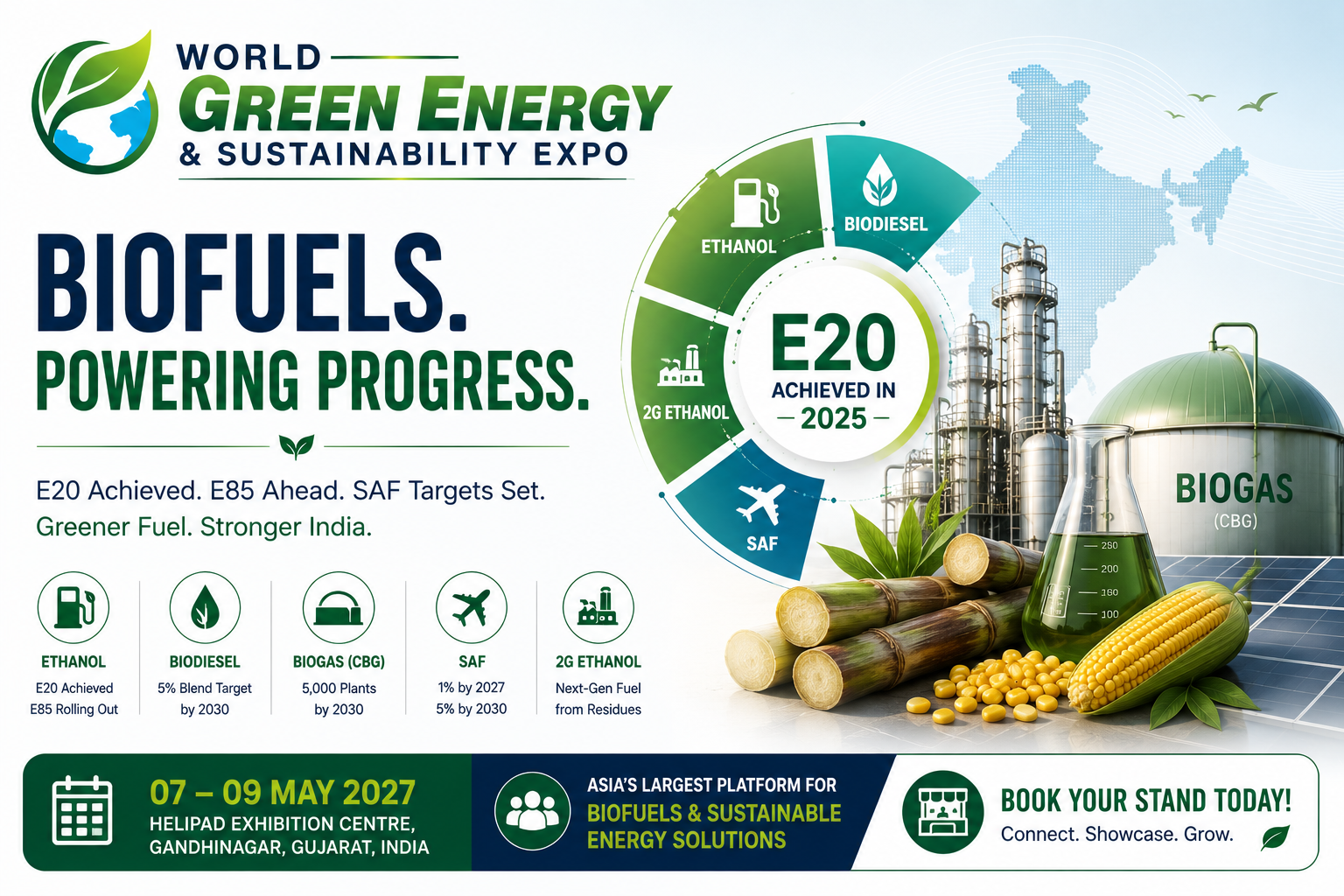
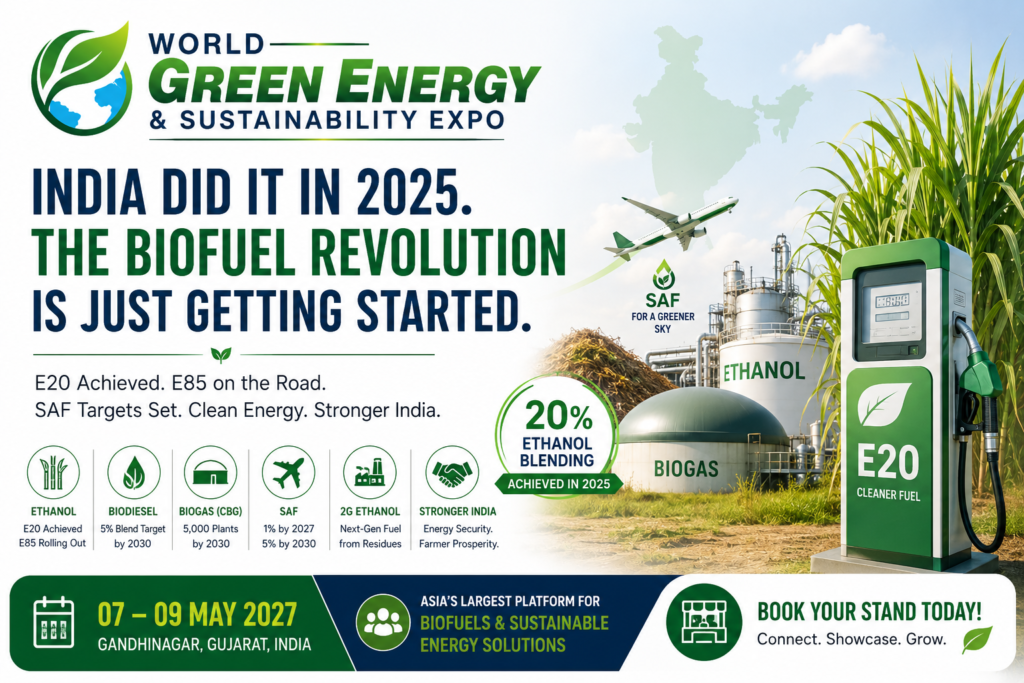
On a timeline that the government itself originally thought would take until 2030, India achieved 20% ethanol blending in petrol – E20 – in March 2025. Five years early. In a country that was blending less than 1.5% ethanol in petrol as recently as 2013. The numbers behind that achievement are extraordinary on every dimension.
Ethanol procurement rose from around 380 million liters in 2013-14 to an estimated 12 billion liters in 2025-26. Production capacity increased nearly fivefold, from 4.21 billion liters in 2014 to approximately 20 billion liters in 2026. Since 2014-15, the program has saved more than INR 1.90 lakh crore in foreign exchange, substituted over 310 lakh metric tonnes of crude oil, reduced approximately 930 lakh metric tonnes of CO2 emissions, and generated over INR 1.60 lakh crore in additional farmer earnings.
The E20 milestone is not the end of India’s biofuel story. It is the beginning of its next chapter.
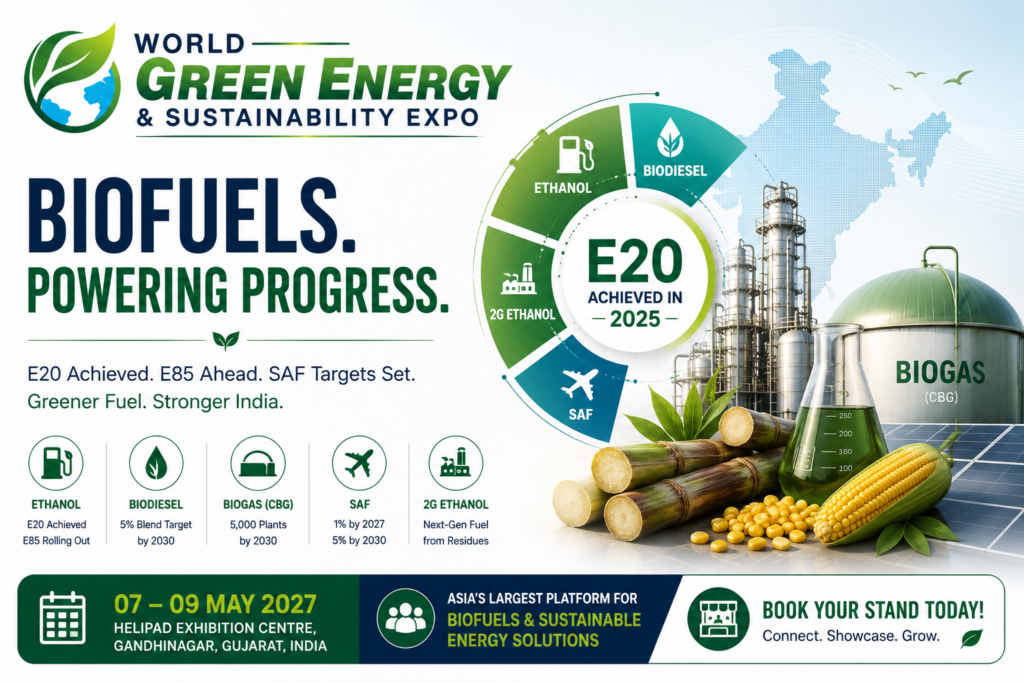
In April 2026, the Ministry of Road Transport and Highways released a draft notification to recognize flex-fuel vehicles running on E85 and E100. Around 48 retail outlets of public oil marketing companies started rolling out E85 fuel in June 2026. India has set progressive Sustainable Aviation Fuel blending targets of 1% by 2027, 2% by 2028, and 5% by 2030. The SATAT scheme targets 5,000 Compressed Biogas plants by 2030. And discussions are advancing toward E27 and selective E85 deployment by 2030 as the next milestone in what has become the world’s most ambitious national biofuel program outside Brazil.
For ethanol producers, distillery equipment manufacturers, grain processors, sugar mills, agricultural technology companies, biogas plant developers, SAF technology providers, and the hundreds of engineering and technology companies serving India’s rapidly expanding biofuel supply chain – this is the single most commercially important industry brief you can read heading into 2027.
India’s Biofuel Market – Size, Scale and Growth Trajectory
The India biofuel market size reached USD 6.2 billion in 2025 and is projected to reach USD 10.2 billion by 2034, exhibiting a CAGR of 5.57% during 2026-2034.
Other research houses apply broader scope and arrive at higher figures that better capture the full commercial ecosystem. India biofuels market size was valued at USD 3.82 billion in 2025 and is expected to reach USD 15.56 billion by 2032, growing at a CAGR of 22.2% – reflecting the inclusion of biogas, SAF, and advanced biofuels alongside conventional ethanol and biodiesel.
The India ethanol market – the single largest component – is projected to expand from USD 3.43 billion in 2025 to USD 11.78 billion by 2034 at a CAGR of 13.95%. Bio-ethanol leads with 87.6% share in 2025, drawn from sugarcane molasses, surplus sugar, damaged grains, and maize. Denatured ethanol dominates with 81.3% share in 2025, anchored by oil marketing company offtake under the Ethanol Blended Petrol program. India’s bioethanol market was valued at USD 2.3 billion in 2024 and will grow to USD 6.5 billion at a CAGR of 11.5% by 2033.
The regional distribution of India’s ethanol market is instructive for any company planning market entry or capacity investment. North India leads regionally at 31.5% share in 2025 – driven by Uttar Pradesh sugarcane, Punjab-Haryana grain feedstock, and the IOCL Panipat 2G plant. West India follows at 27.2%, anchored by Maharashtra’s sugarcane-dense western districts and Gujarat’s expanding grain-based distillery industry. South India accounts for 23.6% and East India for 17.7% – both growing as feedstock diversification and SATAT biogas expansion reach these regions.
The E20 mandate requires approximately 1,016 crore liters of ethanol annually by 2025-26, anchoring long-term offtake by IOCL, BPCL, and HPCL, and supporting distillery capacity expansion across India. Government-backed financing crossed INR 41,000 crore in interest-subvention loans by 2024 across more than 400 distillery projects – a capital deployment scale that represents genuine structural commitment rather than aspirational policy.
The E20 Achievement – What India Just Accomplished and Why It Matters
Understanding the scale of what India has done between 2013 and 2025 requires placing it in global context.
Brazil – the world’s biofuel pioneer – took approximately 30 years from its 1975 ProAlcohol program launch to achieve stable high-blend ethanol fuel deployment at national scale. India has compressed a comparable national biofuel transformation into approximately 11 years, against the structural challenges of a far larger, more diverse, and more fragmented agricultural and fuel distribution system.
Ethanol blending under the EBP Program increased from less than 1.5% in 2013-14 to 20% in 2025-26. India achieved the 20% blending target five years ahead of schedule. The progression tells a story of accelerating policy execution: 1.5% in 2013-14, 5% in 2019, 10% achieved five months ahead of schedule in June 2022, 12.06% in 2022-23, 14.60% in 2023-24, 17.98% in 2024-25, and 20% in 2025-26 – each step building on the infrastructure, institutional capacity, and supply chain relationships established in the previous phase.
The economic outcomes of this progression are measurable and significant on every dimension the government targeted. Since 2014-15, the program has saved more than INR 1.90 lakh crore – approximately USD 22.8 billion – in foreign exchange by reducing crude oil import dependence. India currently imports around 88.5% of its crude oil requirements, making fuel diversification a critical national priority. Replacing imported crude with domestically produced ethanol directly improves India’s current account balance by a figure equivalent to approximately one-quarter of the country’s annual education budget.
The environmental outcome is equally substantial. The program has reduced approximately 930 lakh metric tonnes of CO2 emissions since 2014-15 – equivalent to removing approximately 20 million passenger vehicles from Indian roads for a full year. This is not a projection or an estimate based on laboratory conditions. It is a measured outcome from fuel sales data across the country’s entire petrol distribution network.
The agricultural income outcome addresses one of the most politically sensitive dimensions of India’s economic development. The program has generated over INR 1.60 lakh crore in additional farmer earnings since 2014-15. For India’s sugarcane farmers – who supply the majority of the feedstock for sugar-based ethanol – the EBP has created a guaranteed and government-priced demand channel for their crop that reduces price volatility and improves income predictability in ways that market-based agricultural commodity trading never reliably delivers.
Confidence in E20 is reinforced by leading automobile manufacturers and energy sector experts, drawing on extensive testing and real-world service data. Across 2.84 crore vehicles serviced by Maruti Suzuki in FY 2025-26, more than 1.5 crore were over three years old and hence not E20-certified – yet no E20-related damage was found. Toyota Kirloskar confirms that vehicles undergo rigorous, independent certification worldwide, and that E10-designed vehicles have been tested extensively with E20 fuel. Hero MotoCorp reports that extensive analysis of service data found no incidence of higher damage in vehicles running on E20 compared to earlier fuels.
The Complete Policy Framework – Every Scheme Every Company Must Know
India’s biofuel policy ecosystem is unusually well-developed – spanning production incentives, feedstock pricing, infrastructure investment, research and development support, export facilitation, and international cooperation. Understanding it comprehensively is a commercial prerequisite for any company operating in this space.
National Policy on Biofuels 2018 (Amended 2022)
The National Policy on Biofuels 2018 is the cornerstone framework. It set the 20% ethanol blending target, allowed multiple feedstocks including sugarcane juice, molasses, surplus food grains, and agricultural residues, supported 2G ethanol projects using cellulosic biomass and waste, and provided viability gap funding for 2G bio-refineries using stubble, bamboo, and agricultural residues. The 2022 amendment formally advanced the 20% blending deadline to ESY 2025-26 from 2030, included newer feedstocks like damaged grains, and extended viability gap funding for 2G bio-refineries to 2026-27.
Ethanol Blended Petrol Program (EBP) -The Delivery Mechanism
The EBP is the operational program through which the National Policy’s blending targets are delivered. Under the EBP, oil marketing companies – IOCL, BPCL, and HPCL – procure ethanol from distilleries under the Administered Price Mechanism, which sets annual procurement prices differentiated by feedstock. Higher rates apply to ethanol from B-heavy molasses, cane juice, surplus rice, and maize – creating a feedstock diversity incentive that prevents the program from being entirely dependent on any single agricultural commodity. GST on ethanol for the EBP program was reduced from 18% to 5% – a structural cost reduction that directly improves distillery economics across every feedstock category.
Ethanol Interest Subvention Schemes (EISS)
The EISS provided 6% loan subsidies for new distilleries established between 2018 and 2022, with more than 200 projects benefiting directly. These subsidies catalyzed the capacity expansion that enabled India to reach E20 ahead of schedule – without the distillery capital expenditure they enabled, the feedstock diversification and production scale-up would not have happened within the program’s timeline.
PM JI-VAN Yojana – The 2G Ethanol Development Program
Pradhan Mantri Jaiv Indhan-Vatavaran Anukool fasal awashesh Nivaran Yojana – universally abbreviated as PM JI-VAN – provides viability gap funding for integrated second-generation ethanol bio-refinery facilities. India’s first 2G ethanol plant was IOCL’s Panipat facility in Haryana, producing 100 kiloliters per day from paddy straw. Projects at Bhatinda in Punjab, Bargarh in Odisha, and Numaligarh in Assam are in advanced stages of construction.
A total of INR 18 billion has been allocated for 12 integrated bioethanol projects. An additional INR 1.5 billion supports 10 demonstration plants. In August 2024, the Union Cabinet extended the PM JI-VAN Yojana timeline by five years to 2028-29 and expanded its scope to include industrial waste and algae alongside agricultural and forestry residues – reflecting the government’s commitment to advancing 2G technology commercialization on a timeline longer than originally envisioned. India aims to blend 5 to 10 billion liters of cellulosic ethanol into its fuel mix by 2030. The country produces 120 to 160 million metric tonnes of biomass annually, which could theoretically yield 30 billion liters of cellulosic ethanol each year.
SATAT – The Compressed Biogas Program
The Sustainable Alternative Towards Affordable Transportation scheme, launched in October 2018, targets 5,000 CBG plants across India by 2030. Oil marketing companies invite expressions of interest from potential investors and entrepreneurs to procure CBG for sale to automotive and commercial customers, providing investment certainty through long-term purchase agreements. As of March 2025, 100 CBG plants with a total production capacity of around 700 metric tonnes per day have been commissioned, with around 80 CBG plants at various stages of construction. Sales of CBG have been initiated from more than 280 retail outlets. CBG is also being supplied to industrial customers, and CBG injection in the city gas distribution network has started. India’s goal of building 5,000 large-scale biomethane plants by 2030 has positioned the country as a key market for biogas solutions globally.
Flex-Fuel Vehicle Policy – The Next Chapter
In April 2026, the Ministry of Road Transport and Highways released a draft notification to recognize flex-fuel vehicles running on E85 and E100, and approximately 48 retail outlets of public oil marketing companies started rolling out E85 fuel in June 2026. Existing E20-compatible vehicles cannot run on E100 without changes to engine calibration and fuel-system components – meaning higher blends require dedicated flex-fuel vehicles, new consumer demand, and a larger ethanol supply base.
If E20 blending continues and flex-fuel vehicles account for even 20% of new vehicle registrations by 2028, India’s ethanol demand could rise from around 1,016 crore liters in 2025 to about 1,600 crore liters by 2028 – an increase of more than 50%. Discussions are advancing toward E27 and selective E85 deployment by 2030, with the government’s stated position being that beyond-E20 blending is under active consideration rather than ruled out.
SAF – Sustainable Aviation Fuel Mandates
India has set progressive SAF blending targets: 1% for international flights by 2027, 2% by 2028, and 5% by 2030. The USDA Biofuels Annual confirms that international flights use 1% SAF by 2027 as a binding target. OMCs are engaged in setting up pilot and commercial scale SAF production facilities of nearly 332 kilotonnes per annum combined capacity. India’s first SAF-powered commercial flight took off in 2023, making India one of the first Asian countries to demonstrate domestic SAF in commercial aviation.
Global Biofuels Alliance – India’s International Biofuel Leadership
In September 2023, India launched the Global Biofuels Alliance at the G20 Summit in New Delhi – modeled on the International Solar Alliance that India pioneered in 2015. The GBA has rapidly expanded to 27 member countries and 12 international organizations, with the United States at 52% and Brazil at 30% of global ethanol production, alongside India at 3%, collectively representing 85% of global ethanol output within a single cooperative framework. India leads the GBA Secretariat, positioning itself as the global convener for biofuel technology sharing, policy harmonization, and market development.
Feedstocks – The Agricultural Foundation of India’s Ethanol Economy
India’s ethanol supply chain draws from multiple agricultural feedstocks, each with distinct economics, seasonal availability, and policy pricing – creating a complex procurement landscape that every distillery, grain processor, and agricultural company needs to understand.
Sugarcane and Molasses – The Historical Foundation
Sugarcane-derived ethanol – from C-heavy molasses, B-heavy molasses, and cane juice directly – formed the foundation of India’s ethanol blending program and continues to dominate production volumes.
Maharashtra, Uttar Pradesh, Karnataka, Tamil Nadu, and Andhra Pradesh are the primary sugarcane states, with Maharashtra’s cooperative sugar mills particularly significant. In March 2025, the government notified a new scheme for converting existing sugarcane-based plants of cooperative sugar mills into multi-feed ethanol plants capable of using grains, maize, and other inputs – diversifying the feedstock base and improving distillery economics across different crop years and price cycles. Sugarcane cultivation requires approximately 210 liters of water per kilogram of feedstock, raising water availability concerns in drought-prone states like Maharashtra where sugarcane cultivation is expanding in regions with varying water availability. This tension between ethanol program goals and water security is one of the most substantive policy challenges the program faces as it scales beyond E20.
Grain-Based Ethanol – The Growth Driver
The most dynamic feedstock shift in India’s ethanol ecosystem over the past three years is the dramatic growth of grain-based ethanol production – particularly from maize and FCI (Food Corporation of India) rice.
In the 2025-26 kharif season, maize cultivation rose by approximately 9 lakh hectares, partly driven by the incentive created by ethanol pricing for maize. Almost 7 million metric tonnes of corn could be diverted for ethanol in 2025-26. However, the incentive has worked almost too well in places – farmers planted so much corn that production surged, creating a market glut, and corn prices fell sharply, sometimes dropping to half the minimum support price. The government reinforced this trend by raising the price for ethanol produced from FCI rice in ESY 2025-26, making rice an even more attractive feedstock. Ethanol producers have increasingly favored FCI rice over corn because rice delivers a higher conversion rate to ethanol. This policy adjustment demonstrates the complexity of managing multiple feedstock incentives simultaneously across a national program operating at the scale India’s EBP has reached.
Agricultural Residues – The 2G Frontier
India produces 120 to 160 million metric tonnes of biomass annually, with paddy straw, sugarcane bagasse, corn stover, wheat straw, and bamboo among the most abundant and geographically concentrated residue streams. Converting this biomass to cellulosic ethanol through second-generation technology is the long-term feedstock strategy that reduces the food-versus-fuel tension that first-generation sugarcane and grain feedstocks create.
India’s first 2G ethanol plant at IOCL Panipat processes paddy straw – the agricultural residue that Punjab and Haryana farmers have historically burned in fields, creating the severe air pollution episodes that affect Delhi each winter. Converting paddy straw from a pollution problem into an ethanol feedstock addresses simultaneously an air quality crisis, an agricultural waste management challenge, and a biofuel supply gap – a triple-benefit proposition that explains why the government prioritized paddy straw as the demonstration feedstock for 2G technology.
Used Cooking Oil – The RUCO Program
FSSAI’s Repurpose Used Cooking Oil program collects used cooking oil from hotels, restaurants, and food processors for conversion to biodiesel. This circular economy approach uses a waste stream with zero feedstock cost as the input for biodiesel production – creating the most compelling feedstock economics of any biodiesel pathway when collection logistics are efficiently managed.
Ethanol Pricing – The Administered Price Mechanism That Makes the Market
Understanding how ethanol is priced in India is fundamental to evaluating the economics of distillery investment, grain procurement, and OMC offtake agreements. India operates an Administered Price Mechanism for ethanol procurement under the EBP, setting annual prices differentiated by feedstock. The 2025-26 ethanol procurement prices established by the Cabinet Committee on Economic Affairs are:
Ethanol from C-heavy molasses: INR 57.97 per liter. Ethanol from B-heavy molasses: INR 60.73 per liter. Ethanol from sugarcane juice and syrup: INR 65.61 per liter. Ethanol from surplus rice through FCI: INR 58.50 per liter. Ethanol from maize and other damaged grains: INR 56.28 per liter for maize, with damaged grains priced at INR 56.58 per liter.
The differential pricing structure is intentional – rewarding higher-octane and more carbon-efficient feedstocks while maintaining economic viability across the full range of feedstocks that India needs to supply its growing ethanol demand. The APM pricing mechanism eliminates the market price risk for distillers – a critical feature that has enabled the distillery capacity investment of INR 41,000 crore in interest-subvention loans across 400-plus projects.
Oil marketing companies – IOCL, BPCL, and HPCL – sign long-term purchase agreements with dedicated ethanol plants across India, ensuring stable procurement channels and encouraging private sector investments in production capacity. IOCL, BPCL, HPCL, and Numaligarh Refinery are scaling 2G commercial plants under JI-VAN.
The Companies Building India’s Biofuel Industry
India’s biofuel industry spans the complete value chain from sugarcane and grain farming through distillation technology, plant construction, ethanol blending, and advanced biofuel research. Several companies have built dominant positions across multiple segments of this chain.
Praj Industries – The Technology Leader
Praj Industries is India’s most comprehensive biofuel technology company – the only organization that covers the complete spectrum from 1G ethanol technology through 2G cellulosic ethanol through biogas through sustainable aviation fuel through green chemicals, all within a single technology and engineering portfolio. Praj has delivered more ethanol plant projects than any other company in India, with over 700 projects globally across its history. Its 2G ethanol technology – being deployed in IOCL’s Panipat plant and under development for the next generation of JI-VAN projects – is the primary Indian-developed cellulosic ethanol technology platform. Strategic acquisitions and expansions by Praj are reshaping competitive intensity across the ethanol engineering segment. Praj is also the primary Indian technology company developing sustainable aviation fuel production pathways – positioning it directly in the 1% SAF mandate market opening from 2027 and the 5% mandate by 2030.
Balrampur Chini Mills – The Integrated Sugarcane Leader
Balrampur Chini Mills is India’s largest integrated sugarcane company by distillery capacity, combining sugar production with ethanol distillation at multiple Uttar Pradesh sites. Its integrated model – capturing value from sugarcane across sugar, ethanol, and power co-generation – is the template for the cooperative sugar mill conversion program that the government’s March 2025 multi-feed distillery notification is designed to replicate at scale. Strategic acquisitions and expansions by Balrampur are reshaping competitive intensity across the ethanol production segment.
Triveni Engineering – The Uttar Pradesh Giant
Triveni Engineering is one of the largest sugarcane processors in India, with multiple integrated sugar and ethanol facilities across Uttar Pradesh. Its ethanol capacity expansion under the EBP’s interest subvention scheme positions it as one of the primary domestic suppliers to IOCL and BPCL’s Uttar Pradesh procurement operations. Strategic acquisitions and expansions by Triveni are reshaping competitive intensity alongside Balrampur and Praj.
Indian Oil Corporation (IOCL) – The State-Owned Anchor
IOCL is simultaneously the largest buyer of ethanol in India – through its OMC procurement operations – and an ethanol producer through its 2G Panipat plant and its dedicated ethanol plant long-term purchase agreements. IOCL’s dual role as buyer and developer gives it a structural position in the ethanol market that no private sector company can match. The IOCL Panipat 2G plant, producing 100 kiloliters per day from paddy straw, is India’s technology demonstration for cellulosic ethanol at commercial scale.
BPCL – The Refinery-to-Biofuel Integrator
In August 2024, BPCL launched India’s first biofuel blend High Flash High-Speed Diesel bunker at Mumbai Port, marking a milestone in green energy adoption for the maritime sector. BPCL is investing significantly in biofuel infrastructure including ethanol production facilities in various states to support the government’s blending targets. BPCL R&D is developing cost-effective enzymes for 2G bioethanol refineries, commercial production of bio-jet fuel, and CBG from biomass, food waste, and municipal solid waste.
Kotyark Industries – The Biodiesel Procurement Winner
Kotyark Industries secured a major contract worth INR 564 crore from OMCs including IOCL, BPCL, and HPCL for supplying 48,381 kiloliters of biodiesel between October 2024 and September 2025 – one of the largest single biodiesel supply contracts awarded to an Indian company, highlighting the growing institutional demand for biodiesel alongside the dominant ethanol program.
The Six Biofuel Segments – A Comprehensive Market Map for 2027
India’s biofuel industry is not a single market – it is six distinct and partially overlapping segments, each with different feedstocks, technologies, policy frameworks, and commercial dynamics.
1: First-Generation Ethanol (1G)
The dominant segment by volume and revenue, using sugarcane, molasses, grain, and damaged food grains as feedstocks through conventional fermentation and distillation. Fully commercial, policy-supported, rapidly scaling. The E20 achievement was built entirely on 1G technology. Production capacity of approximately 20 billion liters per year. Annual procurement exceeding 12 billion liters.
2: Second-Generation Cellulosic Ethanol (2G)
Using agricultural residues – paddy straw, bagasse, corn stover, bamboo – through enzymatic hydrolysis and fermentation. India’s first commercial 2G plant is IOCL Panipat. Multiple projects under PM JI-VAN at Bhatinda, Bargarh, and Numaligarh. Six commercial and four demonstration 2G ethanol plants have been approved. Target of 5 to 10 billion liters by 2030. Technology cost reduction and enzyme development are the primary commercial challenges. The most important long-term feedstock pathway for reducing food-versus-fuel competition.
3: Biodiesel
Produced from non-edible oils, used cooking oil through the RUCO program, and animal tallow through transesterification. Government target of 5% biodiesel blend in diesel by 2030. Biodiesel procurement increased from 0.6 million liters in FY 2021-22 to 489.3 million liters in calendar year 2024 – a genuine ramp-up but still a fraction of what the 5% target requires. Kotyark’s INR 564 crore contract demonstrates growing institutional procurement. No biodiesel trade in 2024 given import restrictions – entirely domestic production and consumption.
4: Compressed Biogas (CBG)
Produced from agricultural residues, cattle dung, and municipal solid waste through anaerobic digestion and purification. SATAT scheme targets 5,000 plants by 2030. 100 plants commissioned as of March 2025 with 700 MT per day capacity. 280-plus retail outlets selling CBG. CBG being injected into city gas distribution networks. GOBAR-Dhan program specifically targets cattle dung-to-biogas. India Energy Week 2026 highlighted India’s status as a key market for biogas solutions globally.
5: Sustainable Aviation Fuel (SAF)
The newest and fastest-growing segment by regulatory momentum. India: 1% SAF mandate for international flights from 2027, 2% from 2028, 5% from 2030. OMCs setting up 332 KTPA of SAF production capacity. Praj Industries is the primary domestic SAF technology developer. India-Brazil joint statement in September 2024 on SAF for coordinated position at international forums. India can be a great producer of SAF according to Airbus officials, with the fuel able to help reduce pollution across South Asian aviation routes.
6: Advanced and Next-Generation Biofuels
Third-generation biofuels from algae and microbes are at early commercial stage. Fourth-generation synthetic and CO2-capturing biofuels are at R&D stage only. CSIR-IIP Dehradun and multiple IIT research groups are active in this space. The PM JI-VAN Yojana extension to 2028-29 includes industrial waste and algae within its expanded scope – signaling that the government is deliberately creating the policy space for 3G technology commercialization before 2G has fully scaled, rather than sequentially.
The Feedstock Price and Food Security Challenge
Any assessment of India’s biofuel market must address the feedstock tension that has become the most substantive policy debate in the industry.
Maize is seeing stronger demand signals – in the 2025-26 kharif season, maize cultivation rose by approximately 9 lakh hectares, while oilseed area declined. Higher maize-based ethanol prices – which grew at 11.7% annually between 2022 and 2025 – could pull farmers away from pulses and oilseeds, deepening import dependence and complicating India’s crop diversification goals.
Feedstock choices also have implications for water available for agriculture. Paddy cultivation remains a primary driver of groundwater depletion in Punjab and Haryana. Sugarcane and maize are also water-intensive feedstocks, requiring approximately 210 litres and 500 litres of water per kilogram of feedstock respectively.
As blending volumes grow, the program’s next phase can be strengthened by publishing annual estimates of its total public expenditure, planning ethanol capacity in step with petrol demand and electric-vehicle adoption, and periodically reassessing feedstock incentives against food security, water use, and fiscal objectives.
The electric vehicle dimension adds an important nuance that every company planning long-term investment in India’s ethanol industry must incorporate. Petrol demand is expected to peak and then decline sooner as EV adoption grows. The total addressable market for ethanol blending is therefore not unlimited – it is bounded by petrol consumption, which will grow through the near term before peaking as EVs take share in the 2030s. Planning ethanol capacity with petrol demand, EVs, and food and water security in mind can avoid costly trade-offs.
State-by-State – Where the Biofuel Business Is Built
Uttar Pradesh – The Ethanol Capital
India’s most populous state is also its ethanol capital, driven by the world’s largest sugarcane cultivation area. Uttar Pradesh’s cooperative and private sugar mills collectively represent the largest single-state ethanol production base in the country. The state’s geography – with dense sugar mill clusters in western UP and grain-surplus regions in eastern UP – makes it naturally suited to both sugarcane-based and grain-based ethanol production simultaneously.
Maharashtra – The Sugarcane Belt
Maharashtra’s cooperative sugar mills are the backbone of sugar-based ethanol production in western India. The government’s March 2025 notification for converting cooperative sugar mills to multi-feed distilleries is particularly significant for Maharashtra, where sugarcane yields and sugar recovery rates are among the highest in the country. Mumbai Port’s role as BPCL’s marine biofuel launch point connects Maharashtra’s ethanol production to the emerging maritime biofuel market.
Punjab and Haryana – The Grain Corridor
These two states produce the paddy straw that feeds IOCL’s Panipat 2G plant and the maize and rice that supply grain-based ethanol distilleries across the region. The Iowa-Maharashtra Sister-State MoU signed in 2025 to promote cooperation in agriculture, food processing, and renewable energy reflects the international interest in India’s grain-based ethanol model from the world’s most advanced corn ethanol producer.
Gujarat – The Western Hub
Gujarat’s ethanol market is anchored by a combination of sugarcane processing in Saurashtra and the rapidly expanding grain-based distillery industry in north and central Gujarat. The state’s progressive industrial investment promotion policies and strong logistics infrastructure make it one of the preferred locations for new distillery investment under the EBP program. Gujarat’s positioning as World Green Energy & Sustainability Expo (WGES 2027) host state directly connects the exposition’s biofuel exhibitor community to the state’s active ethanol procurement and investment ecosystem.
Karnataka and Tamil Nadu – The Southern Producers
Both states have significant sugarcane cultivation and existing distillery infrastructure that has been progressively upgraded under the EBP. Karnataka’s ethanol production has grown substantially through the integration of existing molasses-based distilleries with new grain-processing capabilities. Tamil Nadu’s biofuel development includes both ethanol and biodiesel from non-edible oil plantations.
The International Dimension – Export Opportunity and Global Leadership
India’s biofuel story is no longer only domestic. The Global Biofuels Alliance that India launched at G20 in 2023 has made India the convener of international biofuel policy dialogue. India and Brazil released a joint statement on sustainable aviation fuel in September 2024 for a coordinated position at international forums. India signed a Letter of Intent with Italy in June 2024 for collaboration in green hydrogen and sustainable biofuels.
Export potential represents a significant opportunity. India has the opportunity to boost foreign exchange earnings by tapping into export markets for biofuels. There is established export demand for ethanol in Europe and Asia due to stringent biofuel blending mandates. Engineering firms are also exporting biofuel technologies overseas, creating scope for growth.
India’s rapidly evolving biofuels sector presents significant opportunities for international companies. US exporters of industrial ethanol, related technologies, and animal feed products are well-positioned to help India meet growing demand. The state of Iowa signed an MoU with Maharashtra in 2025 establishing a Sister-State partnership to promote cooperation in agriculture, food processing, and renewable energy. The distillers dried grains with solubles market offers another promising avenue. India’s growing ethanol industry has surged production of DDGS, a valuable co-product used in animal feed – creating an export opportunity for Indian-produced DDGS into Southeast Asian and Middle Eastern livestock markets.
The Business Opportunity – Segment by Segment
India’s biofuel industry creates distinct commercial opportunities across every part of the value chain – and World Green Energy & Sustainability Expo (WGES 2027) is the platform where those opportunities are accessed.
For distillery equipment manufacturers and engineering companies: India’s ethanol production capacity expansion from 4.21 billion liters in 2014 to 20 billion liters in 2026 – a nearly fivefold increase – represents one of the largest single-sector industrial equipment procurement programs in India’s history. The next phase – 2G cellulosic ethanol plants, multi-feed distillery conversions, and CBG plant buildout under SATAT – extends this procurement pipeline through 2030 and beyond.
For grain processors and agricultural technology companies: The EBP’s grain-based ethanol programme has created structured, government-priced demand for maize, damaged rice, and surplus food grains that is transforming agricultural procurement economics across Punjab, Haryana, Uttar Pradesh, Madhya Pradesh, and Bihar. Companies with grain handling, drying, storage, and transportation technology and infrastructure are direct beneficiaries of the programme’s grain feedstock shift.
For sugar mills and cooperative processing companies: The March 2025 notification enabling cooperative sugar mills to convert to multi-feed distilleries creates the most commercially significant structural change to Indian sugar mill economics since the introduction of the EBP itself. Mills that were previously locked into a single-commodity sugarcane processing model can now diversify revenue across sugar, ethanol, and power co-generation – improving year-round asset utilization and reducing exposure to sugarcane price cycles.
For SAF technology and aviation fuel companies: The 1% SAF mandate for international flights from 2027 creates the first structured regulatory demand for sustainable aviation fuel in India’s commercial aviation market. OMCs are establishing 332 KTPA of SAF production capacity. Praj Industries is the domestic technology leader. International SAF technology companies, biojet fuel process licensors, and feedstock logistics specialists have a directly accessible and government-mandated market opening in 2027.
For biogas plant developers and CBG technology companies: The SATAT scheme’s 5,000 plant target – with only 100 commissioned as of March 2025 – represents an enormous deployment pipeline requiring anaerobic digestion technology, biogas purification systems, compression equipment, storage infrastructure, and distribution logistics at a scale that the current domestic industry cannot supply without significant international technology partnerships.
For automotive companies and fuel system manufacturers: The E85 and E100 flex-fuel vehicle notification released in April 2026 opens the most commercially transformative opportunity in the Indian automotive aftermarket since the E20 mandate. Every existing petrol vehicle in India is a potential flex-fuel conversion candidate. Every new vehicle launched from 2027 onward faces a market where fuel station networks are beginning to offer E85 alongside E20. Fuel injector manufacturers, fuel pump specialists, engine calibration software developers, and materials companies serving the automotive sector all have direct commercial relevance to this transition.
Why World Green Energy & Sustainability Expo (WGES 2027) Is the Right Platform for India’s Biofuel Industry
India’s biofuel industry is entering its most commercially dynamic phase since the program’s inception – transitioning from E20 achievement to E85 and E100 deployment, from 1G to 2G technology, from domestic consumption to SAF and export ambition, and from national program to global leadership through the Global Biofuels Alliance.
Every part of this transition – the distillery equipment, the grain procurement technology, the 2G cellulosic ethanol engineering, the CBG plant buildout, the SAF production facilities, the flex-fuel vehicle components, and the international technology partnerships – represents procurement activity happening in the same geography and the same commercial ecosystem that World Green Energy & Sustainability Expo (WGES 2027) serves.
Gujarat, the host state of World Green Energy & Sustainability Expo (WGES 2027), is home to an expanding grain-based ethanol distillery industry, a strong sugarcane processing sector in Saurashtra, a BPCL refinery complex at Vadodara with active SAF development programs, and direct access to the Mumbai financial markets where most of India’s biofuel project finance is arranged.
For distillery equipment manufacturers seeking India’s growing 1G and 2G ethanol plant market, for grain technology companies targeting the EBP’s expanding grain feedstock procurement, for biogas plant developers targeting the SATAT 5,000 plant pipeline, for SAF technology companies accessing India’s 2027 aviation fuel mandate, for automotive suppliers evaluating the E85 and E100 flex-fuel opportunity, and for international companies building India entry strategies for the world’s most ambitious national biofuel program – World Green Energy & Sustainability Expo (WGES 2027) is where the most important commercial conversations in this industry are happening.
Register Today.
Contact: info@adexexhibitions.com | +91 81770 53335 +91 91528 96078 | Exhibitor Registration Form