
The Most Underrated Clean Energy Technology Working Inside Every Organic Waste Stream
There is a biological process happening right now – at this exact moment – inside every cow’s stomach, at the bottom of every lake, under every rice paddy field, and deep within every landfill in the world. Microorganisms are consuming organic material in the absence of oxygen and producing methane gas as a metabolic by-product. This process has been happening continuously on Earth for approximately 3.5 billion years.
Humanity discovered it could be harnessed commercially in the 19th century. The first known biogas plant was built at a leper colony in Bombay, India, in 1859. But it was not until the convergence of renewable energy policy mandates, organic waste management regulations, carbon market incentives, and technology maturation in the 21st century that anaerobic digestion crossed from a niche agricultural technology into one of the fastest-growing clean energy markets in the world.
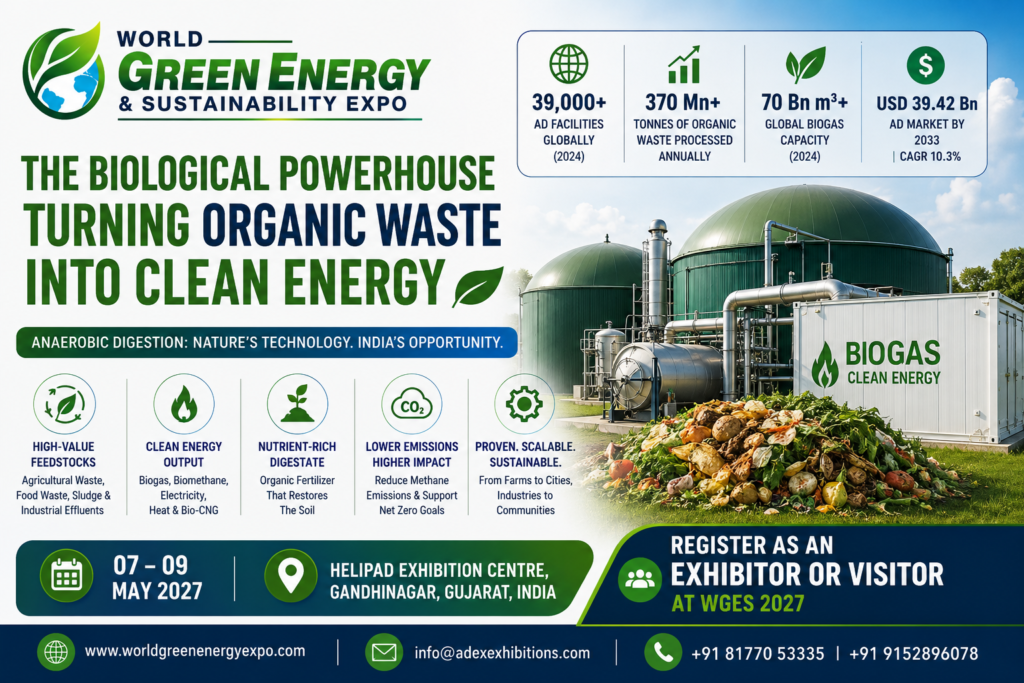
The global anaerobic digestion market size was estimated at USD 18.07 billion in 2025 and is projected to reach USD 39.42 billion by 2033, growing at a CAGR of 10.3% from 2026 to 2033. In 2024, over 39,000 anaerobic digestion facilities were operational globally, processing more than 370 million metric tonnes of organic waste annually. More than 95 countries have active policies supporting biogas production from anaerobic digestion, with over 48 nations offering subsidies or tax incentives for new installations.
The global capacity for biogas generation through anaerobic digestion reached over 70 billion cubic meters in 2024, with Europe contributing nearly 46% of that volume.
For anaerobic digestion technology providers, reactor and equipment manufacturers, biogas upgrading specialists, organic waste management companies, food processing industry energy managers, agricultural companies evaluating on-farm energy production, and investors in the clean energy transition – this is the complete, data-backed, commercially honest guide to where anaerobic digestion technology stands in 2027 and what the market opportunity looks like across every geography and every feedstock category.
What Anaerobic Digestion Actually Is – The Science Behind the Clean Energy
Anaerobic digestion sounds complex. The underlying biology is actually elegant in its simplicity – which is one of the reasons it has proven so commercially durable across such diverse applications and geographies.
When organic material – food scraps, crop residues, animal manure, sewage sludge, industrial effluent – is placed in an enclosed vessel in the absence of oxygen, naturally occurring microorganisms begin to break it down through a sequence of four distinct biological stages. Understanding these four stages is commercially important because each stage can become a bottleneck that reduces biogas yield if not properly managed – and much of what distinguishes the best AD technology providers from average ones is the sophistication of their process control across all four.
Stage 1 – Hydrolysis: Complex organic molecules – proteins, carbohydrates, fats – are broken down by specialized bacteria into simpler soluble compounds – amino acids, sugars, fatty acids. This is typically the rate-limiting step for complex or high-solids feedstocks, and the reason that pre-treatment technologies – mechanical, thermal, or enzymatic – can significantly improve overall digestion efficiency and biogas yield.
Stage 2 – Acidogenesis: The soluble compounds from hydrolysis are fermented by acid-producing bacteria into volatile fatty acids, alcohols, carbon dioxide, and hydrogen. This stage is generally fast and robust – it rarely becomes a bottleneck in well-operated digesters.
Stage 3 – Acetogenesis: Volatile fatty acids are converted into acetic acid, hydrogen, and carbon dioxide by acetogenic bacteria. This stage is sensitive to hydrogen partial pressure – if hydrogen accumulates in the digester, acetogenesis is inhibited and the process can acidify, crashing the digester. Managing hydrogen partial pressure through proper mixing and retention time is a critical operational parameter.
Stage 4 – Methanogenesis: Methanogenic archaea – the ancient microorganisms that are the most sensitive and commercially critical members of the microbial community – convert acetic acid and hydrogen into methane and carbon dioxide. This is the step that produces the biogas that is the entire commercial output of the process. Methanogens are slow-growing, sensitive to temperature swings, pH extremes, and toxic compounds including heavy metals and antibiotics, and they are the primary reason that anaerobic digestion requires more careful operational management than simpler biological treatment processes.
The output of this four-stage process is biogas – typically 55 to 65% methane and 35 to 45% carbon dioxide, with trace quantities of hydrogen sulphide, water vapor, and other gases – and digestate, the biologically stabilized residue of the digested material. Both are commercially valuable. The biogas is the energy product. The digestate is a nutrient-rich organic soil amendment – in well-structured AD projects, digestate revenue can contribute 15 to 30% of total project income, substantially improving project economics.
The Global Anaerobic Digestion Market in Numbers – Scale, Growth and Structure
The global anaerobic digestion market size was estimated at USD 18.07 billion in 2025 and is projected to reach USD 39.42 billion by 2033, growing at a CAGR of 10.3% from 2026 to 2033. Market growth is primarily driven by the increasing demand for renewable energy, rising emphasis on sustainable waste management, and stringent regulations aimed at reducing greenhouse gas emissions.
The anaerobic digestion equipment market provides a complementary perspective. The anaerobic digestion equipment market was estimated at USD 11.5 billion in 2025 and is expected to grow at a CAGR of 8.5% between 2026 and 2035, driven by rising focus on organic waste management and reduction of landfill usage. The global anaerobic digestion equipment market was valued at USD 11.5 billion in 2025 and is projected to grow to USD 26 billion by 2035. Market Leader: Veolia led with over 12% market share in 2025.
By technology, the market’s structure is commercially specific. Based on technology, the wet anaerobic digestion segment held the highest market share in 2025. Based on feedstock, the agricultural waste segment held the highest market share in 2025. Based on end use, the agriculture segment held the highest market share of over 30% in 2025.
Top Segment: Energy production remains the dominant application, with over 62% of the biogas generated being converted into electricity and heat.
The biomethane upgrading dimension is one of the most commercially significant growth drivers within the broader AD ecosystem. Biomethane upgrading is emerging as the primary revenue uplift mechanism across the global AD market – because upgraded biomethane commands a significantly higher price than raw biogas used for direct electricity generation, particularly in markets with renewable gas certificates, ISCC certification for transport fuel applications, or green gas tariff structures.
A growth surge of 60% in biogas-to-RNG projects is forecast, driven by urban sustainability initiatives. Agricultural and food waste projects attract nearly 44% of infrastructure expansion globally. The adoption rate of anaerobic digestion systems in the agricultural sector increased by 23% between 2022 and 2024.
The Four Major Feedstock Categories – What Goes In Determines What Comes Out
Understanding feedstock is commercially foundational for any company in the AD sector – because feedstock characteristics determine reactor design, pre-treatment requirements, biogas yield, digestate quality, and ultimately project economics.
Feedstock 1: Agricultural Waste – The Global Volume Leader
Based on feedstock, the agricultural waste segment held the highest market share in 2025. Agricultural waste encompasses animal manure from livestock operations, crop residues including straw, corn stover, and sugarcane bagasse, silage crops grown specifically for energy production, and slurries from large-scale dairy, pig, and poultry farming. Agricultural feedstocks are the most widely used globally because they are generated continuously, are typically available at zero or negative cost to the farm operator, and the digestate produced from animal manure is directly applicable as a crop fertilizer in the same agricultural operation – creating a circular nutrient cycle that improves overall farm economics.
The specific methane yield from agricultural feedstocks varies significantly by material type. Animal manure typically yields 15 to 30 cubic meters of methane per tonne of fresh material. Maize silage – the highest-yield dedicated energy crop – yields 90 to 115 cubic meters per tonne. Wheat straw yields 70 to 100 cubic meters per tonne at typical moisture contents.
Verbio SE commissioned a large biomethane biorefinery in Punjab that uses rice straw as the primary raw material, explicitly positioned to reduce stubble burning by creating a commercial outlet for straw collection and conversion via anaerobic digestion-based processing. This Verbio project in Punjab is one of the most commercially significant AD developments in India in the past two years – demonstrating that European AD technology companies are actively investing in India’s agricultural residue biogas opportunity at commercial scale.
Feedstock 2: Food Waste – The Fastest-Growing Segment
Food waste is the highest-biogas-yield feedstock category available to AD plants – because food has been optimized by evolution and food science to be easily digestible, and the same characteristics that make food digestible for humans make it rapidly and completely converted to biogas by anaerobic microorganisms.
Specific methane yields from food waste feedstocks range from 80 to 120 cubic meters per tonne for mixed food waste, 150 to 250 cubic meters per tonne for fat, oil, and grease, and 30 to 60 cubic meters per tonne for fruits and vegetables. These yields are typically 3 to 5 times higher per tonne than agricultural manure, making food waste one of the most economically valuable AD feedstocks when available in sufficient volume and at acceptable collection cost.
In 2023, more than 135 municipal governments globally launched food waste collection programs tied to anaerobic digestion plants. These programs diverted over 5.8 million metric tonnes of organic waste from landfills.
The commercial challenge of food waste as an AD feedstock is collection logistics – getting food waste from restaurants, supermarkets, institutional kitchens, and food processing facilities to AD plant intake points consistently, reliably, and at sufficient quality to avoid process disruptions from packaging contamination, saline waste from food processing, or chemical contamination from cleaning agents.
Feedstock 3: Sewage Sludge – The Municipal Staple
Sewage sludge – the organic residue from municipal wastewater treatment – is the most widely digested single feedstock category at the plant level, because virtually every large wastewater treatment facility globally operates an on-site anaerobic digester to stabilize its sludge before disposal. Sewage sludge digestion is the original application of industrial-scale AD technology, with operational experience spanning over 100 years across European, North American, and Japanese wastewater treatment utilities.
The biogas produced from sewage sludge digestion is typically used on-site for electricity and heat generation – powering the wastewater treatment facility itself and reducing or eliminating its net electricity import from the grid. Advanced sludge digestion – including thermal hydrolysis pre-treatment, which significantly increases biogas yield and reduces sludge volume – is the leading capital investment priority for wastewater utilities seeking to improve energy self-sufficiency.
Feedstock 4: Industrial and Commercial Organic Effluents
Food processing effluents – from dairy, brewery, distillery, slaughterhouse, fruit and vegetable processing, and pharmaceutical manufacturing operations – are among the most productive AD feedstocks in terms of biogas yield per unit volume, due to their high dissolved organic content (measured as Chemical Oxygen Demand). High-rate AD reactors operating on industrial effluents can achieve methane recovery rates exceeding 70%, simultaneously treating a wastewater stream that would otherwise require energy-intensive aerobic treatment.
Approximately 61% of organic industrial waste streams from food processing, paper manufacturing, and chemical production are suitable for anaerobic digestion systems. For industrial companies currently paying wastewater treatment costs for organic effluents, the AD option converts a cost center into a revenue-generating energy asset – one of the most commercially compelling value propositions in any sector.
The Reactor Technologies – Which AD System Is Right for Which Application
AD reactor design is not one-size-fits-all. The optimal reactor configuration depends on feedstock characteristics, plant scale, available land, required retention time, and the biogas application downstream. Understanding reactor technology is essential for any company evaluating AD plant investment or technology supply.
Continuously Stirred Tank Reactor (CSTR)
The CSTR is the most widely deployed AD reactor configuration globally, particularly for wet feedstocks – animal manure, food waste slurries, and agricultural residues at 8 to 15% total solids content. It operates as a single continuously mixed tank with retention times of 20 to 40 days, providing consistent process conditions and straightforward operational management. CSTR technology is mature, well-understood, and supported by a global supply chain of reactor vessels, mixing systems, and control equipment.
Based on technology, the wet anaerobic digestion segment held the highest market share in 2025. CSTRs are the primary wet AD technology, and their market leadership reflects the dominance of agricultural and municipal sludge feedstocks in the global installed base.
Upflow Anaerobic Sludge Blanket (UASB) Reactor
The UASB reactor is the dominant technology for treating high-strength liquid industrial effluents – dairy, brewery, distillery, and food processing wastewaters. It operates by passing the liquid waste upward through a dense blanket of granular anaerobic biomass, achieving very high organic removal rates in short retention times of 4 to 8 hours. UASB technology is particularly well-established in India, where Paques and Bio-thane have installed hundreds of industrial effluent treatment systems across the food processing, sugar, and chemical sectors.
Over 53% of system deployments focus on wastewater-to-energy efficiency, with methane recovery rates often exceeding 70%. UASB reactors consistently achieve the upper end of this methane recovery range when applied to appropriate high-strength liquid feedstocks.
Business Research Insights
Plug Flow Reactor
Plug flow reactors are optimized for high-solids feedstocks – particularly straw, crop residues, and solid animal manures that cannot be pumped as liquids. The waste moves in a plug through an elongated horizontal or inclined digester vessel, with retention times of 20 to 30 days. Plug flow reactors are the preferred technology for dry fermentation of agricultural crop residues, as demonstrated in the Nagpur mobile dry fermentation plant and in the hundreds of agricultural straw digestion plants operating across Germany and Austria.
High-Rate Anaerobic Reactors
A family of high-rate AD reactor configurations – including Expanded Granular Sludge Bed (EGSB), Anaerobic Membrane Bioreactor (AnMBR), and Internal Circulation (IC) reactors – achieve very high organic removal rates and biogas yields in compact footprints by immobilizing the anaerobic biomass on granules or membranes rather than relying on suspended growth. These technologies are preferred for industrial applications where land is expensive, wastewater flow rates are high, and achieving consistent effluent quality is critical.
Modular and Containerized Systems
New product development in anaerobic digestion is centered on modular reactors, smart automation, and methane purification. Approximately 61% of manufacturers prioritize digital controls for pH, temperature, and gas optimization.
The trend toward modular, factory-built, containerized AD systems – deployable at small to medium scale without site-specific civil engineering – is one of the most commercially significant technology developments in the sector. Modular systems reduce capital cost, shorten construction timelines, enable phased capacity expansion, and make AD technology accessible to smaller-scale organic waste generators – institutional kitchens, markets, medium-scale food processors – that cannot justify the investment in large bespoke systems.
Co-Digestion – The Performance Multiplier
One of the most commercially significant operational strategies in modern AD is co-digestion – simultaneously processing multiple feedstock types in a single digester to optimize biogas yield, process stability, and nutrient balance in the digestate. A significant trend in the market is the use of co-digestion, where multiple feedstocks like agricultural residues, food waste, and sewage sludge are processed simultaneously to enhance biogas yield.
The principle behind co-digestion is straightforward. Different feedstocks have complementary characteristics – manure provides the active microbial population and buffering capacity that stabilizes the process, while food waste provides the high-energy organic content that maximizes biogas yield. Agricultural crop residues provide carbon-rich material that balances nitrogen-rich sewage sludge. Fat, oil, and grease from restaurant waste provides the highest biogas yield of any feedstock category but will overwhelm a digester if used as the sole input. Combining these materials in appropriate ratios achieves synergistic yield improvements that exceed what any single feedstock can deliver independently.
The commercial implication of co-digestion for AD plant operators is significant. A farm digester receiving animal manure as its primary feedstock can dramatically improve project economics by accepting food waste from nearby restaurants, supermarkets, or food processors at a tipping fee – adding both revenue and biogas yield improvement simultaneously. A wastewater treatment plant digesting sewage sludge can improve energy self-sufficiency by co-digesting food waste or grease trap waste collected from the same urban area. These co-digestion revenue stacking opportunities are transforming the business models of both agricultural and municipal AD operators.
Biogas Utilization – From Raw Gas to Maximum Commercial Value
The biogas produced by AD can be utilized across several different pathways, each with different capital cost, revenue profile, and market application. The choice of utilization pathway is one of the most commercially consequential decisions in AD project development.
Combined Heat and Power (CHP)
The most widely deployed biogas utilization pathway globally is direct combustion in gas engines for combined heat and power generation – simultaneously producing electricity and useful thermal energy from a single biogas input. CHP systems achieve overall energy efficiencies of 80 to 85% when both electricity and heat outputs are fully utilized, making them the most efficient single-step biogas utilization option.
Energy production remains the dominant application, with over 62% of the biogas generated being converted into electricity and heat. For AD plants co-located with industrial facilities or food processing operations with significant thermal energy demand – dairy processors, breweries, slaughterhouses, pharmaceutical manufacturers – CHP is typically the optimal utilization pathway because the waste heat can displace fossil fuel-generated process heat at a direct economic benefit that pure power generation cannot replicate.
Biomethane Upgrading and Grid Injection
Upgrading raw biogas to biomethane – removing CO2 to raise methane content to above 95% – enables injection into the natural gas grid, supply as vehicle fuel, or export as liquefied biomethane. Biomethane commands a significantly higher price than raw biogas in markets with renewable gas certification frameworks, green gas tariffs, or transport fuel incentive schemes.
Biomethane upgrading is emerging as the primary revenue uplift mechanism across the global AD market. A growth surge of 60% in biogas-to-RNG projects is forecast, driven by urban sustainability initiatives.
In India’s context, biomethane upgrading to compressed biogas (CBG) specification – greater than 90% methane at 250 bar – enables offtake under SATAT’s 15-year oil marketing company purchase agreements, providing revenue certainty that grid-injected biomethane in Western markets provides through different mechanisms.
Direct Use as Heat and Cooking Fuel
At small scale – village biogas plants, farm biogas systems, institutional installations – biogas can be used directly as a cooking and heating fuel without upgrading, avoiding the capital cost of power generation or upgrading equipment. This direct use pathway is the most economically accessible entry point for rural and peri-urban AD in developing countries, including India, where millions of household biogas plants already provide cooking gas from animal manure.
India’s Anaerobic Digestion Market – The Specific Opportunity
India’s AD market in 2027 sits at the most commercially active moment in its history – driven by the convergence of mandatory waste management regulations, SATAT CBG offtake agreements, GOBARdhan scheme support, and the demonstrated commercial success of landmark plants from Punjab to Indore.
The Verbio SE rice straw biomethane plant in Punjab – described above – is one of the most commercially significant AD developments in India in recent years because it demonstrates something that has been theoretically understood but commercially under-proven: that European-scale, professionally operated AD technology can be applied profitably to India’s agricultural residue feedstock streams at large commercial scale.
Verbio SE commissioned a large BioCNG/biomethane biorefinery in Punjab that uses rice straw as the primary raw material, explicitly positioned to reduce stubble burning by creating a commercial outlet for straw collection and conversion via anaerobic digestion-based processing. India’s food waste AD opportunity is particularly compelling given the CPCB bulk waste generator mandate – requiring commercial complexes above 20,000 square meters, industrial parks, and hotels to process their organic waste rather than depositing it in municipal bins. This mandate creates a distributed, business-to-business AD market that does not depend on urban local body contract awards – making it one of the most commercially accessible near-term AD deployment opportunities in India’s organic waste management ecosystem.
The dairy sector creates a parallel and equally significant opportunity. India’s dairy industry – the world’s largest – generates enormous quantities of wash water, whey, buttermilk, and organic effluent from processing operations. UASB and high-rate AD reactors applied to dairy effluent convert a mandatory treatment cost into a biogas revenue asset. The number of dairy processing facilities across Gujarat, Maharashtra, Punjab, Rajasthan, and Uttar Pradesh that could benefit from AD integration represents a substantial and largely untapped market for industrial AD technology in India.
Country-by-Country – Global AD Market Leaders
Germany – The World’s Most Mature Agricultural AD Market
Germany operates more than 9,500 agricultural biogas plants – more than any other country – producing over 32 TWh of electricity annually. Germany’s AD industry was built on direct electricity feed-in tariffs under the Erneuerbare Energien Gesetz (EEG), which provided guaranteed prices for biogas-generated electricity that enabled investors to finance plants with confidence. The policy has since evolved toward biomethane injection and direct marketing, but the installed base remains the world’s most comprehensive agricultural AD infrastructure and the reference case against which all other national AD programs are benchmarked.
United Kingdom – The Biomethane Innovation Leader
The UK’s AD industry – with over 800 operational plants – has distinguished itself through the most developed biomethane grid injection infrastructure outside Germany, with active green gas tariff structures, renewable transport fuel incentives, and carbon reduction mandate credits that together make biomethane injection commercially superior to power generation in most UK AD project economics. Historically, market growth has been anchored by agricultural biogas in Europe and sewage sludge digestion in North America.
United States – The RNG Scaling Story
The US biogas market currently captures approximately 25% of its estimated technical potential of 3,043 billion cubic feet per year, indicating substantial greenfield capacity across agricultural, municipal, and food waste segments.
The US AD market is being reshaped by two specific policy instruments – California’s Low Carbon Fuel Standard, which creates very high-value credits for vehicle-grade renewable natural gas produced from organic waste, and the Inflation Reduction Act’s clean energy tax credits. The combination of LCFS credits and IRA investment tax credits has made US dairy biogas to RNG projects among the most financially attractive AD investments in the world, generating project IRRs above 20% for well-structured dairy manure RNG operations in California and the Midwest.
China – The Scale Leader
China operates the world’s largest number of biogas installations – primarily small-scale household digesters in rural areas, numbering in the tens of millions, supplemented by a growing fleet of large commercial AD plants serving agricultural and food processing sectors. China’s 14th Five-Year Plan includes specific biogas development targets, and Chinese AD equipment manufacturers are increasingly competitive internationally.
Japan and Southeast Asia – The Expanding Asian Market
Weltec Biopower secured orders for two agricultural biogas plants in Yamagata Prefecture in March 2025, with the company specifically engineering its structural systems for seismic zone requirements. EnviTec Biogas is simultaneously building its first plant in the Philippines, a 1.4 MW agricultural cooperative facility in Quezon Province, scheduled to feed electricity into Meralco’s grid from June 2026, demonstrating the expanding geographic reach of European AD equipment suppliers into Southeast Asian markets.
Japan’s AD market is growing through food waste processing – responding to the government’s target of halving food waste by 2030 – and through agricultural biogas in its northern Hokkaido dairy region. Southeast Asian markets – Philippines, Vietnam, Thailand, and Indonesia – are at earlier stages of commercial AD development but represent significant long-term growth potential given their large agricultural sectors, high organic fraction municipal waste streams, and growing renewable energy policy frameworks.
The Global Companies Building the AD Industry
Veolia – The Market Leader
Veolia led the anaerobic digestion equipment market with over 12% market share in 2025. Leading players: top 5 players include Veolia, SUEZ Group, Xylem, Anaergia Inc., and Hitachi Zosen, which collectively held a market share of 40% in 2025.
Veolia is the world’s largest water and waste management company, with AD technology deployed across municipal wastewater treatment, industrial effluent treatment, and food waste processing on every inhabited continent. Its global operational scale gives it unparalleled reference case breadth and engineering talent depth for complex, large-scale AD projects.
SUEZ Group
SUEZ – formerly part of GDF Suez before spinning off as an independent entity – operates AD facilities across Europe, Australia, and the Middle East as part of its integrated water and waste management platform. Its Organic Waste Converter technology for decentralized food waste processing is particularly relevant to the Indian bulk waste generator mandate market.
Anaergia Inc.
Anaergia specializes in the integration of AD with other waste processing technologies – mechanical biological treatment, liquid-solid separation, biogas upgrading, and digestate management – creating integrated organic waste processing solutions that maximize both energy recovery and material recovery simultaneously. Its projects span municipal solid waste processing, wastewater treatment, and agricultural biogas across North America, Europe, and the Middle East.
PlanET Biogas
In April 2025, PlanET Biogas announced its role as the technology supplier for the Convertus York Biofuels Facility in Ontario, Canada. This flagship project aims to convert organic waste into renewable natural gas, highlighting PlanET’s expertise in delivering integrated anaerobic digestion and gas upgrading systems.
PlanET is one of Germany’s leading agricultural and food waste AD technology companies, with a strong track record in CHP and biomethane upgrading integration that makes it a relevant technology partner for Indian agricultural biogas projects.
Weltec Biopower
Weltec Biopower secured orders for two agricultural biogas plants in Yamagata Prefecture in March 2025. Weltec is among the most internationally active German AD technology companies, with projects across Europe, Asia, and North America combining turnkey plant delivery with long-term operational support.
EnviTec Biogas
EnviTec Biogas is simultaneously building its first plant in the Philippines – a 1.4 MW agricultural cooperative facility in Quezon Province scheduled to feed electricity into Meralco’s grid from June 2026. EnviTec’s Southeast Asian expansion reflects the broader movement of European AD equipment companies into Asian markets where agricultural biogas development is at an earlier commercial stage and where European technology expertise commands a strong market position.
Paques – The Industrial Wastewater Specialist
Paques is the world’s leading developer of high-rate anaerobic reactors for industrial wastewater treatment – including the Biopaq IC reactor that is widely deployed in brewery, dairy, food processing, and paper mill effluent treatment globally. In India, Paques systems are operational across food processing, sugar, and distillery sectors, treating high-strength effluents while recovering biogas for on-site energy generation.
Praj Industries – India’s Technology Bridge
Praj Industries – India’s most comprehensive bioenergy technology company – brings AD expertise alongside its core ethanol and biofuel technology capabilities, providing Indian AD project developers with domestic engineering competence backed by international technology partnerships. Praj’s role in CBG plant technology for the SATAT market makes it one of the most commercially relevant Indian AD technology companies for the bulk of India’s near-term AD project pipeline.
Advance Biofuel – Gujarat’s AD Engineering Pioneer
Advance Biofuel – the Ahmedabad-headquartered CBG plant engineering company and World Green Energy & Sustainability Expo (WGES 2027) association partner – brings over 12 years of operational AD and CBG plant experience across India. Its engineering capability spans digester design, biogas upgrading, compression, ZLD compliance, and MNRE subsidy documentation – the complete technical and regulatory scope that Indian AD project developers need to convert LOI allocations into commissioned, revenue-generating plants.
Technology Trends Reshaping AD Through 2030
AI and Digital Process Optimisation
Approximately 61% of manufacturers prioritize digital controls for pH, temperature, and gas optimization. Artificial intelligence applications in AD process management are delivering measurable improvements in biogas yield, process stability, and energy self-consumption. Real-time prediction of digester instability – through early detection of volatile fatty acid accumulation, pH drift, and temperature anomalies – enables operators to intervene before process crashes occur rather than responding after the fact. AI-optimized feeding schedules – adjusting feedstock input rates and composition in real time based on digester response – are improving biogas yield by 5 to 15% above what fixed-schedule feeding achieves.
Thermal Hydrolysis Pre-treatment
Thermal hydrolysis – subjecting sewage sludge or food waste to high temperature and pressure before anaerobic digestion – dramatically improves both biogas yield and digestate quality. It is the leading capital investment priority for wastewater utilities seeking to improve their AD plant performance, and it is increasingly being applied to food waste processing to improve throughput rates and energy output. The cost premium of thermal hydrolysis pre-treatment is typically recovered in two to four years through improved biogas yield and reduced digestate disposal costs.
Advanced Biogas Upgrading Technologies
Membrane separation, pressure swing adsorption, and amine scrubbing technologies for biogas upgrading to biomethane specification are all improving in efficiency and declining in capital cost as manufacturing scale increases. The development of in-situ biological methanation – where CO2 in biogas is converted to methane by hydrogen-consuming methanogens fed with renewable hydrogen – represents the next frontier of upgrading technology, enabling AD plants to increase their methane output beyond what the organic feedstock alone delivers.
Digestate Nutrient Recovery
Digestate – the solid and liquid residue from AD – contains nitrogen, phosphorus, potassium, and micronutrients in plant-available form. Advanced digestate processing – struvite precipitation for phosphorus recovery, ammonia stripping for nitrogen concentration, and membrane filtration for liquid-solid separation – is increasingly enabling AD operators to market digestate nutrients as certified organic fertilizer products rather than simply spreading them on nearby agricultural land.
The Business Opportunity – Who Benefits and How
The AD market creates commercially specific opportunities across every value chain segment – from technology licensing and plant engineering through feedstock logistics and digestate management to financing and carbon credit monetization.
For AD technology licensors and reactor manufacturers: The global AD market’s 10.3% CAGR through 2033 is translating into a sustained pipeline of new plant construction across agricultural, food waste, and industrial wastewater applications. European AD technology companies evaluating Asian market entry – as EnviTec and Weltec are already demonstrating – find India’s combination of abundant organic feedstock, SATAT offtake certainty, and MNRE subsidy support to be a more commercially accessible market than many anticipated.
For biogas upgrading equipment suppliers: The 60% forecast growth surge in biogas-to-RNG projects creates direct procurement demand for pressure swing adsorption, membrane separation, and water scrubbing upgrading systems. For India specifically, CBG upgrading equipment for the SATAT market – achieving greater than 90% methane at 250 bar – is a near-term procurement requirement for every new AD plant targeting OMC offtake.
For food waste collection and logistics companies: The AD sector’s growing demand for consistent, quality-controlled food waste feedstock is creating a structured commercial market for food waste collection services that the waste management sector has historically underserved. Collection companies that can guarantee feedstock supply consistency, contamination management, and pre-treatment to AD plant specification are commercially differentiated in a market where feedstock supply risk is frequently the primary cause of AD project underperformance.
For agricultural cooperatives and farmer groups: On-farm AD using animal manure and crop residue – supported by GOBARdhan scheme CFA and SATAT offtake for CBG – converts waste management costs into revenue-generating energy assets. The Verbio Punjab model demonstrates that even rice straw – one of the most challenging agricultural residues to process – can be economically converted to biomethane at commercial scale with appropriate technology and feedstock aggregation infrastructure.
For investors and project finance institutions: Investment trends indicate a 40% rise in funding for waste-to-energy startups. AD projects with secured feedstock agreements, SATAT offtake contracts, MNRE CFA, and IREDA project finance present among the most bankable clean energy project structures available in the Indian market – combining multiple government support mechanisms with proven technology and a waste feedstock that is simultaneously a regulatory compliance requirement for the generators providing it.
Why World Green Energy & Sustainability Expo (WGES 2027) Is the Right Platform for the Anaerobic Digestion Industry
Anaerobic digestion sits at the direct intersection of five of World Green Energy & Sustainability Expo (WGES 2027)’s most commercially active exhibitor and visitor communities simultaneously – bioenergy and biofuels, waste management and recycling, industrial boilers and process heat, water treatment, and sustainability and ESG. Every AD plant that converts food waste to biogas is simultaneously a waste management solution, a renewable energy system, a water treatment facility, and a carbon reduction project – making it uniquely cross-sector in its commercial relevance.
World Green Energy & Sustainability Expo (WGES 2027)’s Advance Biofuel Ahmedabad association partner connection places it directly at the institutional center of India’s CBG and AD engineering community – a company with 12 years of operational AD plant experience whose customer base spans exactly the feedstock types, plant scales, and regulatory contexts described throughout this article.
Gujarat – World Green Energy & Sustainability Expo (WGES 2027)’s host state – is home to one of India’s most diverse AD feedstock landscapes: the state’s dairy cooperatives including Amul generate enormous quantities of dairy effluent, its food processing industry generates high-strength wastewater from every production facility, its sugar mills generate press mud and vinasse, its chemical and pharmaceutical industry generates organic industrial effluent, and its growing urban population generates the food and organic municipal waste that is the feedstock for the SATAT CBG plants being developed across the state.
For European and Asian AD technology companies seeking Indian market partnerships, for biogas upgrading equipment suppliers targeting India’s SATAT CBG plant pipeline, for agricultural AD project developers evaluating Indian market entry, for industrial wastewater AD technology companies targeting India’s food processing and dairy sectors, for digestate nutrient recovery technology companies addressing India’s agricultural fertilizer market, and for investors evaluating the Indian AD project pipeline – WGES 2027 in Gandhinagar is where these commercial conversations happen in the most commercially relevant geography available in Asia’s fastest-growing biogas market.
Register at the World Green Energy & Sustainability Expo 2027 today.