
The Renewable Energy Idea That Water Made Possible
There is a particular kind of engineering elegance to floating solar that explains why it has gone from a curiosity to a serious global industry in less than fifteen years. The core insight is almost embarrassingly simple: if land is scarce, expensive, or contested, and water bodies sit unused right next to where electricity is needed, why not put the solar panels on the water instead?
That simple idea is now reshaping how dozens of countries plan their renewable energy expansion. A floating solar photovoltaic system is a solar power installation mounted on the body of water, comprising of a lake, reservoir, or ocean, installed on floating platforms instead of placing the solar panels on land, allowing the system to generate electricity from sunlight while floating on the water’s surface.
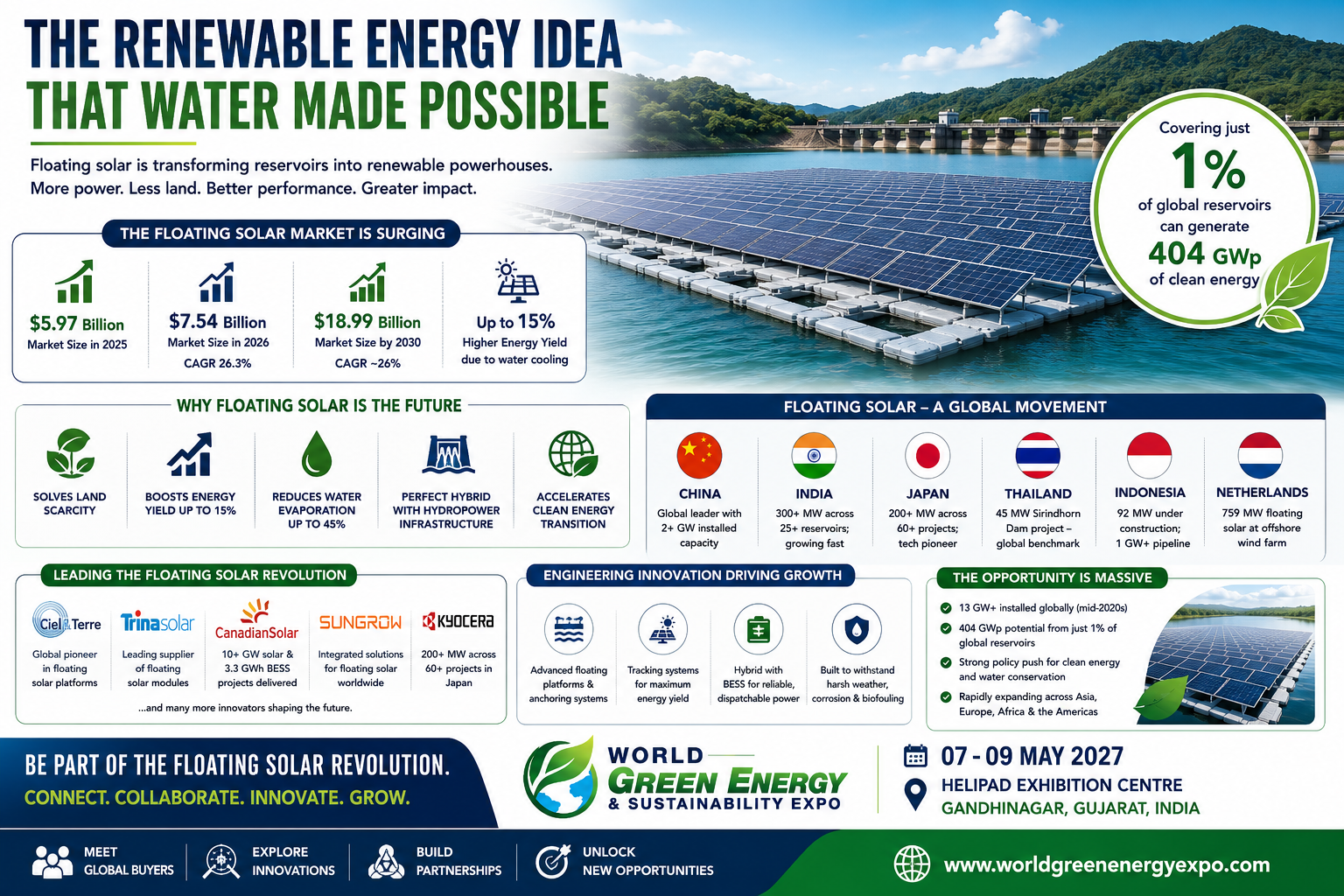
The growth numbers behind this technology are genuinely striking, even allowing for the wide variance you typically see across different market research firms in a young and fast-evolving sector. The floating solar market grew from USD 5.97 billion in 2025 to USD 7.54 billion in 2026, a compound annual growth rate of 26.3%, and is projected to reach USD 18.99 billion by 2030 at a continued CAGR of around 26%.
For solar developers, module manufacturers, floating platform engineers, mooring system specialists, and hydropower operators worldwide, this is no longer an emerging niche. It is one of the fastest-scaling segments inside the broader solar industry, and 2027 is shaping up to be a defining year for it.
Why Floating Solar Is Growing So Fast
Three structural forces are driving this growth simultaneously and understanding them explains why floating solar has consistently outpaced more conservative early forecasts.
The first is land scarcity. Ground-mounted solar farms at gigawatt scale require enormous tracts of land – land that is frequently needed for agriculture, housing, or industrial development, particularly across densely populated parts of Asia. Solar photovoltaic power plants require huge land areas, an issue in many countries across the globe, and floating solar installations have opened up new possibilities for growing solar generating capacity in regions with high population density coupled with growing electricity demand and competing uses for available land.
The second is a genuine performance advantage that surprises people unfamiliar with the technology. Water cools the underside of solar panels far more effectively than open air does, and that cooling effect directly improves how much electricity the panels produce. Floating solar panels reduce land-use conflicts and increase energy yield by up to 15% due to water surface cooling.
The third is water conservation – an unexpected co-benefit that has become a major selling point in drought-prone regions. In 2023, over 40% of new floating PV projects were co-located with hydropower facilities, enabling synchronized power delivery during peak demand, and the panels themselves provide a useful side effect by shading the water surface. Floating solar reduces evaporation by up to 45%, enhancing dam water retention.
Put simply, a single floating solar installation on a hydropower reservoir can generate clean electricity, conserve scarce water, avoid land acquisition disputes, and use transmission infrastructure that already exists at the dam site. Few renewable energy technologies deliver that many simultaneous benefits from one investment.
The Scale of the Opportunity Sitting Untapped
What makes floating solar genuinely compelling from an investment standpoint is not just current deployment, but how small a fraction of the available opportunity has actually been built so far.
According to official statistics published by Cleaner Engineering and Technology in July 2025, covering only 1% of international reservoirs with floating photovoltaics can tend to generate 404 GWp of clean energy, which makes them a strong tool in the objective of achieving net-zero emissions. To put that figure in perspective, that is roughly double the entire installed solar capacity of India as of early 2026 – generated from covering just one percent of the world’s reservoirs.
Global floating solar capacity has grown from 1 MW to 2.6 GW, effectively reaching an estimated 5.9 GW as of 2023. Other estimates place installed capacity slightly higher by the mid-2020s – global installed capacity reaching approximately 13 GW by 2022, surpassing earlier predictions – but every credible figure tells the same underlying story: actual deployment still represents a tiny sliver of the available reservoir surface area worldwide, which is precisely why growth forecasts remain so aggressive even years into the technology’s commercial life.
There is a parallel story unfolding in hydropower infrastructure that is directly relevant here. As per an article published by the IEA Organisation in 2026, hydro generated almost 4,500 terawatt-hours of electricity, which is 14% of the international total as of 2024, and over 150 GW of the latest hydro capacity is projected to come online by the end of the decade. Every new hydropower reservoir built over the coming years is, in effect, a potential future floating solar site – making the addressable market for this technology grow alongside the hydropower sector itself.
China – The Undisputed Global Leader
No discussion of floating solar is complete without China, which has approached the technology with the same scale-first mentality it has applied to ground-mounted solar manufacturing. As of 2024, more than 60 countries have deployed floating photovoltaic installations, with over 3,000 MW of installed capacity globally. China leads with over 1,300 MW of installations, including a single 320 MW plant in Dezhou, Shandong.
China’s projects are not modest demonstrations – they are full utility-scale power stations that happen to float. China has developed some of the world’s largest floating solar facilities, including a 650 MW plant in Anhui province, commissioned in 2023. Asia-Pacific dominates the floating solar landscape, accounting for nearly 70% of global floating solar capacity in 2023, with China leading installations exceeding 2 GW across multiple provinces.
China’s dominance extends beyond project deployment into manufacturing and platform technology – a point that matters enormously for any company evaluating where to source floating solar components or compete for global market share.
India’s Floating Solar Story – From Demonstration to Dam-Scale Power Plants
India’s floating solar trajectory mirrors its broader solar story: starting from pilot projects and rapidly scaling toward genuinely large installations, with a particularly strong focus on combining floating solar with existing hydropower and reservoir infrastructure.
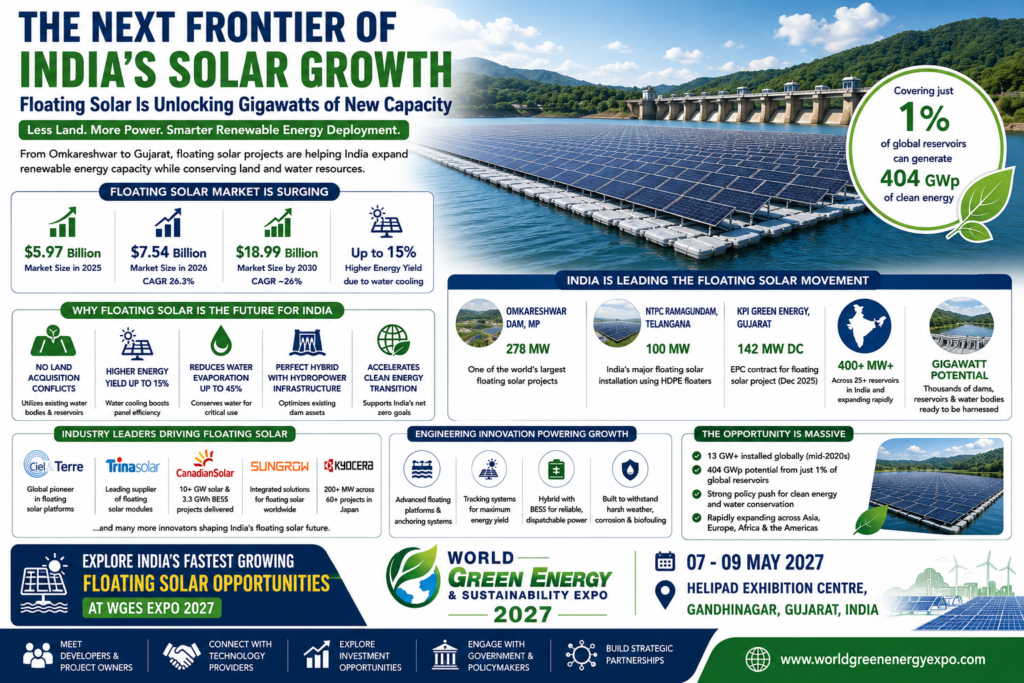
India’s Omkareshwar Floating Solar Power Park, located on the Omkareshwar Dam in Madhya Pradesh, achieved significant milestones, with 278 MW activated by August 2023. This project – developed with significant involvement from Tata Power Solar – has become one of the most cited reference projects in the global floating solar industry, demonstrating that gigawatt-adjacent scale floating installations are commercially and technically achievable.
India’s installed base, while smaller than China’s, is expanding steadily across multiple states. India has over 300 MW across 25-plus reservoirs. Among the country’s notable installations, the NTPC Ramagundam Floating Solar Power Plant in Telangana, with a capacity of 100 MW, utilizes high-density polyethylene floaters, ensuring longevity and stability.
India’s solar manufacturing and EPC ecosystem is increasingly active in the floating solar segment specifically. In December 2025, KPI Green Energy secured an EPC contract from GSECL for a 142 MW DC floating solar project – a clear signal that Gujarat-based developers are positioning themselves directly in this growing sub-sector of the solar industry. India’s named players in the global floating solar competitive landscape include some of the same companies leading the country’s broader solar market: the major players in the floating solar PV market include Vikram Solar Limited, Tata Power Solar Systems Ltd, Adtech Systems Co Ltd, Ocean Sun AS, and Solaris Synergy, among others.
For India specifically, the strategic logic behind floating solar is unusually strong. The country has thousands of irrigation reservoirs, hydropower dams, and water treatment facilities that sit largely unused for power generation, while simultaneously facing intense competition for agricultural and industrial land in its most solar-favorable states. Floating solar offers a direct way to add gigawatts of capacity without entering land acquisition disputes – one of the most persistent bottlenecks facing India’s broader solar expansion.
Country-by-Country – Who Else Is Building Floating Solar
Beyond China and India, floating solar deployment has spread across a genuinely diverse set of countries, each adapting the technology to their own water resources and energy needs.
Japan
Japan was an early pioneer of the technology and remains one of its most sophisticated practitioners. Kyocera leads Japan’s floating solar market, having installed over 200 MW across 60-plus projects. Its largest plant, on the Yamakura Dam, generates over 15 GWh annually and withstands typhoon wind speeds up to 190 km/h – a notable engineering achievement given Japan’s frequent severe weather. South Korea and Japan together contribute more than 400 MW.
Thailand
Thailand has built one of the most celebrated hydro-solar hybrid projects in the world. In Thailand, the 45 MW Sirindhorn Dam floating solar plant generated 75 GWh in its first operational year. In 2023, Thailand launched the world’s largest hybrid floating solar-hydro project at Sirindhorn Dam, adding 45 MW capacity to the national grid.
Indonesia & Vietnam
Indonesia and Vietnam are emerging as significant Southeast Asian growth markets. Indonesia and Vietnam have over 1,000 MW in the pipeline for 2024 to 2026. In October 2025, Indonesia’s state-owned utility, Perusahaan Listrik Negara, began construction of a 92 MW floating solar power plant in West Java, marking a significant step in the country’s renewable energy expansion. Indonesia aims to add 42.6 GW of renewable energy capacity by 2034, with solar expected to account for approximately 17.1 GW of that total.
Netherlands
The Netherlands represents the technology’s most ambitious push into open marine waters rather than sheltered inland reservoirs. A nearly 759 MW floating solar power plant is anticipated to be commercialized in 2025 in the Netherlands at the Hollandse Kust Noord offshore wind farm, developed by Shell-Eneco, CrossWind, and Oceans of Energy. Combining floating solar with offshore wind infrastructure – sharing the same grid connection and maritime real estate – represents one of the most technically advanced frontiers in the entire industry.
Middle East & Africa
The Middle East and Africa are increasingly active, often pursuing floating solar specifically as a way to fast-track large renewable capacity additions. In August 2025, the African Export-Import Bank announced financing for a 1 GW hybrid floating solar PV project in Zimbabwe. The initiative is planned in two stages, beginning with a 500 MW pilot phase, with the consortium securing the project capacity at a cost-reflective tariff through a 20-year power purchase agreement. The UAE commissioned its first 2 MW floating solar plant in 2023, with plans for 20 MW by 2025. South Africa leads in Africa with three floating PV systems totaling 5 MW on dam reservoirs, while Kenya and Egypt have announced feasibility studies for large-scale floating PV on Lake Victoria and the Nile.
Brazil
Brazil is bringing floating solar into Latin America’s hydropower-heavy grid in a meaningful way. In December 2025, Brazil’s environmental agency, Ibama, issued a preliminary license for a 100 MW floating PV complex at the Anta Hydroelectric reservoir, operated by Furnas. The project will consist of 20 floating solar units of 5 MW each, spread across 110 hectares of the reservoir.
North America
North America is being identified by several research firms as the next major growth frontier, largely on the back of enormous, untapped reservoir capacity. North America’s floating solar PV market is expected to emerge as the fastest-growing region during the forecast period, propelled by an increase in industrial demand, water-constrained siting, and utility decarbonization mandates. Based on government data published by NREL in January 2025, reservoirs in the United States have the capability to host generous floating solar panels and generate almost 1,476 terawatt hours of energy to power an estimated 100 million homes every year.
The Companies Building the Floating Solar Industry
The competitive landscape in floating solar spans specialist platform engineering firms and major global solar manufacturers who have extended their existing module businesses into water-based installation. The top five players operating in the floating solar industry include Sungrow Power Supply, Ciel & Terre, Zimmermann, Scotra and Floatex Solar.
Ciel & Terre International
Ciel & Terre International is widely regarded as the pioneer and category leader of dedicated floating platform technology. Ciel & Terre International is well known for its Hydrelio floating platform and has played a key role in deploying large-scale floating PV projects worldwide, operating in over 30 countries, collaborating with partners across Asia, North America, and Europe. By 2025, it has launched more than 250 floating photovoltaic projects, representing a total installed capacity of 1.2 GW. Other sources place the company’s track record slightly higher still: companies like Ciel & Terre alone installing over 1.5 GW of floating solar projects across 30 countries.
Trina Solar
Trina Solar has emerged as a dominant force specifically in floating module supply. As of 2023, Trina Solar holds the largest market share among floating panel manufacturers. The company supplied over 700 MW of floating solar modules to projects in China, Vietnam, and India, with its floating PV modules offering a 21.3% efficiency rate.
Canadian Solar
Canadian Solar, through its project development arm, has become one of the most prolific global floating solar developers. Canadian Solar operates manufacturing facilities across several countries including the United States, Canada, China, Indonesia, Vietnam, and Brazil where it produces solar modules and cells. Through its subsidiary Recurrent Energy, the company has developed and delivered more than 10 GW of solar power projects and 3.3 GWh of battery energy storage projects worldwide.
Sungrow
Sungrow Power Supply has built a strong position by combining its core inverter business with floating-specific engineering. Sungrow Power Supply is actively engaged in numerous floating PV projects, primarily in Southeast Asia and China, where it focuses on integrating its inverters with floating solar platforms.
A broader tier of established global solar manufacturers has also extended into floating solar as the segment has matured. Major companies operating in the floating solar market include Sharp Corporation, LONGi Green Energy Technology, JinkoSolar, Kyocera, Trina Solar, JA Solar, Canadian Solar, Sungrow Power Supply, Risen Energy, First Solar, GCL-Poly Energy, SunPower, Tata Power Solar Systems, Cleantech Solar, Vikram Solar, REC Solar, Greenyellow, Seraphim Solar, Adtech Systems, Pristine Sun Corporation, Mecasolar, Ciel & Terre International, Yingli Green Energy, and Solaris.
A newer category of specialist offshore floating solar companies is also gaining prominence as marine deployment grows. Key players in the floating solar platform market include SolarDuck, Swimsol, Romande Energie, EDP, Groenleven, Trina Solar, Statkraft, Mibet, BayWa r.e., Ciel & Terre, Z-ONE New Energy Technology, Banpu NEXT, Sungrow Power, and Sunlit Sea.
Technology and Engineering – What Has Made Floating Solar Commercially Viable
The reason floating solar has moved from experimental pilot projects to gigawatt-scale infrastructure largely comes down to genuine engineering progress over the past decade.
Growing utilization of solar PV systems installed on reservoirs linked to hydropower plants, coupled with innovations in design and material including advances in mooring technology and durable floating structures, will stimulate product adoption. Early floating solar systems faced real durability questions – would the platforms survive years of wave action, UV exposure, and water chemistry without degrading? Those questions have been substantially answered by the current generation of high-density polyethylene floats, advanced anchoring systems, and corrosion-resistant components now standard across the industry.
Tracking technology, long established in ground-mounted solar, is now being adapted for the water environment as well. Tracking floating solar panels are gaining popularity due to their ability to adjust orientation for improved energy yield, while lightweight modular designs are simplifying installation and maintenance processes.
Energy storage integration is becoming a defining trend for the most advanced floating solar projects. Battery energy storage systems are increasingly integrated with floating solar, with over 50 MW of combined floating PV-BESS systems deployed globally, and market analysts project over 100 hybrid floating PV projects to be launched across emerging economies
None of this means floating solar has become a simple technology. A key restraint affecting the solar floating panel market is the high initial cost and technical complexity associated with floating installations, with specialized floating structures, anchoring systems, and electrical safety measures increasing project costs compared to ground-mounted systems. Maintenance challenges such as water corrosion, biofouling, and weather exposure can impact long-term performance, while limited availability of skilled contractors and standardized installation practices also restrains rapid adoption. High installation costs remain a challenge, as floating solar projects can be 10 to 15% more expensive than ground-mounted alternatives due to specialized anchoring and floatation systems.
These are real and honest constraints – and they are precisely why specialist platform engineering, anchoring system design, and biofouling-resistant materials represent such a substantial and growing business opportunity within the floating solar value chain, rather than commodity components that any general solar EPC contractor can simply absorb into existing project delivery.
What This Means for Your Business in 2027
The floating solar opportunity breaks down clearly across several distinct buyer and supplier categories, each with genuine commercial relevance. For hydropower operators and reservoir owners, floating solar represents one of the most capital-efficient ways to add renewable generation capacity, since transmission infrastructure, land rights, and grid connection often already exist at the site. This is precisely why so much current deployment is happening directly on or adjacent to existing dams across India, China, Thailand, and Brazil.
For solar module manufacturers, floating-specific product lines – bifacial modules optimized for water-reflected light, corrosion-resistant frames, and lightweight designs suited to floating structures – represent a genuine product differentiation opportunity in an otherwise intensely commoditized global module market.
For platform engineering and mooring system companies, this remains one of the few genuinely specialist niches within solar where deep technical expertise still commands a meaningful premium, rather than being rapidly commoditized the way standard ground-mounted racking has been.
For EPC contractors and project developers, particularly those already active in India, Southeast Asia, and the Middle East, floating solar offers a credible answer to the land acquisition bottleneck that increasingly constrains conventional utility-scale solar expansion in densely populated or agriculturally important regions.
For investors, the combination of strong structural growth drivers, a still-tiny share of addressable reservoir surface area actually developed, and a clear technology maturation curve suggests floating solar will remain one of the more durable growth stories within the broader solar sector through the rest of this decade.
Why World Green Energy & Sustainability (WGES) Expo 2027 Is the Right Platform for Floating Solar
India’s own floating solar story – anchored by the Omkareshwar Dam project, the NTPC Ramagundam plant, and KPI Green Energy‘s growing EPC portfolio in Gujarat – places the country firmly among the global leaders in this technology, with thousands of additional reservoirs and irrigation infrastructure still entirely undeveloped for solar generation.
Gujarat, the host state of World Green Energy & Sustainability (WGES) Expo 2027, has direct relevance to this conversation. With KPI Green Energy already securing major floating solar EPC contracts, and the state’s extensive network of irrigation canals, reservoirs, and water bodies, Gujarat represents genuine near-term floating solar development opportunity alongside its better-known ground-mounted solar leadership.
For floating platform manufacturers, mooring and anchoring system specialists, bifacial and floating-optimised module suppliers, hydropower operators exploring hybrid projects, and EPC contractors with floating solar capability, World Green Energy & Sustainability (WGES) Expo 2027 connects you directly with India’s project developers, state utilities, and international investors who are actively evaluating this technology for their next wave of renewable energy capacity additions.
Register as an exhibitor at the World Green Energy & Sustainability (WGES) Expo 2027 today. Secure your position in front of India’s most active solar buyers, developers, investors, and policymakers – all in one place, at the moment the market is moving fastest.
For more details: contact us at info@adexexhibitions.com | +91 81770 53335 | +91 91528 96078
For Exhibitor Registration: If you have not registered, you may also fill out this Exhibitor Registration Form.