
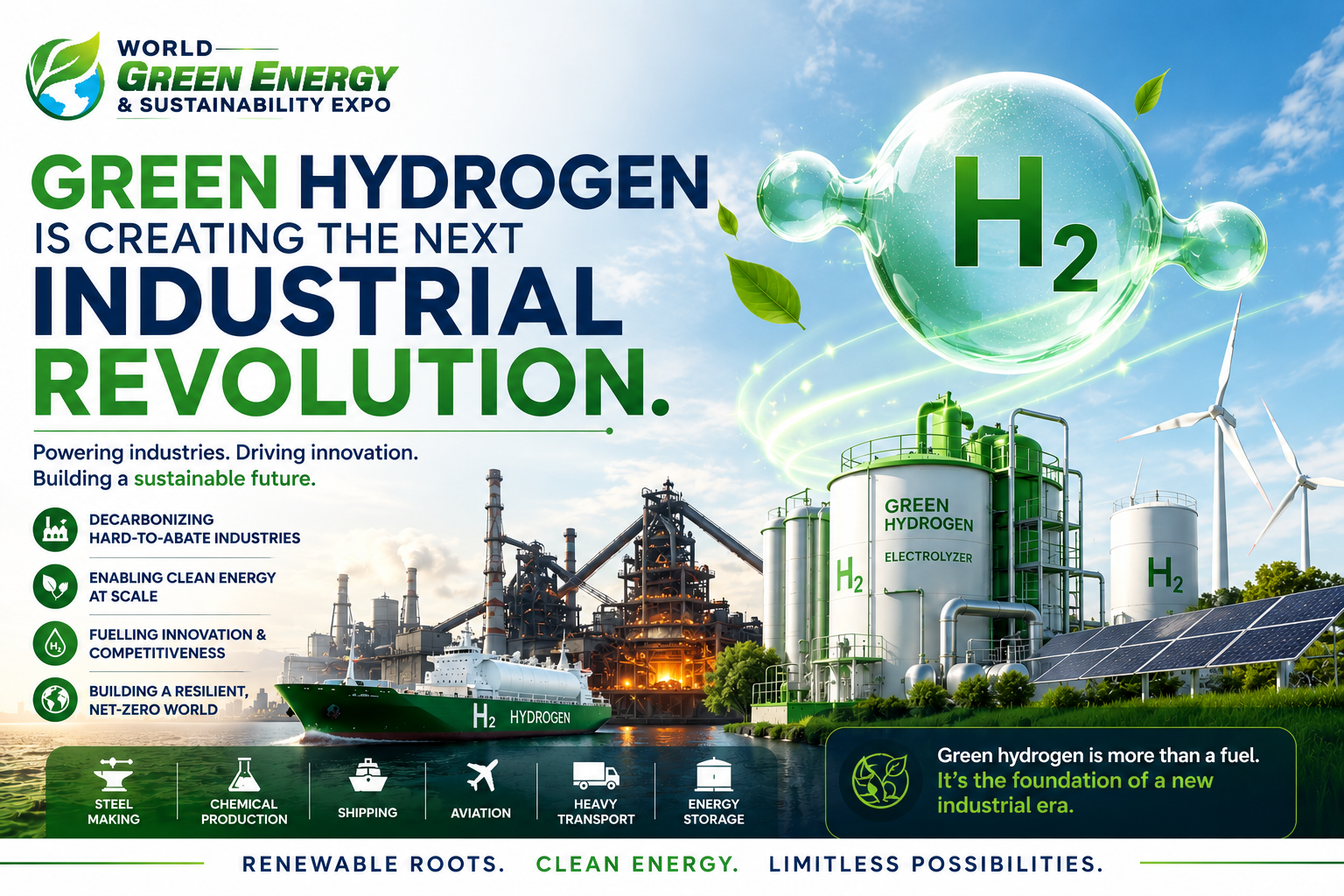
Why the Most Important Energy Story of the Decade Is No Longer About Power – But About Molecules
For years, the global energy transition was largely defined by electricity. Countries competed to install more solar capacity. Utilities expanded wind generation. Investors tracked battery deployments and renewable energy targets. The conversation revolved around how to generate cleaner power.
But a new chapter is now unfolding. The next phase of the energy transition is not primarily about electrons moving through transmission lines. It is about molecules moving through factories, ports, steel plants, refineries, shipping corridors, and industrial supply chains.
At the center of this transformation stands green hydrogen.
What began as a promising technology is rapidly evolving into a strategic industrial priority for governments, investors, manufacturers, and infrastructure developers across the world. The hydrogen economy is no longer a concept under discussion. It is becoming a geopolitical, industrial, and economic reality.
The Missing Piece in the Net-Zero Puzzle: Why Green Hydrogen Matters
The global transition to renewable energy has already begun reshaping the power sector. Solar, wind, hydro, and other renewable technologies are rapidly expanding their share in electricity generation, helping countries reduce dependence on fossil fuels and accelerate progress toward climate goals.
However, achieving true net-zero emissions requires more than decarbonizing electricity production alone.
Some of the world’s most carbon-intensive sectors remain exceptionally difficult to transition. Industries such as steel, cement, chemicals, refining, shipping, aviation, and heavy manufacturing demand extremely high-temperature processes, energy-dense fuels, and industrial feedstocks that conventional renewable electricity and battery technologies cannot easily provide at scale.
Steel production, for example, requires temperatures exceeding 1,500°C and traditionally relies on coal-based processes. Chemical manufacturing depends heavily on hydrogen as a critical feedstock, much of which is currently produced from natural gas. Meanwhile, long-distance shipping and aviation require fuels with high energy density, making direct electrification challenging with current battery technology.
This is where green hydrogen is emerging as a transformative solution.
Green hydrogen is produced through electrolysis, a process that uses renewable electricity to split water into hydrogen and oxygen without generating carbon emissions. Unlike conventional hydrogen production methods, green hydrogen offers a sustainable pathway for industries seeking deep decarbonization while maintaining operational efficiency and competitiveness.
Its significance extends far beyond being another clean energy source. Green hydrogen has the potential to become the vital link between renewable energy generation and industrial transformation. It can serve as a clean fuel, an industrial feedstock, an energy storage medium, and a foundation for producing sustainable fuels for transportation and manufacturing sectors.
As governments, investors, and industry leaders accelerate their net-zero commitments, green hydrogen is increasingly being recognized as a strategic pillar of future energy systems. Major economies across Europe, Asia, the Middle East, and North America are investing billions of dollars into hydrogen infrastructure, production facilities, transportation networks, and industrial applications.
The future of decarbonization will not be driven by renewable electricity alone. It will require integrated solutions capable of addressing the most challenging industrial emissions. Green hydrogen represents one of the most promising pathways to achieve that goal—enabling industries to reduce carbon footprints, strengthen energy security, and unlock a new era of sustainable economic growth.
The journey to net-zero is complex, but for many sectors, green hydrogen may well be the missing piece of the puzzle.
2026: The Year Hydrogen Moved Beyond Pilot Projects
For much of the last decade, hydrogen remained confined to demonstration projects and policy roadmaps. By 2026, that situation has changed dramatically.
More than 70 countries have now published hydrogen strategies, and over 400 hydrogen-related projects worldwide have reached final investment decisions, signaling a transition from ambition to implementation. The conversation is no longer about whether hydrogen will play a role. The conversation is now about who will lead the industry.
The Countries Shaping the Hydrogen Economy
China: Building Hydrogen at Industrial Scale
If solar panels defined China’s rise in renewable energy, hydrogen may define its next industrial chapter.
China has emerged as the global leader in electrolytic green hydrogen deployment, supported by strong national planning, manufacturing scale, and renewable energy expansion. Approximately 10 GW of electrolyzer capacity is already under construction, with deployment expected to accelerate significantly through 2026 and beyond.
The country’s latest Five-Year Plan places hydrogen at the heart of industrial decarbonization strategies, with applications extending into steel, chemicals, transport, and green fuels.
China’s strategy is clear: Not simply to use hydrogen, But to dominate the global hydrogen supply chain.
India: From Energy Importer to Hydrogen Exporter
Few countries have moved as aggressively as India.
Through the National Green Hydrogen Mission, India aims to establish itself as a global hub for the production, utilization, and export of green hydrogen and its derivatives. Current programs support large-scale electrolyzer manufacturing, hydrogen production incentives, green ammonia demand creation, and hydrogen deployment in refining and steel sectors.
India’s long-term ambition of producing 5 million tonnes of green hydrogen annually by 2030 has attracted global attention and significant investment interest.
For international exhibitors, India represents one of the world’s most dynamic emerging hydrogen markets.
Europe: Turning Climate Policy Into Industrial Policy
Europe continues to treat hydrogen as a cornerstone of its industrial decarbonization strategy.
Germany remains one of the most active markets, supported by substantial public funding and industrial demand. In 2026, the European Commission approved approximately €1.3 billion in German support measures to accelerate renewable hydrogen production.
Across Europe, refineries, ammonia producers, and industrial manufacturers are increasingly becoming the first large-scale adopters of green hydrogen technologies. The European approach demonstrates how policy can create entirely new industrial ecosystems.
Middle East: Reinventing Energy Leadership
The Middle East is pursuing one of the most ambitious hydrogen strategies anywhere in the world.
Countries such as Oman, Saudi Arabia, and the UAE are leveraging abundant solar resources to develop large-scale hydrogen production and export infrastructure.
In 2026, Oman signed agreements worth approximately $7.5 billion for new industrial projects, including major green hydrogen developments in Duqm.
For a region historically associated with hydrocarbons, hydrogen represents an opportunity to maintain global energy leadership in a low-carbon economy.
United States: Innovation Meets Infrastructure
The United States continues to focus on hydrogen hubs, industrial decarbonization, clean manufacturing, and advanced technology development.
Federal incentives and regional hydrogen programs are encouraging investment in transportation, energy storage, chemicals, and heavy industry applications. While deployment momentum varies by region, the U.S. remains one of the world’s most important innovation centers for hydrogen technologies.
Why Investors Are Paying Attention to the Hydrogen Economy
Throughout industrial history, the most transformative investment opportunities have emerged when entirely new infrastructure ecosystems were being built. From railways that connected nations, to electricity networks that powered economies, to telecommunications and internet infrastructure that transformed global commerce – each industrial revolution created value far beyond the core technology itself.
Today, many investors, policymakers, and industry leaders believe that green hydrogen represents the next major infrastructure-driven growth opportunity. Around the world, governments and private-sector organizations are committing unprecedented levels of capital toward hydrogen-related projects. According to global industry estimates, hundreds of billions of dollars have already been allocated to hydrogen production facilities, electrolyzer manufacturing, transportation networks, storage infrastructure, export terminals, and industrial decarbonization projects.
What makes hydrogen particularly attractive from an investment perspective is that the opportunity extends far beyond hydrogen production alone.
A Multi-Billion-Dollar Value Chain
The hydrogen economy is creating demand across an extensive industrial ecosystem that spans multiple sectors and technologies.
Investment opportunities are emerging in:
- Electrolyzer manufacturing
- Fuel cell technologies
- Green ammonia production
- Green methanol and sustainable fuels
- Industrial heating solutions
- Hydrogen mobility and transportation
- Storage and compression systems
- Pipeline infrastructure
- Export and import terminals
- Engineering, Procurement & Construction (EPC) services
- Industrial equipment and component manufacturing
Unlike many emerging technologies that are limited to a single industry, hydrogen is creating interconnected opportunities across numerous sectors simultaneously, generating a broad and diversified investment landscape.
Beyond Energy: The Rise of a New Industrial Ecosystem
One of the most common misconceptions about hydrogen is that it belongs exclusively to the energy sector. In reality, hydrogen is rapidly becoming an industrial transformation platform capable of reshaping multiple areas of the global economy.
Renewable Energy
Green hydrogen enables renewable electricity generated from solar, wind, and hydro sources to be converted into transportable, storable industrial fuel, significantly expanding the value and reach of renewable energy assets.
Industrial Manufacturing
Manufacturers are increasingly exploring hydrogen-based solutions to reduce emissions from energy-intensive production processes and support low-carbon industrial growth.
Chemicals & Fertilizers
Green ammonia and sustainable chemical feedstocks are emerging as critical pathways for decarbonizing one of the world’s most emissions-intensive industries.
Ports, Shipping & Logistics
Major ports around the world are positioning themselves as future hydrogen hubs, creating new trade corridors and supporting the movement of clean fuels across international markets.
Steel & Metals
Hydrogen-based steelmaking technologies are opening pathways toward low-carbon industrial production while helping countries meet ambitious climate targets.
Industrial Machinery & Equipment
The growth of hydrogen infrastructure is generating demand for advanced manufacturing systems, specialized equipment, compressors, storage technologies, and next-generation industrial solutions.
Sustainable Infrastructure Development
Perhaps most importantly, hydrogen is enabling the creation of entirely new industrial ecosystems that combine clean energy, manufacturing, logistics, transportation, and international trade.
This is why many industry leaders no longer view hydrogen merely as an energy technology. Increasingly, it is being recognized as a foundational platform for industrial transformation and long-term economic growth.
Why Global Industry Platforms Matter More Than Ever
As hydrogen projects move from pilot phases to commercial-scale deployment, the challenge facing the industry is no longer awareness. The challenge is collaboration.
- Technology providers need access to industrial buyers.
- Investors need scalable, commercially viable opportunities.
- Governments require implementation partners capable of delivering large-scale projects.
- Developers seek engineering expertise and technology solutions.
- Manufacturers need new markets and strategic partnerships.
- Building a successful hydrogen economy requires cooperation across an entire value chain that spans industries, geographies, and sectors.
This is precisely why dedicated international platforms are becoming increasingly important.
Events such as the World Green Energy & Sustainability Expo (WGES 2027) provide a critical meeting point where policymakers, investors, technology innovators, industrial users, EPC companies, manufacturers, and sustainability leaders can connect, collaborate, and accelerate the transition toward a low-carbon future.
The next industrial revolution will not be driven by a single technology. It will be driven by ecosystems and green hydrogen is rapidly emerging as one of the most important ecosystems shaping the future of global industry.
World Green Energy & Sustainability Expo: A Platform for the Green Hydrogen Economy
The World Green Energy & Sustainability Expo has been conceived at a pivotal moment for the global energy transition.
As a world green hydrogen exhibition, renewable energy platform, green energy expo, sustainability expo, and clean energy conference, World Green Energy & Sustainability Expo aims to bring together the stakeholders shaping the next phase of industrial growth.
The event is designed to connect:
- Green hydrogen developers
- Electrolyzer manufacturers
- Renewable energy companies
- Rooftop Solar Companies
- Industrial machinery manufacturers
- EPC contractors
- Biofuel, ethanol, biomass & biogas industries
- Boiler & thermal technology providers
- Infrastructure developers
- Investors and financial institutions
- Government agencies and policymakers
At a time when the hydrogen economy is moving from policy documents to commercial reality, platforms that encourage partnerships, investment, technology exchange, and market access will become increasingly valuable.
Every industrial revolution has been defined by a dominant source of energy. The next one may be defined by a clean molecule. Green hydrogen is no longer competing for relevance. It is competing for leadership and the countries, companies, investors, and innovators that position themselves early will help shape one of the most significant industrial opportunities of the twenty-first century.