

India Is Building Hundreds of New Distilleries – And Every One Needs Equipment
India achieved E20 ethanol blending in petrol in the financial year 2025-26 – five years ahead of its original 2030 target. The country increased ethanol procurement from approximately 380 million liters in 2013-14 to an estimated 12 billion liters in 2025-26. Production capacity grew nearly fivefold from 4.21 billion liters in 2014 to approximately 20 billion liters in 2026.
These headline achievements tell a compelling policy success story. What they do not immediately reveal is the industrial procurement story happening behind them – the thousands of crores of machinery, equipment, and engineering services that had to be specified, procured, installed, commissioned, and validated to build the production capacity that makes those headline numbers possible.
A new 750 KLPD grain-based ethanol plant, 20 KLD malt distillery, and 15 MW co-generation power unit costing INR 4,677.5 million is planned with construction targeted from September 2026 to September 2027 in Gorakhpur, Uttar Pradesh. A 120 KLPD grain-based distillery and 3.4 MW co-generation power plant costing INR 1,350 million is planned for Jalgaon, Maharashtra, with construction scheduled from September 2026 to March 2027. A INR 3,088 million grain-based distillery expansion project is underway in Raipur, Chhattisgarh, scaling capacity from 100 KLD to 300 KLD. A 91 KLPD second-generation ethanol biorefinery is planned at Wave Sugar complex in Dhanaura, Uttar Pradesh – which in June 2026 secured financial support via PM JI-VAN Yojana. An agro-industrial firm is constructing a INR 1,560 million greenfield 100 KLPD ethanol plant in East Singhbhum, Jharkhand, with commercial production targeted in FY2026-27.
These are not projections or policy ambitions. These are active construction projects with environmental clearances, confirmed investment figures, and scheduled completion dates. They represent the tip of a procurement pipeline that spans every major agricultural state in India – and every one of them needs milling equipment, fermentation tanks, distillation columns, dehydration units, boilers, heat exchangers, evaporation systems, DDGS recovery lines, ZLD systems, automation controls, and the engineering services to integrate all of these into a functioning, IBR-compliant, CPCB-approved ethanol production facility.
For grain processing machinery manufacturers, distillation column fabricators, fermentation equipment suppliers, molecular sieve dehydration system providers, DDGS drying technology companies, ZLD system engineers, automation and controls companies, and ethanol plant engineering contractors – India’s ethanol equipment market in 2027 is the most commercially active it has ever been, with a forward pipeline that is equally clear and equally large. This is the complete article.
India’s Ethanol Production – The Commercial Context Every Equipment Company Must Understand
Four structural drivers make ethanol manufacturing a strategically compelling opportunity for Indian investors in 2026 – and by extension, make the ethanol equipment market one of the most commercially predictable capital goods procurement markets in India’s industrial sector.
The first driver is the legally mandated demand created by the Ethanol Blended Petrol program. With approximately 1,016 crore liters of ethanol required annually to sustain E20 blending across India’s petrol consumption base, and with oil marketing companies – IOCL, BPCL, and HPCL – publishing progressive procurement plans supporting this mandate, the revenue certainty for ethanol producers is exceptional by the standards of any industrial commodity.
The second driver is the Administered Price Mechanism, which sets annual ethanol procurement prices by feedstock – INR 57.97 per liter for C-heavy molasses, INR 60.73 for B-heavy molasses, INR 65.61 for cane juice and syrup, INR 58.50 for FCI rice, and INR 56.28 for maize. These government-notified prices eliminate the market price risk that makes most agricultural commodity processing investments commercially uncertain, providing the revenue predictability that project finance requires.
The third driver is the interest subvention scheme under which public sector banks provide loans at subsidized rates for new distillery construction and expansion – reducing the cost of capital for ethanol plant investment and improving project IRR significantly relative to financing at commercial rates.
The fourth driver is the expansion of permitted feedstocks under the National Biofuels Policy 2022 amendment – including damaged food grains, surplus FCI rice and wheat, sugarcane juice and syrup, and maize alongside the traditional molasses-based pathway – which means new distillery investment is not dependent on any single agricultural commodity’s availability and pricing.
India’s fuel ethanol demand is projected at approximately 10 billion liters, requiring production capacity of approximately 1,700 crore liters – currently at approximately 1,600 crore liters, with scope for both molasses and grain-based expansion. Gross profit margins in ethanol production typically range 20 to 30% with net margins of 8 to 12%, improving with higher capacity utilization.
The commercial conclusion for equipment manufacturers is direct: the ethanol production investment environment in India is the most policy-supported, demand-certain, and capital-accessible in the country’s industrial history. Companies that position their equipment and engineering services in this market now – through exhibition at WGES 2027, distributor relationships with active distillery EPC contractors, and demonstration of compliance with BIS, IBR, and CPCB standards – will capture a procurement pipeline that is simultaneously large, growing, and structurally de-risked by government policy.
The Two Primary Production Pathways – Grain-Based vs Molasses-Based
Every piece of ethanol plant equipment is selected in the context of one fundamental choice: which feedstock pathway the plant is designed for. The two primary pathways – grain-based and molasses-based – have meaningfully different equipment requirements, capital costs, operating cost structures, and business models.
Grain-Based Ethanol Plants
Grain-based ethanol – using maize, broken rice, damaged wheat, sorghum, and other starch-rich grains – is India’s fastest-growing production pathway and the feedstock category most driving new distillery construction in 2026 and 2027. With the need for approximately 1,700 crore liters of ethanol annually to meet E20 targets, grain-based plants must contribute at least 40 to 45% of the total supply. India’s ethanol journey, once dominated by molasses from the sugar industry, is undergoing a strategic shift.
Grain-based plants offer year-round production capability – unlike molasses-based plants that are dependent on the sugar crushing season – and produce DDGS (Dried Distillers Grains with Solubles) as a co-product that commands a strong price as high-protein animal feed, significantly improving overall plant economics. The capital cost of a grain-based plant is higher than an equivalent-capacity molasses plant – reflecting the additional grain handling, milling, cooking, and saccharification equipment required upstream of fermentation – but the operating economics over a full year typically favor grain-based plants through superior capacity utilization.
Molasses-Based Ethanol Plants
Molasses-based distilleries operate downstream of sugar mills or independently, sourcing molasses from the open market. Advantages include lower capital cost per KLPD of capacity relative to grain-based plants, simplicity of feedstock handling (molasses is a liquid requiring pumping and storage rather than solid grain handling and milling), established supply chain relationships with sugar mills, and lower utility consumption for the feedstock preparation stages.
Disadvantages include seasonal production constraints linked to the sugar crushing season, vulnerability to molasses price and availability volatility in the open market, and the Zero Liquid Discharge requirement for the high-strength spent wash effluent that molasses fermentation generates – which adds capital and operating cost relative to grain-based plants where spent wash management is less complex.
Multi-Feed and Dual-Feed Plants
The most commercially sophisticated new distillery investments in India are multi-feed or dual-feed plants – capable of processing both grain and molasses feedstocks by switching between production modes depending on seasonal feedstock availability and relative economics.
State-level reforms: Maharashtra now permits dual-feed distilleries using grains and molasses year-round. Multi-feed plants command a capital cost premium of 15 to 25% over single-feedstock designs but provide the operational flexibility to optimize feedstock procurement throughout the year – achieving the highest annual capacity utilization and the most resilient operating economics of any distillery configuration.
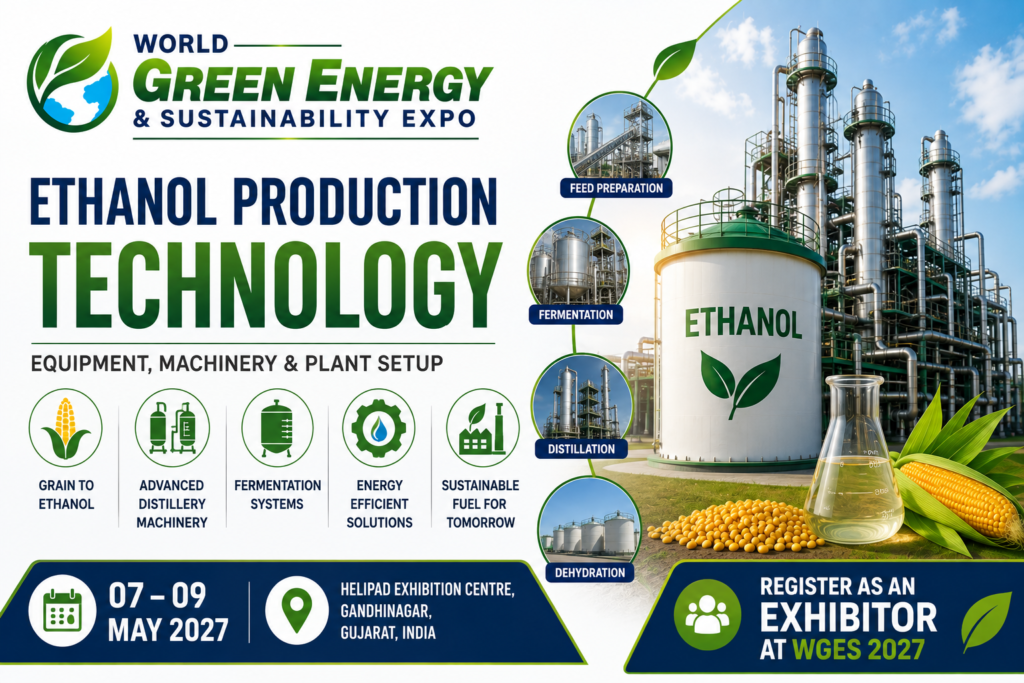
The Complete Equipment List – Every Major Technology in an Ethanol Plant
This section is the most commercially specific in this article – because it describes exactly what equipment buyers are procuring, which enables equipment manufacturers to position their specific products against the procurement requirements of India’s active distillery construction pipeline.
Step 1: Feedstock Handling and Preparation Equipment
For grain-based plants, feedstock preparation begins with grain reception – weighbridges, truck tippers, conveyors, bucket elevators, and silos for dry grain storage. Grain quality testing equipment – moisture meters, protein analyzers, and contaminant detection systems – is required at intake to ensure feedstock meets the specifications for efficient fermentation.
Key equipment includes milling units, fermentation tanks, distillation columns, dehydration units, boilers, storage tanks, heat exchangers, and packaging and control systems. The milling unit for grain-based plants is one of the highest-wear equipment categories – hammer mills or roller mills reduce grain to flour-consistency particle size that maximizes surface area for subsequent enzymatic hydrolysis. Mill capacity must match the plant’s daily grain consumption – a 100 KLPD plant consuming approximately 280 to 300 tonnes of maize per day requires milling capacity of 12 to 15 tonnes per hour.
For molasses-based plants, feedstock preparation involves molasses reception, pumping, storage in large stainless steel or mild steel tanks, dilution with water to the optimal Brix concentration for fermentation, and clarification to remove suspended solids that can inhibit yeast activity.
Step 2: Cooking, Liquefaction, and Saccharification (Grain Plants Only)
After milling, grain slurry is cooked at high temperature – 80 to 90 degrees Celsius for liquid cooking, or 120 to 150 degrees Celsius for jet cooking – to gelatinize starch granules and make them accessible to enzymes. This cooking stage requires pressure cookers or jet cookers, heat exchangers for slurry heating and cooling, and the associated pipework and instrumentation for process control.
After cooking, alpha-amylase enzymes are added during liquefaction to break long starch chains into shorter dextrins. Glucoamylase enzymes are then added during saccharification to convert dextrins into fermentable glucose. The saccharification reactors – typically continuous stirred tank reactors at 60 to 65 degrees Celsius – are critical to fermentation yield, and their design, residence time, and temperature control directly affect the efficiency of sugar extraction from the grain feedstock.
Step 3: Fermentation Equipment
Fermentation is the biological heart of an ethanol plant – where yeast converts glucose into ethanol and carbon dioxide. Industrial-scale ethanol fermentation uses closed stainless steel fermentation tanks of 500,000 to 2,000,000 liters capacity for large plants, with multiple tanks operating in a continuous or semi-continuous batch configuration to maximize overall plant productivity.
Fermentation tank specifications include internal cooling coils or external heat exchangers to maintain the optimal fermentation temperature of 30 to 34 degrees Celsius, agitation systems to maintain yeast suspension and CO2 degassing, vent gas scrubbing systems to recover ethanol from CO2 vents, pressure and temperature instrumentation, and clean-in-place (CIP) systems for rapid tank turnaround between batches.
Yeast propagation systems – sterile propagation vessels where the working yeast culture is grown before inoculation into the main fermentation tanks – are a critical but frequently overlooked component of the fermentation section. Contamination of the yeast propagation system is one of the most common causes of fermentation underperformance in Indian distilleries.
Carbon dioxide recovery systems – capturing the CO2 produced during fermentation, purifying it to food grade, compressing it, and selling it as a commodity product – are increasingly standard in new distillery designs because CO2 recovery adds INR 5 to 8 per liter of ethanol produced to overall plant revenue, significantly improving project economics.
Step 4: Distillation Equipment
Distillation is the most capital-intensive and energy-intensive single section of an ethanol plant, and the design of the distillation train has the greatest impact on both product quality and operating cost of any equipment choice in the plant.
A multi-column distillation system is required for ethanol production to IS 15464 specification (99.5% anhydrous ethanol for fuel applications). Process engineering covers multi-column distillation comprising rectifier, stripper, and purifier columns, along with dehydration through molecular sieve to 99.5 percent-plus anhydrous ethanol.
The rectifier column concentrates ethanol from the fermented beer (typically 8 to 12% ethanol) to approximately 95% – the azeotropic limit for conventional distillation. The stripper column strips residual ethanol from the bottom product (spent wash or vinasse) to minimize ethanol losses. The purifier column removes congeners – fusel oils and other impurities – from the product stream when high-purity ENA (Extra Neutral Alcohol) is required alongside fuel ethanol.
Heat integration in the distillation section – using vapor recompression, multi-effect evaporation, and heat exchanger networks – is the primary mechanism for reducing energy consumption in ethanol production and directly affects the plant’s competitive position through its operating cost structure. A well-designed multi-effect distillation system consumes 2 to 3 kg of steam per liter of ethanol produced, compared to 4 to 6 kg per liter for a poorly optimized conventional system – a difference that at scale represents millions of rupees annually in fuel cost.
Step 5: Molecular Sieve Dehydration
Breaking the ethanol-water azeotrope – achieving ethanol concentration above 95.6% – requires dehydration technology. Molecular sieve dehydration has become the universal standard for fuel ethanol production, displacing older azeotropic distillation and extractive distillation approaches.
Molecular sieve dehydration uses pellets of zeolite – a crystalline aluminosilicate material with precisely controlled pore size – that selectively adsorb water molecules while allowing ethanol to pass through. Operating in a two-vessel swing cycle – one vessel adsorbing while the other regenerates – molecular sieve units achieve dehydration to 99.5% ethanol at high efficiency with relatively low energy consumption.
Molecular sieve unit sizing, zeolite type selection, regeneration cycle optimization, and integration with the upstream distillation system are all engineering decisions that significantly affect unit performance and operating cost. Zeolite replacement – typically required every 7 to 10 years in well-operated systems – is a recurring maintenance cost that should be factored into project economics from the design stage.
Step 6: DDGS Recovery Systems (Grain Plants)
For grain-based ethanol plants, the DDGS (Dried Distillers Grains with Solubles) recovery section is the most commercially important co-product processing system. DDGS is produced by combining the wet distillers grains from the centrifuge with the concentrated solubles from the evaporation of the centrate liquid, then drying the mixture to below 10% moisture.
DDGS is sold as high-protein animal feed at INR 15,000 to INR 22,000 per tonne – representing a revenue contribution of INR 8 to 15 per liter of ethanol produced, depending on maize conversion efficiency and DDGS market pricing. This co-product revenue is frequently the difference between marginally viable and clearly profitable project economics for grain-based ethanol plants.
Key DDGS processing equipment includes decanter centrifuges for solids-liquid separation of the whole stillage, multi-effect evaporators for concentration of the thin stillage to high-solids syrup, rotary drum dryers or ring dryers for drying the combined wet cake and syrup to specification moisture, and pelletizing or bulk loading equipment for product dispatch.
Step 7: Effluent Treatment – ZLD System
Zero Liquid Discharge is mandatory for all distilleries in India under CPCB regulations. The ZLD system for a grain-based plant processes primarily the condensate from evaporation and the reject streams from reverse osmosis – achieving complete liquid recovery with no effluent discharge to environment. The ZLD system for a molasses-based plant is significantly more complex, as it must handle the high-strength spent wash (vinasse) which contains concentrated organic and inorganic dissolved solids at levels that make direct treatment challenging.
Molasses distillery ZLD systems typically combine anaerobic digestion of the spent wash for biogas recovery – generating additional energy revenue – with multi-effect evaporation, mechanical vapor recompression, and membrane filtration to achieve complete liquid closure.
ZLD system capital cost for a 100 KLPD molasses distillery typically ranges from INR 15 to 25 crore – a significant fraction of total plant capital that must be included in project financial models. For grain-based plants, ZLD capital cost is typically INR 8 to 15 crore for equivalent capacity.
Step 8: Utilities – Boiler, Power, Water Treatment
Every ethanol plant requires a boiler for steam supply to distillation, cooking, and evaporation. For 100 KLPD grain-based plants, steam demand of approximately 300 to 400 tonnes per day requires a boiler of 15 to 20 tonnes per hour capacity operating at 10 to 14 bar. For molasses plants with more steam-intensive spent wash evaporation, steam demand is higher.
A 200 KLPD grain-based distillery and 4.80 MW captive power plant with dry DDGS cattle feed recovery at an estimated cost of INR 220 crore gives a comprehensive benchmark for integrated plant capital at this scale.
Co-generation power plants – installing a steam turbine between the boiler and the process steam consumers to generate electricity from the pressure drop – are standard in new Indian distilleries above 60 KLPD. Co-generation adds 2 to 4 MW of captive power generation capacity per 100 KLPD of ethanol production, reducing grid electricity consumption and improving overall plant economics.
Water treatment systems – comprising clarification, filtration, softening, deaeration, and reverse osmosis – are required to produce the process water and boiler feed water quality that efficient fermentation and steam generation demand.
Ethanol Plant Setup – The Complete Step-by-Step Process
For companies evaluating ethanol plant investment in India for the first time, understanding the complete setup process – from initial concept through commercial production – is foundational for project timeline and budget planning.
Step 1: Feasibility and DPR Preparation
The Detailed Project Report is the foundational document for ethanol plant investment – covering feedstock analysis, production capacity selection, technology pathway choice, equipment specification, utility requirements, site selection criteria, financial projections, and regulatory compliance roadmap. A well-prepared DPR is the prerequisite for bank financing under the interest subvention scheme and for government subsidy applications under the National Biofuels Program.
Step 2: Site Selection and Land Acquisition
Site selection criteria for Indian ethanol plants include proximity to feedstock sources (within 50 to 100 kilometers for agricultural residues or grain, downstream of or adjacent to sugar mills for molasses), access to water – a 100 KLPD plant consumes approximately 400 to 500 kiloliters of water per day – adequate road infrastructure for heavy vehicle access, proximity to DISCOMS grid connection points for power supply and export, and distance from sensitive receptors including residential areas, schools, and water bodies that affect environmental clearance timelines.
Step 3: Regulatory Clearances
The regulatory clearance sequence for a new Indian distillery typically involves environmental clearance from the Ministry of Environment, Forest and Climate Change for plants above 30 KLPD capacity, State Pollution Control Board consent to establish before construction, IBR approval for boiler design before equipment procurement, Petroleum and Explosives Safety Organization (PESO) licenses for ethanol storage above threshold quantities, and consent to operate from the SPCB before commissioning.
Licenses and approvals required to start an ethanol plant in India span environmental, safety, boiler, and excise dimensions. The combined regulatory timeline – from initial application to all clearances received – typically runs 12 to 24 months for a large new distillery, with environmental clearance and SPCB consent being the longest lead-time items.
Step 4: Equipment Procurement and Engineering
Vendor selection typically involves Praj Industries, Vogelbusch, Katzen International, ThyssenKrupp, and others with proven Indian references. The equipment procurement sequence follows detailed engineering – once process flow diagrams, equipment data sheets, and site layouts are finalized, the procurement team issues enquiries for major equipment items in parallel to minimize total lead time. Critical long-lead items – distillation column internals, molecular sieve vessels, large fermentation tanks, and boiler pressure parts – are typically ordered first, often before civil construction is complete.
Step 5: Civil Construction and Equipment Installation
Civil construction for a 100 KLPD ethanol plant typically requires 18 to 24 months from groundbreaking to mechanical completion. The construction sequence follows civil foundations, structural steel erection, major vessel installation, piping fabrication and installation, electrical and instrumentation installation, insulation and painting, and final mechanical completion and hydrotesting of pressure systems.
Step 6: Commissioning and Start-Up
Commissioning begins with utilities – water treatment, boiler, and power supply – followed by individual equipment systems, then integrated systems testing, and finally production start-up with fermentation inoculation and distillation optimization. Start-up for a grain-based plant typically achieves design capacity within 30 to 60 days of first fermentation. Start-up for a complex multi-feed plant with new operators may require 60 to 90 days to achieve stable full-capacity operation.

Capital Cost Guide – What an Ethanol Plant Costs in India in 2027
Capital expenditure estimates for Indian ethanol plants vary significantly depending on capacity, feedstock pathway, technology configuration, location, and the extent of co-product recovery and utility integration. Capital expenditure ranges from USD 150,000 for basic small-scale distillation lines to USD 3,000,000 and above for large turnkey solutions. For Indian-context project sizing, the most commercially relevant benchmark is the INR-denominated cost per KLPD of installed capacity – the standard metric used by Indian project financiers and equipment suppliers to evaluate and compare distillery investment proposals.
For a grain-based ethanol plant without co-generation, a 100 KLPD plant costs approximately INR 80 to 110 crore inclusive of civil, equipment, and working capital. For a 200 KLPD grain-based plant with co-generation – as benchmarked by the Madhya Pradesh project feasibility at INR 220 crore – the cost per KLPD falls from INR 80 to 110 crore to approximately INR 110 crore total including the co-generation unit. For a 750 KLPD plant with multi-product capability – as in the Gorakhpur, UP project at INR 4,677.5 million – the cost per KLPD is approximately INR 62 lakh, reflecting the economies of scale in civil and engineering fixed costs.
Bihar building Asia’s largest grain-based ethanol plant represents a INR 4,000 crore investment – benchmarking the cost structure of the very largest integrated grain-based ethanol complexes including grain handling, milling, fermentation, distillation, DDGS processing, co-generation, and all associated utilities.
The Technology Providers – Who Supplies Ethanol Plant Engineering in India
Praj Industries – India’s Global Ethanol Technology Leader
Praj Industries is India’s most comprehensive bioenergy technology company and the undisputed leader in ethanol plant engineering across every production pathway – first-generation grain and molasses-based plants, second-generation cellulosic ethanol, and the emerging sustainable aviation fuel pathway. Vendor selection typically involves Praj Industries as the primary domestic technology provider with proven Indian references across hundreds of distillery projects.
Praj’s process technology – spanning feedstock preparation, fermentation, multi-column distillation, molecular sieve dehydration, DDGS recovery, and ZLD – is deployed in ethanol plants across India, Southeast Asia, Africa, and the Americas. Its BioX platform – integrating biogas recovery from distillery effluent with ZLD compliance – is the industry standard for sustainable distillery design in India. Its technology partnership with Axens for alcohol-to-jet SAF conversion positions it at the frontier of ethanol’s expanding application into aviation fuel.
Vogelbusch – The Austrian Fermentation and Distillation Specialist
Vogelbusch Bio commodities is one of the world’s most experienced providers of fermentation, distillation, and biorefinery technology for ethanol production. Its tubular reactors, continuous fermentation systems, and multi-pressure distillation designs are deployed in large-scale ethanol plants globally. In India, Vogelbusch technology is present in several large sugar and grain-based ethanol facilities.
Katzen International – The American Process Engineering Reference
Katzen International is one of the longest-established ethanol process technology providers globally, with grain-based ethanol technology deployed across the American Midwest’s corn ethanol industry and in international markets. In India, Katzen technology references through licensing arrangements provide Indian project developers access to American grain ethanol process technology with adaptation for Indian feedstock conditions and regulatory requirements.
ThyssenKrupp Industrial Solutions – The German Engineering House
ThyssenKrupp’s industrial solutions division provides ethanol and distillery process technology through its bioenergy and chemicals engineering business, with particular strength in large-scale distillation system design and modular plant engineering for emerging market deployment.
Universal Forces Industries – The Domestic Turnkey Provider
Universal Forces Industries specializes in designing, building, and optimizing grain-based ethanol plants tailored to India’s evolving energy goals. It offers turnkey solutions for both molasses and grain-based ethanol plants, systems for fermentation, distillation, ZLD, biogas, and co-generation, DDGS recovery units for grain-based plants, and compliance machinery for CPCB/SPCB norms, wastewater treatment, and automation.
Universal Forces Industries’ domestic manufacturing base and established relationships with Indian project developers, project financiers, and state pollution control boards make it a competitive turnkey provider for the mid-scale distillery market – 60 to 200 KLPD plants – that represents the majority of India’s active construction pipeline by project count.
Attaquant Enterprises – The Integrated Process Equipment Manufacturer
Attaquant Enterprises manufactures ethanol distillery plants, distillation columns, crude oil refinery plants, solvent recovery plants, heat exchangers, evaporation plants, and zero liquid discharge systems. Its integrated process equipment manufacturing capability – covering multiple distillery equipment categories from a single supplier – positions it for comprehensive equipment supply packages to new distillery projects.
The 2G Ethanol Technology Frontier – The Next Wave of Equipment Demand
Second-generation (2G) ethanol – produced from agricultural residues such as paddy straw, wheat straw, corn stover, and sugarcane bagasse through enzymatic hydrolysis and fermentation – is the technology pathway that will define the next phase of India’s ethanol capacity expansion beyond the limits of first-generation feedstock availability.
A 91 KLPD second-generation ethanol biorefinery is planned at Wave Sugar complex in Dhanaura, Uttar Pradesh. Estimated at INR 1,500 million, the eco-friendly plant converts biomass waste into fuel using high-end thermal integration. In June 2026, the clean-tech development secured financial support approval via PM JI-VAN Yojana.
The equipment requirements for 2G ethanol plants are fundamentally different from 1G plants – and significantly more complex and capital-intensive on a per-KLPD basis. The additional equipment sections required for 2G production include biomass reception and size reduction – bale busters, shredders, and conveyors for agricultural residue feedstock – pre-treatment reactors that subject biomass to dilute acid, alkaline, or steam explosion treatment to disrupt the lignocellulosic structure, enzymatic hydrolysis reactors where cellulase enzymes convert pre-treated cellulose to fermentable glucose, and lignin handling and combustion systems that convert the non-fermentable lignin fraction to energy.
Six commercial and four demonstration 2G ethanol plants have been approved under PM JI-VAN Yojana. IOCL’s Panipat 2G plant – India’s most advanced operational demonstration – uses paddy straw as feedstock and has validated the complete technology chain from agricultural residue to anhydrous fuel ethanol. The Panipat plant’s technology, supplied by Praj Industries using its proprietary pre-treatment and enzymatic hydrolysis process, is the reference system against which subsequent commercial 2G plants are being designed.
For equipment manufacturers, 2G ethanol represents a significantly larger capital equipment opportunity per plant than equivalent-capacity 1G plants – with total project capital for a 60 to 100 KLPD 2G plant typically ranging from INR 300 to INR 600 crore, compared to INR 50 to 110 crore for a 1G plant of the same ethanol output capacity.
The Multi-Feed Distillery Conversion Opportunity
The government’s March 2025 notification enabling cooperative sugar mills to convert to multi-feed distilleries capable of using grains, maize, and other inputs alongside molasses creates one of the most commercially specific equipment upgrade opportunities in India’s ethanol sector.
Sugar mills that currently operate seasonal molasses-based distilleries – producing ethanol only during the crushing season when molasses is available – can convert to multi-feed operation that extends production throughout the year by switching to grain feedstocks between crushing seasons. This conversion requires the addition of grain handling and milling equipment, cooking and saccharification reactors, and potentially modifications to the fermentation and distillation sections – all of which represent specific, near-term equipment procurement opportunities.
Maharashtra now permits dual-feed distilleries using grains and molasses year-round. The Maharashtra regulatory reform – combined with the March 2025 central government notification – creates the commercial and regulatory certainty that cooperative sugar mill management teams needed to begin the capital investment planning for multi-feed conversion projects.
For equipment manufacturers with grain handling, milling, cooking, and saccharification technology, the multi-feed conversion market represents a potentially very large near-term sales opportunity. India’s cooperative sugar sector operates hundreds of sugar mills across Maharashtra, Karnataka, Tamil Nadu, Andhra Pradesh, and UP – many of which have existing molasses distilleries that could benefit commercially from multi-feed conversion with relatively modest additional capital investment.
Co-Products – The Revenue Streams That Change Project Economics
A standalone ethanol plant – producing only fuel ethanol without recovering co-products – is increasingly commercially suboptimal relative to an integrated biorefinery that maximizes value from every output of the production process. Understanding co-products and their economics is commercially critical for both project developers and the equipment manufacturers supplying the recovery systems.
DDGS – Dried Distillers Grains with Solubles – is the most commercially valuable co-product of grain-based ethanol production. DDGS from maize-based plants contains approximately 26 to 30% crude protein, 10 to 12% fat, and 35 to 40% digestible fiber – making it a high-value ingredient in poultry, pig, aquaculture, and ruminant feed formulations. At INR 15,000 to INR 22,000 per tonne, DDGS from a 100 KLPD maize-based plant – producing approximately 80 to 100 tonnes per day – contributes INR 12 to 22 lakh per day of additional revenue beyond ethanol sales.
Carbon dioxide is produced in approximately 48 kg per 100 liters of ethanol during fermentation. Food-grade liquid CO2, recovered and purified from fermentation vent gas, sells at INR 8,000 to INR 12,000 per tonne – representing a revenue contribution of INR 3 to 6 per liter of ethanol produced for plants with CO2 recovery systems.
Biogas from spent wash anaerobic digestion – available in molasses-based plants where the high-strength vinasse is processed through anaerobic digesters – provides fuel for the plant’s own boiler, reducing solid or gas fuel consumption and lowering operating costs.
Fusel oil – the higher-alcohol fraction separated in the distillation purifier column – commands INR 25 to 50 per kilogram as a chemical intermediate or solvent. Its recovery adds minor but positive contribution to overall plant economics.
Modern biorefineries are designed to enhance ethanol production and can generate products such as chemicals, bio-plastics, and valuable co-products. The integrated biorefinery model – designing the ethanol plant from the outset to maximize value from every output stream – is the direction that sophisticated new Indian distillery investment is moving, and the equipment complexity of multi-product recovery is creating growing demand for engineering companies with biorefinery system integration capability alongside individual equipment supply.
Why World Green Energy & Sustainability Expo (WGES 2027) Is the Right Platform for India’s Ethanol Equipment Industry
India’s ethanol equipment market in 2027 is the most commercially active it has ever been. Hundreds of distilleries are under construction or in advanced planning. The government’s interest subvention scheme and OMC offtake agreements provide the demand certainty and capital accessibility that make new distillery investment commercially rational. The multi-feed conversion opportunity is opening an additional equipment sales market across India’s existing sugar mill fleet. And the 2G ethanol programme is creating a new, capital-intensive equipment category with significantly higher per-plant procurement value than 1G distillery equipment.
Every one of these equipment procurement decisions – grain handling conveyors, hammer mills, cooking reactors, fermentation tanks, distillation columns, molecular sieve dehydration units, DDGS dryers, evaporators, ZLD systems, boilers, and automation controls – is made by project developers, EPC contractors, and engineering consultants who attend India’s clean energy and biofuel industry events to evaluate suppliers, compare technology options, and build the relationships that precede formal equipment procurement.
Gujarat – World Green Energy & Sustainability Expo (WGES 2027)’s host state – is directly connected to India’s ethanol equipment story. Gujarat’s large food processing, pharmaceutical, and chemical industrial base operates hundreds of boilers that are potential biomass fuel switch candidates. The state’s sugar and distillery industry generates significant press mud and vinasse feedstock for integrated biogas-ethanol plant configurations. And Praj Industries – India’s leading ethanol technology company – has significant engineering and manufacturing operations in Gujarat.
World Green Energy & Sustainability Expo (WGES 2027)’s biofuel and bioenergy exhibitor community – connected through the Bharat Bio Energy Association partnership and the Advance Biofuel Ahmedabad association – brings the ethanol plant equipment procurement community together with the technology providers, engineering companies, and project developers who are driving India’s most active industrial equipment investment cycle in a generation.
For grain handling and milling equipment manufacturers seeking distillery procurement relationships, for fermentation tank fabricators targeting India’s active distillery construction pipeline, for distillation column and molecular sieve system suppliers evaluating Indian market entry, for DDGS drying and recovery technology companies addressing the grain ethanol co-product market, for ZLD system engineers serving distillery effluent compliance requirements, for automation and control system companies targeting distillery digitization, and for EPC contractors providing turnkey distillery construction services – World Green Energy & Sustainability Expo (WGES 2027) is where India’s ethanol equipment industry comes together at the moment of its greatest commercial activity.