
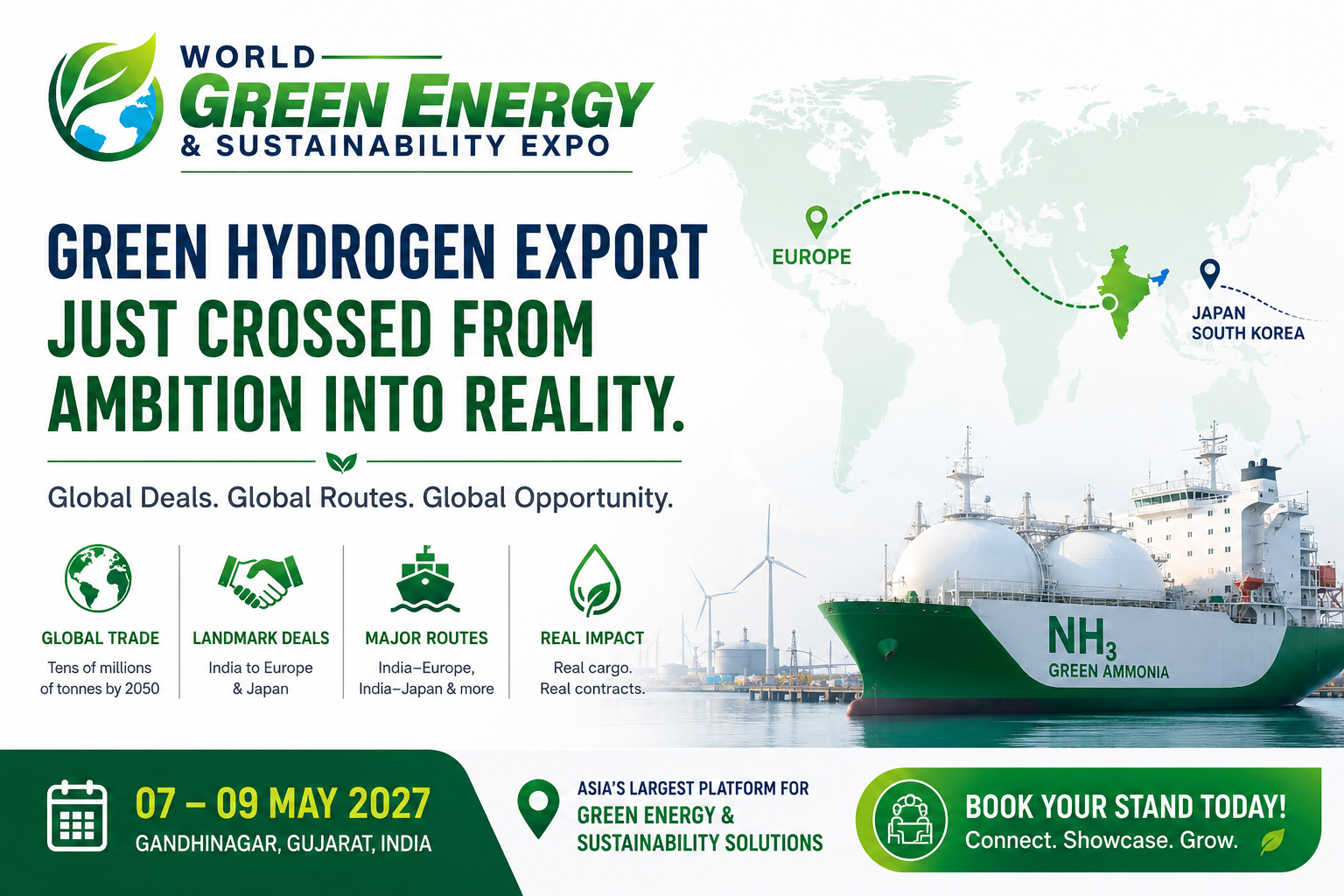
Green Hydrogen Export Just Crossed From Ambition Into Reality
There is a moment in the development of every new global commodity market when the story changes permanently. For decades, oil was simply fuel burned locally. Then tankers appeared, pipelines crossed borders, trading hubs formed, and overnight it became the most globally traded commodity in history. Green hydrogen is having its version of that moment right now – and it is happening faster than almost anyone predicted even two years ago.
On January 12, 2026, in Ahmedabad – a moment that deserves particular attention from every World Green Energy & Sustainability Expo (WGES 2027) attendee – German Chancellor Friedrich Merz and Indian Prime Minister Narendra Modi witnessed the signing of a long-term binding offtake agreement between Uniper Global Commodities and AM Green Ammonia for up to 500,000 tonnes per year of RFNBO-certified renewable ammonia from India to Germany. The first shipment is expected as early as 2028.
Three days after this article goes to press – on July 5, 2026, just four days ago – ACME Cleantech signed landmark long-term export agreements with two leading Japanese companies, IHI Corporation and Mitsubishi Gas Chemical Company, for the supply of 405,000 tonnes per year of green ammonia and a significant volume of green methanol. The Japan deals are supported by Japan’s Ministry of Economy, Trade and Industry Contract for Difference subsidy mechanism, which provides financial support to Japanese importers of clean fuels, bridging the cost gap between conventional and low-carbon alternatives.
These are not memoranda of understanding. These are not letters of intent. These are binding, long-term contracts between industrial producers and industrial buyers, denominated in specific volumes at specific prices, with specific delivery timelines. Green hydrogen export is moving from announcements to offtake. The question every developer, infrastructure company, shipping operator, port authority, certification body, and industrial buyer needs to answer right now is the same one: where do I fit in what is becoming a genuinely global clean molecule supply chain?
Looking for the right answers? This article will guide you, and World Green Energy & Sustainability Expo (WGES 2027) is where you’ll find complete solutions, industry insights, and unmatched business opportunities – all under one roof.
The Scale of the Global Green Hydrogen Export – Where It Is Going
Understanding the green hydrogen export starts with understanding what makes it structurally different from every previous clean energy trade – and what makes it structurally similar to the fossil fuel trade it is being built to replace.
IRENA’s analysis of the potential for green hydrogen and related commodities trade confirms that Europe, Japan, the Republic of Korea, and Southeast Asia are likely to be significant import markets for hydrogen commodities due to the large cost differences between domestic production and imports from renewable-energy-rich exporting nations.
The export of hydrogen in commodity form – as green ammonia, green methanol, liquid hydrogen, or direct reduced iron – represents almost 72% of the total equivalent hydrogen export projected. Pure hydrogen gas transport, despite its theoretical appeal, is economically viable only in very specific circumstances. The commodity carriers – primarily green ammonia – are the practical vehicles of the global hydrogen trade as it is actually developing.
By the 2050 scenarios modelled in the most rigorous analyses, approximately one-third of all green hydrogen produced globally will be traded across borders, with two-thirds used locally. That means the international trade market for green hydrogen derivatives in 2050 is approximately equivalent in scale to one-third of total global hydrogen consumption – a commodity flow that, at projected demand levels, would represent tens of millions of tonnes per year. This is the size of the market that the deals being signed right now are the first generation of – structurally comparable to the first LNG contracts signed in the 1960s before the global LNG market existed at recognizable scale.
For 2030, the projected global green hydrogen export is far more modest than the 2050 vision – and significantly more commercially specific. The deals being signed today between Indian, Australian, Middle Eastern, African, and South American producers and European, Japanese, and South Korean buyers are the contracts that will define trade flows through the first decade of large-scale green hydrogen shipping. Global announcements of hydrogen projects by 2030 add up to USD 160 billion of investment, with half of the investments planned for green hydrogen production. Leading lights in the move towards green hydrogen are the EU, China, India, Japan, South Korea, and the US.
Who Is Buying – The Importing Nations and Why They Cannot Produce Enough at Home
The geography of green hydrogen imports is fundamentally determined by two factors: land constraints that limit domestic renewable energy production, and industrial energy demand that exceeds what domestically produced green hydrogen can supply at competitive cost.
Germany – Europe’s Most Active Importer
Germany is investing in partnerships around the world to secure clean hydrogen imports, since its own renewable capacity may not meet demand. Germany has been the most active and commercially specific green hydrogen import market in the world, establishing bilateral hydrogen partnerships with more than fifteen countries and launching the H2Global mechanism – a government-funded intermediary that buys green hydrogen internationally and sells it to German industrial buyers at a fixed price differential – as a practical tool for bridging the current cost gap between green hydrogen and fossil-based alternatives.
Germany’s landmark Import Strategy commits to importing 50 to 70% of its total hydrogen demand by 2030. This is a structural import dependency larger than most European countries’ entire hydrogen demand – and it creates an enormous purchasing market for producers in India, Australia, Morocco, Namibia, Chile, and the Middle East.
Germany awarded a tender to UAE-based Fertiglobe to purchase a minimum of 259,000 metric tonnes of green ammonia between 2027 and 2033 – the first of several global tenders aimed at importing green hydrogen derivatives. Germany’s designation of Rotterdam, Hamburg, and Brunsbüttel as primary import terminals connects directly to the infrastructure investment needed to receive, crack, and distribute imported green hydrogen at scale. The January 12, 2026 AM Green-Uniper agreement – signed in Ahmedabad in the presence of both national leaders – is the most commercially significant single offtake commitment between India and Germany in the green hydrogen space, and it was explicitly welcomed in the India-Germany Joint Statement as evidence that their National Green Hydrogen Mission and Germany’s National Hydrogen Strategy are aligning through deeper commercial linkages.
Japan – The Pioneer Importer
Japan has made hydrogen a cornerstone of its energy policy and is already importing hydrogen and hydrogen-based fuels like ammonia. Due to the nature of its territory, Japan has 91% of its total land mass excluded from renewable electricity production that could be used for hydrogen production. Japan’s technical potential of approximately 380 GW of PV and 180 GW of onshore wind would be enough to produce about 20 million tonnes per year of hydrogen, but the quality of resources is relatively poor, and once electricity consumption for other uses is considered, very little remains for hydrogen production. Japan is the world’s most mature and specific hydrogen importing nation. Its Basic Hydrogen Strategy sets import targets, its Contract for Difference subsidy mechanism subsidizes Japanese importers of clean fuels, and its ports at Kobe, Kawasaki, and Yokohama are being retrofitted to receive liquid hydrogen and green ammonia at commercial scale.
The ACME-IHI Corporation agreement signed on July 5, 2026 for 405,000 tonnes per year of green ammonia is supported by Japan’s METI Contract for Difference scheme – meaning the Japanese government is actively subsidizing this specific offtake to make it commercially viable, reflecting how seriously Japan treats green hydrogen import security as a matter of national energy policy. Tokyo has moved from ambition to allocation. For project developers and oil and gas, the way Japan structured its first hydrogen awards matters more than any headline target – because the CfD mechanism creates commercially specific, government-backed demand at defined prices for defined volumes, which is exactly what project developers need to reach Final Investment Decision.
South Korea – The Industrial Hydrogen Economy
A major industrial powerhouse, South Korea is investing heavily in hydrogen fuel cells, mobility, and power generation, with a strong emphasis on importing green hydrogen to meet its needs. Like Japan, South Korea would need to use about one-third of its entire renewable energy potential to satisfy its domestic hydrogen demand in 2050 – and that is before electricity consumption for other uses is considered.
South Korea’s Hydrogen Economy Roadmap and its emerging hydrogen import terminal infrastructure at Incheon and Busan position it as the second most commercially specific Asian hydrogen import market, with Korean industrial companies including POSCO, SK Group, and Hyundai actively evaluating long-term green hydrogen supply agreements with Australian, Middle Eastern, and increasingly Indian producers.
The Netherlands – Europe’s Primary Import Hub
The Netherlands has positioned Rotterdam – Europe’s largest port – as the primary green hydrogen import and distribution hub for the entire European continent. Dutch government investment in hydrogen import terminals, pipeline connections to Germany and Belgium, and underground hydrogen storage in depleted North Sea gas fields is building the infrastructure that turns Rotterdam from a fossil fuel trading centre into a clean energy molecule distribution hub.
AM Green signed an MoU with the Port of Rotterdam towards the establishment of a renewable molecules corridor between India and North-Western Europe, via Rotterdam – a direct connection between India’s most advanced green ammonia project and Europe’s most important import gateway.
Southeast Asia – The Fast-Growing Import Market
Europe, Japan, the Republic of Korea, and Southeast Asia are the major import markets for green hydrogen commodities. Singapore, with no meaningful land for renewable energy and the world’s fourth-busiest container port, is positioning itself as the primary green hydrogen distribution hub for Southeast Asia – importing green ammonia and green methanol for bunkering, industrial use, and re-export across the ASEAN region.
Vietnam, Indonesia, the Philippines, and Thailand all have rapidly growing industrial electricity demand that their domestic renewable energy systems cannot fully serve competitively. Each of them represents a growing import market for green hydrogen derivatives as industrial decarbonization targets tighten through the late 2020’s and into the 2030’s.
Who Is Selling – The Exporting Nations Building Green Hydrogen Capacity
The geography of green hydrogen exports is determined by the inverse of import geography: abundant, cheap renewable energy resources, available land, and acceptable production economics relative to international market prices.
India – The Emerging Green Molecule Superpower
India’s position in the global green hydrogen export market has shifted fundamentally in 2025 and 2026 – from a country with ambitious production targets and limited commercial delivery to a country with binding offtake agreements, construction-stage projects, and certified production facilities. Six months into 2026, announced and tied green ammonia volumes alone are beginning to represent a meaningful share of India’s 5 million tonne per year 2030 ambition on a hydrogen-equivalent basis. This is not yet victory. It is early validation. The next phase will depend on project execution, cost discipline, certification alignment, and whether Indian developers can convert signed agreements into shipped molecules.
India represents 8% of global ammonia production but is also one of the world’s largest ammonia importers. According to the World Bank, 2.4 million tonnes of ammonia were imported into India in 2021. As India has significant potential for renewables, new renewable ammonia capacity is an opportunity for the country to export green hydrogen and green ammonia to the world, and also replace these imports. The price competitiveness that India demonstrated through the SECI GAPA program – green ammonia at USD 572 to USD 744 per tonne compared to Europe’s H2Global auction price of approximately EUR 1,000 per tonne – is the single most commercially significant validation of India’s export potential. These prices came in at roughly half of what Europe paid for equivalent product through its own procurement mechanism, reflecting India’s combination of low renewable electricity costs, competitive engineering, and the SIGHT program’s subsidy architecture.
India’s three designated Green Hydrogen Hubs – Deendayal Port in Gujarat, V.O. Chidambaranar Port in Tamil Nadu, and Paradip Port in Odisha – provide the export infrastructure connecting India’s renewable energy production corridor with the global shipping lanes that serve European and East Asian import markets.
Australia – The Asian Corridor
Australia has vast solar and wind resources and is investing heavily in green hydrogen. It plans to export hydrogen to Asia, particularly Japan and South Korea. Australia’s Asian Renewable Energy Hub in Western Australia, targeting 26 GW of combined solar and wind capacity, is the largest single renewable energy project proposed globally and is specifically designed around hydrogen production and export. Australia’s advantage is proximity to Japan and South Korea – the shipping distance from Western Australia to Japanese ports is a fraction of the distance from the Middle East or India, reducing transport cost and transit time for the world’s most commercially specific hydrogen import markets.
Australia’s combination of exceptional renewable resources, stable political environment, existing energy export relationships with Japan and South Korea, and a federal government that has made clean energy export a strategic national objective positions it as one of the two or three most commercially credible green hydrogen exporters in the world over the coming decade.
Saudi Arabia – The Scale Play
Saudi Arabia is using its oil wealth to pivot toward clean energy. Saudi Arabia’s USD 8.4 billion NEOM plant – a 4 GW solar-wind electrolysis system designed to produce 600 tonnes of green hydrogen per day, roughly 1.2 million tonnes of ammonia per year – is the world’s most ambitious single green hydrogen production facility, with its first output expected around 2026.
Saudi Arabia aims to become one of the top three global hydrogen producers by 2030 under its National Hydrogen Strategy, launched as part of Vision 2030. The combination of Saudi Arabia’s world-class solar irradiance, vast land availability, existing energy export infrastructure, and sovereign wealth fund backing makes it one of the few producers globally capable of scaling to multi-million tonne per year green ammonia export capacity within this decade.
Morocco – Europe’s Closest Renewable Neighbor
Countries such as Chile, Morocco, and Namibia are poised to become green hydrogen exporters. Morocco’s unique position at the northwest tip of Africa – with direct proximity to Spain and Portugal, excellent Atlantic wind resources, and existing energy connections to Europe through the Maghreb-Europe gas pipeline infrastructure – makes it one of the most strategically located green hydrogen production sites in the world relative to European demand.
Morocco’s green hydrogen program – supported by significant investment from European energy companies and development finance institutions – targets both pipeline transport via Spain and France and shipping via Mediterranean ports. Its renewable energy resources, particularly in the Laâyoune and Dakhla regions, support some of the lowest production cost projections of any country outside the Middle East.
Namibia – Africa’s Fastest-Moving Green Hydrogen Producer
Namibia has emerged as one of the most exciting green hydrogen development stories in Africa. The Hyphen Hydrogen Energy project – targeting 2 million tonnes of green ammonia per year for export – is backed by German development finance and European offtake commitments. Namibia’s combination of Atlantic wind resources, solar irradiance in the Namib Desert, and port infrastructure at Lüderitz positions it as the primary African green hydrogen exporter targeting European markets over the 2028 to 2035 horizon.
Chile – The South American Giant
Chile is using its strong solar potential in the Atacama Desert to produce hydrogen for export to Europe and Asia. Chile’s Atacama Desert has solar irradiance levels that make it one of the two or three lowest-cost green hydrogen production locations in the world. Its Pacific coast position gives it access to both European shipping lanes and Japanese and South Korean import markets, and its existing nitrate mining industry provides a workforce and engineering base familiar with large-scale industrial chemistry. Several major projects in Chile have reached advanced development stages, with European offtake discussions and government policy support through Chile’s National Green Hydrogen Strategy targeting 25 GW of electrolysis capacity by 2030.
Egypt – The Mediterranean Export Hub
Egypt is developing green hydrogen production in the Suez Canal Economic Zone, leveraging solar resources and its extraordinarily strategic location at the intersection of European, Asian, and African shipping lanes. Egypt has signed major green hydrogen development agreements with European energy companies and positioned itself as a primary source for European imports through the nearest African production geography to Mediterranean import terminals.
The Landmark Deals That Are Defining the Market – A Complete Review
The green hydrogen trade market in 2027 is being defined by a small number of landmark transactions that establish price references, certification frameworks, and bilateral trade relationships that subsequent deals will follow.
AM Green – Uniper: The India-Europe Corridor
The AM Green-Uniper agreement is the single most significant green hydrogen export deal involving India to date, and its signing location – Ahmedabad, Gujarat, in the presence of both the Indian Prime Minister and the German Chancellor – invests it with geopolitical as well as commercial significance.
Uniper Global Commodities will offtake up to 500,000 tonnes per year from AM Green’s green ammonia projects. First shipment is expected as early as 2028 from AM Green Ammonia’s first 1 million tonne per year plant currently under construction in Kakinada, Andhra Pradesh. The contract is the first of its kind for an Indian company. AM Green’s renewable ammonia is certified as RFNBO-compliant – meeting the EU’s Renewable Fuels of Non-Biological Origin standard – through its unique architecture combining 2.3 GW of wind and solar capacity with Greenko’s 1.68 GW pumped hydro facility at Pinnapuram, which provides firm, dispatchable renewable electricity that enables electrolyser utilization rates above 85% and RFNBO certification that relies on hourly matching rather than annual averaging.
Michael Lewis, CEO of Uniper, was explicit about the commercial rationale: green ammonia stands out as one of the most promising solutions to decarbonize CO2-intensive production of chemicals, fertilizers, and through green hydrogen, also in refining. It offers among the lowest CO2 avoidance costs compared to other renewable and low-carbon molecules, thanks to its mature production process and the absence of carbon feedstock requirements. AM Green is developing a portfolio of renewable ammonia plants in India across Kakinada, Tuticorin, and Kandla with a targeted total production capacity of 4 million tonnes per year of renewable ammonia – which, if delivered, would make it the largest single green ammonia producer in the world.
ACME – IHI Corporation and MGC: The India-Japan Corridor
Just four days before this article is published, on July 5, 2026, ACME Cleantech signed landmark long-term export agreements with IHI Corporation and Mitsubishi Gas Chemical Company at Atal Akshay Urja Bhawan in New Delhi, in the presence of senior MNRE officials and representatives of the Japanese government. Under the arrangements, ACME will supply 405,000 tonnes of green ammonia annually to IHI Corporation, making it one of the largest export commitments between India and Japan. A separate agreement with Mitsubishi Gas Chemical covers supply of green methanol – the first Indian-Japanese green methanol trade deal.
The agreement gains additional importance because it is supported by Japan’s Contract for Difference subsidy mechanism administered by METI, which provides financial support to Japanese importers of clean fuels. The ACME-MGC green methanol project has been designed to comply with EU RFNBO requirements as well as IMO standards for cleaner marine fuels – giving Indian-produced green methanol dual certification for European and Japanese markets simultaneously.
ACME’s total green hydrogen export commitment – across its India-Japan green ammonia deal and its SECI GAPA domestic fertilizer supply agreements covering 370,000 tonnes per year – represents the single largest commercial green hydrogen commitment by any Indian company in history, with a combined contract value that Greenko’s GH2 India platform estimates in the tens of thousands of crores of rupees over the combined life of these agreements.
RWE Supply and Trading – AM Green: The European Trading House Model
RWE Supply and Trading signed an offtake agreement for 250,000 tonnes per year of RFNBO-compliant ammonia from AM Green’s Indian production facilities, with delivery expected from 2027. RWE’s involvement alongside Uniper in AM Green’s offtake portfolio demonstrates that India’s green ammonia is being treated as a serious supply option by multiple major European energy trading companies simultaneously – not as a speculative future option, but as a commodity to be procured for definitive delivery timelines.
ExxonMobil – Marubeni: The US-Japan LNG Model for Hydrogen
On 7 May 2025, ExxonMobil signed a long-term contract to provide Japanese trading company Marubeni with 250,000 metric tonnes of low-carbon ammonia per year – the first client contract for ExxonMobil’s proposed low-carbon hydrogen plant in Baytown, Texas. While this deal involves low-carbon rather than strictly green ammonia, it establishes the US-Japan bilateral supply corridor and demonstrates that Japanese trading companies are actively building diversified import portfolios spanning multiple supplier geographies.
Germany’s H2Global Tender – Fertiglobe
Germany awarded a tender to UAE-based Fertiglobe to purchase a minimum of 259,000 metric tonnes of green ammonia between 2027 and 2033 – the first of several global tenders aimed at importing green hydrogen derivatives that form the backbone of Germany’s import strategy.
The Hydrogen Carriers – How Green Hydrogen Actually Travels
Unlike oil, natural gas, or electricity, green hydrogen does not travel easily in its raw form across long distances. Understanding the carrier options – and why green ammonia has emerged as the dominant choice — is essential for any company evaluating the trade infrastructure requirements of this market.
Green Ammonia – The Dominant Carrier
Green ammonia is gaining favor due to its existing infrastructure, shipping compatibility, and dual-use as a fertilizer and fuel. Compared with the other three green commodities analyzed – gaseous hydrogen, methanol, and direct reduced iron – ammonia is expected to be the most traded, with Japan, South Korea, and Southeast Asia as the major importers.
Ammonia liquefies at minus 33 degrees Celsius – manageable with existing refrigeration technology. Over 170 dedicated ammonia tankers operate globally. Ammonia storage terminals exist at dozens of major ports worldwide. And for fertilizer plant end-users, the ammonia simply enters the existing production process without needing to be converted back to hydrogen.
The primary challenge with ammonia as a hydrogen carrier for energy applications rather than fertilizer production is the ammonia cracking step – converting ammonia back into hydrogen at the point of use – which requires dedicated infrastructure and adds cost. Thyssenkrupp Uhde is currently constructing a 28 tonnes per day ammonia cracker in Germany for Uniper, consuming almost 10,000 tonnes per year – one of the first commercial-scale cracking facilities in Europe, directly connected to the AM Green India supply chain.
Liquid Hydrogen – The Niche Premium Option
Liquid hydrogen requires extremely low temperatures of minus 253 degrees Celsius but enables direct use in some industrial and transport applications without conversion losses from ammonia cracking. Due to significantly reduced efficiency, transporting liquefied hydrogen or liquid organic hydrogen carriers is only cost-effective in a few instances in Asia, hence it is not discussed in detail in the most rigorous trade analyses. Japan has invested in liquid hydrogen shipping infrastructure through the Hydrogen Energy Supply Chain pilot project with Australia – which successfully demonstrated liquid hydrogen shipping in 2022 – but even Japan’s forward-looking hydrogen strategy places green ammonia rather than liquid hydrogen at the centre of its volume import planning, reflecting the economic reality that ammonia’s infrastructure cost advantage is substantial.
Green Methanol – The Maritime Fuel Option
Methanol – produced from green hydrogen and captured carbon dioxide – is liquid at ambient temperature and pressure, making it far easier to store and handle than either compressed hydrogen or liquid hydrogen. Green methanol is gaining commercial traction primarily as a maritime bunker fuel, where Maersk, CMA CGM, and other major shipping lines are ordering methanol-capable vessels.
The ACME-MGC agreement for green methanol from India, designed to comply with both EU RFNBO requirements and IMO clean marine fuel standards, represents India’s first entry into the green methanol export trade – connecting India’s renewable energy surplus to one of the fastest-growing clean fuel markets in global shipping.
Direct Reduced Iron – The Steel Sector Pathway
Green hydrogen-based direct reduction of iron ore produces directly reduced iron – a steel feedstock that captures the hydrogen’s decarbonization value within the iron itself rather than in a separate hydrogen carrier. For steel-importing regions, DRI represents a way to import green hydrogen’s decarbonization benefit embedded in an industrial product rather than as a molecule. Several Middle Eastern and North African green hydrogen projects are evaluating DRI production alongside green ammonia as alternative value-added export products from the same renewable electricity base.
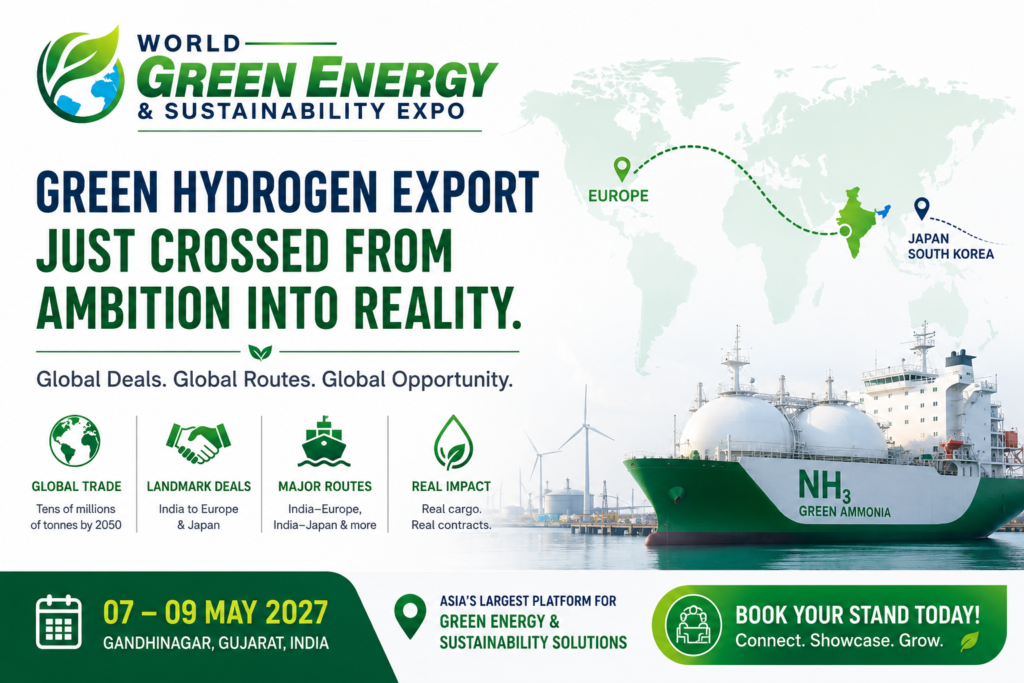
The Export Routes – How Green Hydrogen Will Flow Across the World
The physical geography of green hydrogen export is beginning to crystallize around a small number of major bilateral corridors, each with distinct infrastructure, logistics, and commercial characteristics.
The India-Europe Green Hydrogen Corridor
The India-Europe corridor – anchored by the AM Green-Uniper agreement, the RWE offtake deal, and AM Green’s MoU with the Port of Rotterdam – routes RFNBO-certified green ammonia from India’s east coast ports through the Suez Canal to Rotterdam, Hamburg, and other North European import terminals. The corridor’s economics benefit from India’s world-class renewable electricity costs, competitive engineering and construction, and proximity to Europe via the Suez routing compared to competing suppliers from Australia or South America. The RFNBO certification that AM Green has secured for its Kakinada facility is critical for European market access – without it, Indian-produced green ammonia cannot qualify for EU renewable fuel mandates or the carbon contracts for difference that European industrial buyers depend on to justify the green premium.
In 2025, an MoU was signed between AM Green and the Port of Rotterdam towards the establishment of a renewable molecule’s corridor between India and North-Western Europe, via Rotterdam. This infrastructure partnership – connecting the world’s largest renewable ammonia production project under construction to Europe’s largest port – is the physical foundation of the most commercially advanced India-Europe clean energy trade route yet established.
The Middle East-Europe Corridor
From the Middle East – primarily Saudi Arabia and the UAE – green ammonia travels through the Suez Canal to European import terminals. This corridor benefits from extremely low renewable electricity costs in the Gulf, proximity to European demand relative to Australia or South America, and existing bilateral energy trade relationships between Gulf states and European utilities.
The Australia-Japan-Korea Corridor
Australia to Japan and Korea represents the most geographically natural of all green hydrogen export routes – short shipping distances, existing energy import relationships, and Australian government investment in hydrogen export certification and port infrastructure. Projects including the Asian Renewable Energy Hub in Western Australia and multiple Queensland-based hydrogen production projects are targeting this corridor.
The Africa-Europe Corridors
Morocco to Spain and Portugal through direct pipeline connection or short-haul shipping is the most cost-competitive Africa-Europe hydrogen route. Egypt through the Suez routing or Mediterranean short-haul serves Southern European ports. Namibia through Atlantic shipping lanes serves German and Dutch import terminals. Africa and Europe shared a green hydrogen corridor relationship through the EU’s Global Gateway initiative, which has designated specific African-European hydrogen connections as priority infrastructure investments.
The South America-Europe Corridor
Chile to Spain through the Pacific and Magellan Strait or Atlantic routing, and Brazil to Portugal, Spain, and the Netherlands, are the primary South American export corridors. Chile in particular to Spain represents a long-distance but potentially very competitive route given the Atacama’s exceptional solar resources and Chile’s existing mining industry engineering base.
The Certification Frameworks – Why RFNBO Compliance Defines Market Access
The commercial value of green hydrogen in international trade is entirely dependent on certification – and the EU’s RFNBO framework has emerged as the de facto global standard for certifying green hydrogen in the most commercially significant import market.
AM Green’s renewable ammonia is designed to meet stringent European RFNBO compliance standards. This is achieved through its unique firm and dispatchable clean electricity solutions. It is enabling multiple downstream sectors including ammonia, aluminum, chemicals, and other energy-intensive industries to lower their emissions significantly. RFNBO compliance requires that the renewable electricity used to produce green hydrogen meets specific criteria: it must be from new renewable capacity (additionality), it must be produced in the same bidding zone or a connected zone (geographical correlation), and it must be matched on an hourly basis with production from 2030 onward and annually until then (temporal correlation). Meeting these criteria requires sophisticated electricity procurement architecture – which is why AM Green’s combination of dedicated wind, solar, and pumped hydro storage is specifically designed to enable RFNBO compliance.
The ACME-MGC project has been designed to comply with European Renewable Fuels of Non-Biological Origin requirements as well as standards established by the International Maritime Organization for cleaner marine fuels. Compliance with these global standards is expected to enhance the competitiveness of Indian-produced green fuels in international markets while opening new export opportunities in Europe and Asia. For any green hydrogen producer targeting European markets, RFNBO pre-certification – which AM Green obtained for AMGA-K1 in June 2024 – is a commercial prerequisite, not a nice-to-have. Without it, Indian green ammonia cannot qualify for the EU renewable fuel mandates that create structured demand from European industrial buyers.
India’s launch of the Green Hydrogen Certification Portal of India establishes a national mechanism for verifying green hydrogen production and compliance. Aligning India’s national certification framework with EU RFNBO standards and Japan’s clean fuel certification requirements is one of the most commercially important policy tasks currently underway within the National Green Hydrogen Mission – because without that alignment, Indian producers face duplicate certification costs that erode the competitiveness advantages their renewable energy economics create.
The Investment Required – Infrastructure Costs of Global Green Hydrogen Export
The scale of infrastructure investment required to support global green hydrogen trade at the volumes the 2030 pipeline suggests is substantial, and it creates commercial opportunities across multiple engineering, construction, and equipment categories. IRENA’s analysis of what is needed to make this trade commercially viable identifies three primary investment categories: renewable energy capacity of hundreds of gigawatts dedicated to export production, electrolyser manufacturing scaled approximately 100 times by 2030, and import terminal infrastructure at the ports receiving green hydrogen molecules.
Several ports including Rotterdam, Antwerp-Bruges, and Hamburg are being retrofitted to become hydrogen import hubs. The infrastructure required at import terminals spans ammonia storage tanks, ammonia cracking facilities converting imported ammonia back to hydrogen for end users, pipeline connections to industrial clusters, safety and monitoring systems, and the metering and certification infrastructure needed to verify the green credentials of received molecules.
On the export side, port infrastructure at Kakinada, Gopalpur, Kandla, Tuticorin, and other Indian production facility exit points requires dedicated ammonia loading terminals, cryogenic storage, and the certification and metering infrastructure that European and Japanese off-takers require for RFNBO compliance documentation.
The shipping fleet requirement is also substantial. The first commercial cargo ships that burn ammonia as a fuel – not as cargo but as the actual propellant – are scheduled to start sailing this year, with MAN Energy Solutions delivering its first commercial ammonia-fueled engine for a 93,000 cubic meter ammonia carrier. A growing fleet of ammonia carriers capable of transporting both the fuel and the cargo simultaneously is one of the infrastructure innovations accelerating the economics of green ammonia trade.
The Challenges – What Every Exporter and Importer Must Navigate
An assessment of the green hydrogen export opportunity requires acknowledging the genuine challenges that every party in this supply chain is navigating.
Cost competitiveness remains the primary challenge. Even at India’s SECI GAPA prices of USD 572 to USD 744 per tonne for green ammonia – the most competitive prices yet discovered for large-scale green ammonia trade – the product is more expensive than conventional grey ammonia at approximately USD 300 to 400 per tonne. The importing-country subsidy mechanisms – Germany’s H2Global, Japan’s CfD – are bridging this gap in the first generation of contracts. The long-term sustainability of those subsidies as volumes scale is an open policy question.
Certification complexity across multiple markets. EU RFNBO standards, Japan’s clean fuel certification, South Korea’s hydrogen certification framework, and India’s new Green Hydrogen Certification Portal have different methodologies, different additionality requirements, and different temporal correlation rules. A producer that meets RFNBO standards does not automatically meet Japanese certification requirements, and vice versa. Harmonization of these standards is one of the most commercially important policy challenges in the global green hydrogen trade right now.
Project execution at scale. The binding offtake agreements signed in 2025 and 2026 create contractual obligations to deliver millions of tonnes of green ammonia from facilities that are still under construction. The AM Green Kakinada facility – the most advanced large-scale green ammonia construction project in India – targets commercial production from 2028. Project execution at this scale, integrating gigawatt-scale electrolysis, industrial-scale Haber-Bosch synthesis, renewable energy integration, and grid connectivity, has no precise precedent in India’s industrial history.
Logistics and shipping infrastructure. Dedicated green ammonia tankers, import terminals, cracking facilities, and certification infrastructure are being built in parallel with production facilities. The coordination of supply-side and demand-side infrastructure development is a complex logistics challenge with no single coordinating authority – relying instead on bilateral commercial relationships, government investment programs, and development finance institution funding to develop at matching pace.
India’s Export Positioning
Six months into 2026, India’s green hydrogen export story is best understood as genuinely early validation of a commercially viable position – not yet full-scale delivery, but far more advanced than the sceptics who dismissed India’s 5 million tonne production target as aspirational rather than achievable.
The AM Green-Uniper agreement established India’s first large-scale India-Europe green hydrogen corridor. The ACME-IHI and ACME-MGC agreements have just established India’s first large-scale India-Japan corridor for both green ammonia and green methanol. The SECI GAPA domestic program has demonstrated that Indian-produced green ammonia can be competitive at prices roughly half of what Europe paid through H2Global. And the three Green Hydrogen Hub port designations have created the export infrastructure framework without which none of the commercial offtake commitments could be converted into physically delivered molecules.
India’s National Green Hydrogen Mission set a target of 5 million metric tonnes of green hydrogen production by 2030. The announced and tied green ammonia export volumes – from AM Green alone targeting 4 million tonnes per year of total capacity across its India portfolio – suggest that if execution matches ambition, India could genuinely be shipping significant green hydrogen export volumes by 2028 to 2030. What the market cannot yet fully verify is whether execution will match ambition on the required timeline. That verification will come through the progressive commissioning of AM Green’s Kakinada facility, the construction progress of ACME’s Gopalpur project, and the establishment of the import terminal and shipping infrastructure in Rotterdam, Hamburg, and Japanese ports that the offtake agreements depend on.
India’s green hydrogen export success hinges on converting three types of commitment – production investment, offtake agreements, and infrastructure development – into three types of physical reality – commissioned plants, commissioned ships, and commissioned import terminals. All three are underway. None are complete. The window between now and 2028 is when the answer becomes clear.
Why World Green Energy & Sustainability Expo (WGES 2027) Is Where Global Green Hydrogen Export Gets Built
The AM Green-Uniper agreement – the most commercially significant green hydrogen export deal yet signed involving India – was exchanged in Ahmedabad on January 12, 2026, in the presence of the Indian Prime Minister and the German Chancellor.
That choice of location is not accidental. Ahmedabad is the commercial capital of Gujarat, India’s most advanced renewable energy state, home to Deendayal Port Green Hydrogen Hub, the Kandla industrial corridor, Reliance Industries’ Jamnagar New Energy complex, AM Green’s planned Kandla production facility, L&T’s Hazira electrolyser manufacturing facility, and Waaree Energies’ complete solar-to-hydrogen value chain.
World Green Energy & Sustainability Expo (WGES 2027) – held in Ahmedabad – brings together in a single venue the full spectrum of participants that global green hydrogen trade requires: Indian producers building export capacity, international off-takers seeking certified green molecules, electrolyser manufacturers supplying the production facilities, engineering contractors building the plants, port authorities developing the export infrastructure, certification bodies establishing compliance frameworks, and development finance institutions funding the projects.
For international hydrogen developers seeking Indian supply chain partnerships, for European and Japanese trading companies building import portfolios, for infrastructure companies evaluating port terminal investment in India’s designated Green Hydrogen Hubs, for certification and standards bodies working on RFNBO alignment with India’s national certification framework, and for development finance institutions deploying capital into the India-Europe and India-Japan green hydrogen corridors – World Green Energy & Sustainability Expo (WGES 2027) is where these conversations happen in the most commercially relevant geography available.
The AM Green-Uniper agreement proved that Ahmedabad is where global green hydrogen export gets done. World Green Energy & Sustainability Expo (WGES 2027) is where the next generation of those deals begins.
Register as an exhibitor at the World Green Energy & Sustainability (WGES) Expo 2027 today. Secure your position in front of India’s most active green energy buyers, developers, investors, and policymakers – all in one place, at the moment the market is moving fastest.
For more details: contact us at info@adexexhibitions.com | +91 81770 53335 | +91 91528 96078
For Exhibitor Registration: If you have not registered, you may also fill out this Exhibitor Registration Form.